





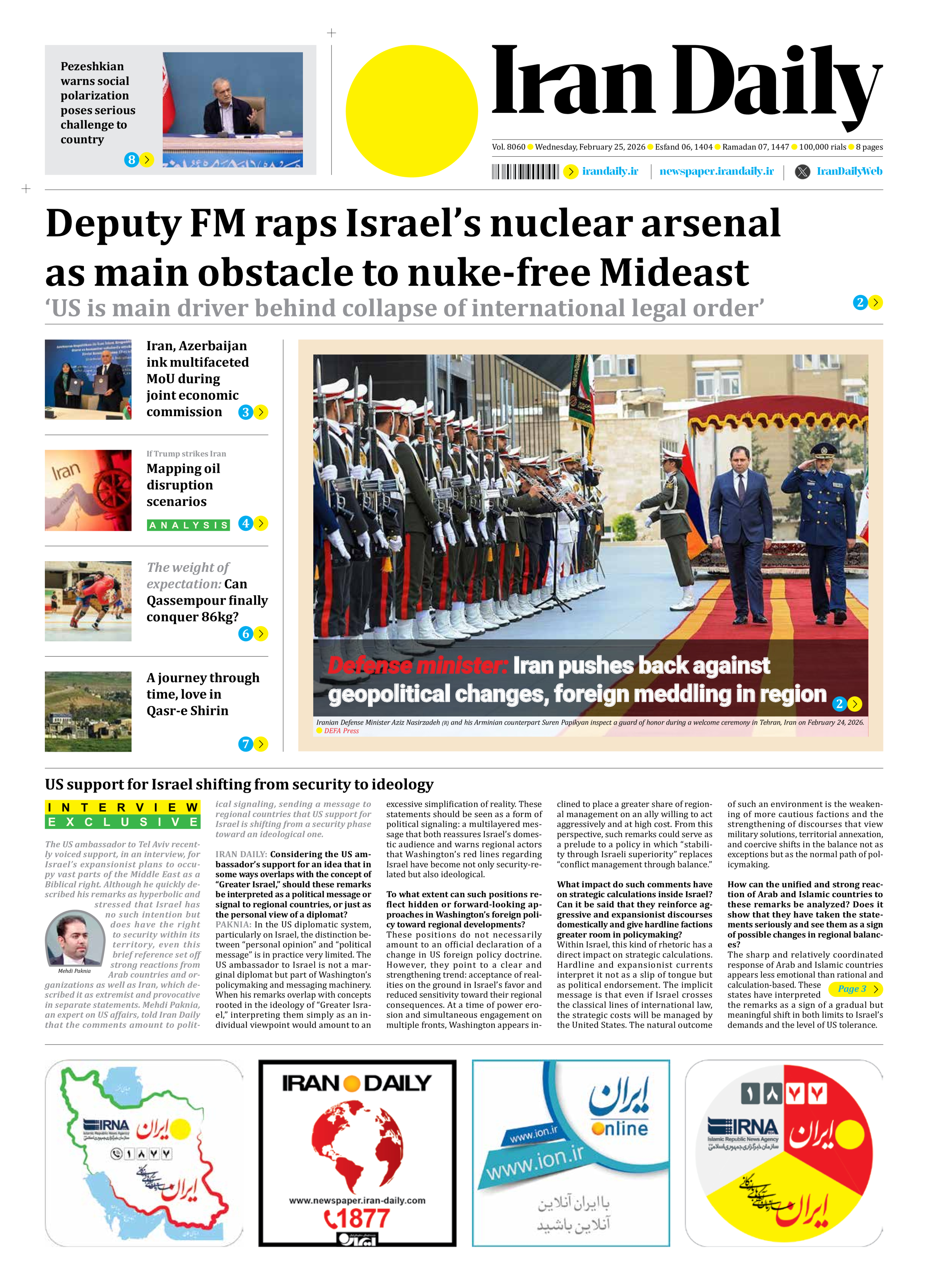


US support for Israel shifting from security to ideology
The US ambassador to Tel Aviv recently voiced support, in an interview, for Israel’s expansionist plans to occupy vast parts of the Middle East as a Biblical right. Although he quickly described his remarks as hyperbolic and stressed that Israel has no such intention but does have the right to security within its territory, even this brief reference set off strong reactions from Arab countries and organizations as well as Iran, which described it as extremist and provocative in separate statements. Mehdi Paknia, an expert on US affairs, told Iran Daily that the comments amount to political signaling, sending a message to regional countries that US support for Israel is shifting from a security phase toward an ideological one.
IRAN DAILY: Considering the US ambassador’s support for an idea that in some ways overlaps with the concept of “Greater Israel,” should these remarks be interpreted as a political message or signal to regional countries, or just as the personal view of a diplomat?
PAKNIA: In the US diplomatic system, particularly on Israel, the distinction between “personal opinion” and “political message” is in practice very limited. The US ambassador to Israel is not a marginal diplomat but part of Washington’s policymaking and messaging machinery. When his remarks overlap with concepts rooted in the ideology of “Greater Israel,” interpreting them simply as an individual viewpoint would amount to an excessive simplification of reality. These statements should be seen as a form of political signaling: a multilayered message that both reassures Israel’s domestic audience and warns regional actors that Washington’s red lines regarding Israel have become not only security-related but also ideological.
To what extent can such positions reflect hidden or forward-looking approaches in Washington’s foreign policy toward regional developments?
These positions do not necessarily amount to an official declaration of a change in US foreign policy doctrine. However, they point to a clear and strengthening trend: acceptance of realities on the ground in Israel’s favor and reduced sensitivity toward their regional consequences. At a time of power erosion and simultaneous engagement on multiple fronts, Washington appears inclined to place a greater share of regional management on an ally willing to act aggressively and at high cost. From this perspective, such remarks could serve as a prelude to a policy in which “stability through Israeli superiority” replaces “conflict management through balance.”
What impact do such comments have on strategic calculations inside Israel? Can it be said that they reinforce aggressive and expansionist discourses domestically and give hardline factions greater room in policymaking?
Within Israel, this kind of rhetoric has a direct impact on strategic calculations. Hardline and expansionist currents interpret it not as a slip of tongue but as political endorsement. The implicit message is that even if Israel crosses the classical lines of international law, the strategic costs will be managed by the United States. The natural outcome of such an environment is the weakening of more cautious factions and the strengthening of discourses that view military solutions, territorial annexation, and coercive shifts in the balance not as exceptions but as the normal path of policymaking.
How can the unified and strong reaction of Arab and Islamic countries to these remarks be analyzed? Does it show that they have taken the statements seriously and see them as a sign of possible changes in regional balances?
The sharp and relatively coordinated response of Arab and Islamic countries appears less emotional than rational and calculation-based. These states have interpreted the remarks as a sign of a gradual but meaningful shift in both limits to Israel’s demands and the level of US tolerance.
Page 3