







Iran’s cognitive misperceptions of China
By Mohammad Ali Ghanamizadeh Fallahi
Expert on international affairs
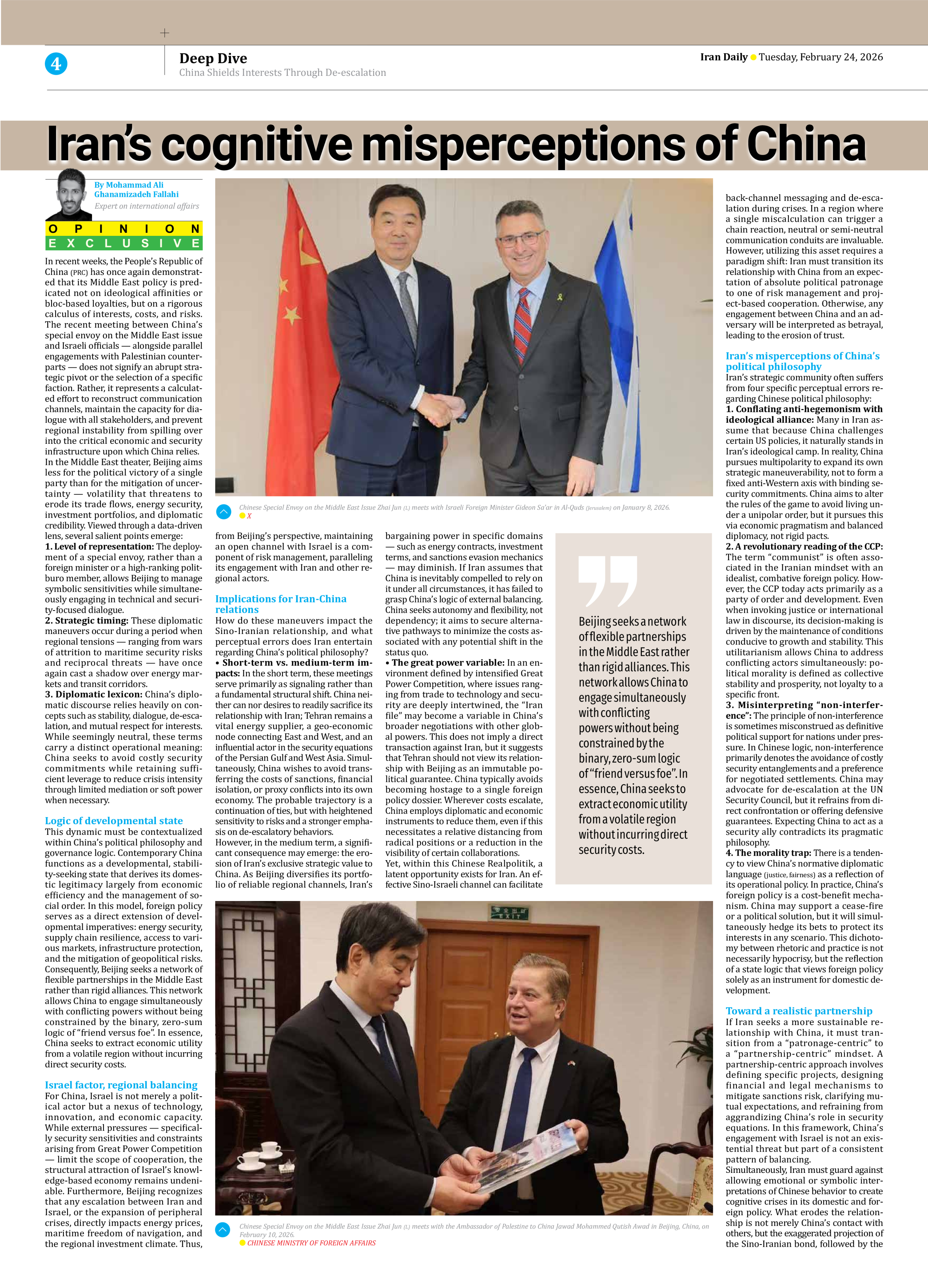
In recent weeks, the People’s Republic of China (PRC) has once again demonstrated that its Middle East policy is predicated not on ideological affinities or bloc-based loyalties, but on a rigorous calculus of interests, costs, and risks. The recent meeting between China’s special envoy on the Middle East issue and Israeli officials — alongside parallel engagements with Palestinian counterparts — does not signify an abrupt strategic pivot or the selection of a specific faction. Rather, it represents a calculated effort to reconstruct communication channels, maintain the capacity for dialogue with all stakeholders, and prevent regional instability from spilling over into the critical economic and security infrastructure upon which China relies.
In the Middle East theater, Beijing aims less for the political victory of a single party than for the mitigation of uncertainty — volatility that threatens to erode its trade flows, energy security, investment portfolios, and diplomatic credibility. Viewed through a data-driven lens, several salient points emerge:
1. Level of representation: The deployment of a special envoy, rather than a foreign minister or a high-ranking politburo member, allows Beijing to manage symbolic sensitivities while simultaneously engaging in technical and security-focused dialogue.
2. Strategic timing: These diplomatic maneuvers occur during a period when regional tensions — ranging from wars of attrition to maritime security risks and reciprocal threats — have once again cast a shadow over energy markets and transit corridors.
3. Diplomatic lexicon: China’s diplomatic discourse relies heavily on concepts such as stability, dialogue, de-escalation, and mutual respect for interests. While seemingly neutral, these terms carry a distinct operational meaning: China seeks to avoid costly security commitments while retaining sufficient leverage to reduce crisis intensity through limited mediation or soft power when necessary.
Logic of developmental state
This dynamic must be contextualized within China’s political philosophy and governance logic. Contemporary China functions as a developmental, stability-seeking state that derives its domestic legitimacy largely from economic efficiency and the management of social order. In this model, foreign policy serves as a direct extension of developmental imperatives: energy security, supply chain resilience, access to various markets, infrastructure protection, and the mitigation of geopolitical risks. Consequently, Beijing seeks a network of flexible partnerships in the Middle East rather than rigid alliances. This network allows China to engage simultaneously with conflicting powers without being constrained by the binary, zero-sum logic of “friend versus foe”. In essence, China seeks to extract economic utility from a volatile region without incurring direct security costs.
Israel factor, regional balancing
For China, Israel is not merely a political actor but a nexus of technology, innovation, and economic capacity. While external pressures — specifically security sensitivities and constraints arising from Great Power Competition — limit the scope of cooperation, the structural attraction of Israel’s knowledge-based economy remains undeniable. Furthermore, Beijing recognizes that any escalation between Iran and Israel, or the expansion of peripheral crises, directly impacts energy prices, maritime freedom of navigation, and the regional investment climate. Thus, from Beijing’s perspective, maintaining an open channel with Israel is a component of risk management, paralleling its engagement with Iran and other regional actors.
Implications for Iran-China relations
How do these maneuvers impact the Sino-Iranian relationship, and what perceptual errors does Iran entertain regarding China’s political philosophy?
• Short-term vs. medium-term impacts: In the short term, these meetings serve primarily as signaling rather than a fundamental structural shift. China neither can nor desires to readily sacrifice its relationship with Iran; Tehran remains a vital energy supplier, a geo-economic node connecting East and West, and an influential actor in the security equations of the Persian Gulf and West Asia. Simultaneously, China wishes to avoid transferring the costs of sanctions, financial isolation, or proxy conflicts into its own economy. The probable trajectory is a continuation of ties, but with heightened sensitivity to risks and a stronger emphasis on de-escalatory behaviors.
However, in the medium term, a significant consequence may emerge: the erosion of Iran’s exclusive strategic value to China. As Beijing diversifies its portfolio of reliable regional channels, Iran’s bargaining power in specific domains — such as energy contracts, investment terms, and sanctions evasion mechanics — may diminish. If Iran assumes that China is inevitably compelled to rely on it under all circumstances, it has failed to grasp China’s logic of external balancing. China seeks autonomy and flexibility, not dependency; it aims to secure alternative pathways to minimize the costs associated with any potential shift in the status quo.
• The great power variable: In an environment defined by intensified Great Power Competition, where issues ranging from trade to technology and security are deeply intertwined, the “Iran file” may become a variable in China’s broader negotiations with other global powers. This does not imply a direct transaction against Iran, but it suggests that Tehran should not view its relationship with Beijing as an immutable political guarantee. China typically avoids becoming hostage to a single foreign policy dossier. Wherever costs escalate, China employs diplomatic and economic instruments to reduce them, even if this necessitates a relative distancing from radical positions or a reduction in the visibility of certain collaborations.
Yet, within this Chinese Realpolitik, a latent opportunity exists for Iran. An effective Sino-Israeli channel can facilitate back-channel messaging and de-escalation during crises. In a region where a single miscalculation can trigger a chain reaction, neutral or semi-neutral communication conduits are invaluable. However, utilizing this asset requires a paradigm shift: Iran must transition its relationship with China from an expectation of absolute political patronage to one of risk management and project-based cooperation. Otherwise, any engagement between China and an adversary will be interpreted as betrayal, leading to the erosion of trust.
Iran’s misperceptions of China’s political philosophy
Iran’s strategic community often suffers from four specific perceptual errors regarding Chinese political philosophy:
1. Conflating anti-hegemonism with ideological alliance: Many in Iran assume that because China challenges certain US policies, it naturally stands in Iran’s ideological camp. In reality, China pursues multipolarity to expand its own strategic maneuverability, not to form a fixed anti-Western axis with binding security commitments. China aims to alter the rules of the game to avoid living under a unipolar order, but it pursues this via economic pragmatism and balanced diplomacy, not rigid pacts.
2. A revolutionary reading of the CCP: The term “communist” is often associated in the Iranian mindset with an idealist, combative foreign policy. However, the CCP today acts primarily as a party of order and development. Even when invoking justice or international law in discourse, its decision-making is driven by the maintenance of conditions conducive to growth and stability. This utilitarianism allows China to address conflicting actors simultaneously: political morality is defined as collective stability and prosperity, not loyalty to a specific front.
3. Misinterpreting “non-interference”: The principle of non-interference is sometimes misconstrued as definitive political support for nations under pressure. In Chinese logic, non-interference primarily denotes the avoidance of costly security entanglements and a preference for negotiated settlements. China may advocate for de-escalation at the UN Security Council, but it refrains from direct confrontation or offering defensive guarantees. Expecting China to act as a security ally contradicts its pragmatic philosophy.
4. The morality trap: There is a tendency to view China’s normative diplomatic language (justice, fairness) as a reflection of its operational policy. In practice, China’s foreign policy is a cost-benefit mechanism. China may support a cease-fire or a political solution, but it will simultaneously hedge its bets to protect its interests in any scenario. This dichotomy between rhetoric and practice is not necessarily hypocrisy, but the reflection of a state logic that views foreign policy solely as an instrument for domestic development.
Toward a realistic partnership
If Iran seeks a more sustainable relationship with China, it must transition from a “patronage-centric” to a “partnership-centric” mindset. A partnership-centric approach involves defining specific projects, designing financial and legal mechanisms to mitigate sanctions risk, clarifying mutual expectations, and refraining from aggrandizing China’s role in security equations. In this framework, China’s engagement with Israel is not an existential threat but part of a consistent pattern of balancing.
Simultaneously, Iran must guard against allowing emotional or symbolic interpretations of Chinese behavior to create cognitive crises in its domestic and foreign policy. What erodes the relationship is not merely China’s contact with others, but the exaggerated projection of the Sino-Iranian bond, followed by the
inevitable disillusionment of reality.
Ultimately, China’s policy in the Middle East resembles a massive ship in a turbulent sea: it can neither outrun the waves nor does it wish to fight them; instead, it attempts to traverse the turmoil by adjusting its angle, selecting the appropriate speed, and maintaining multiple potential courses. If Iran grasps this logic accurately, it can mitigate misunderstandings and define its position vis-à-vis China more realistically. In this view, the improvement of the China-Israel channel is neither a sign of betrayal nor a promise of grand mediation; it is an indication that China intends to be present in multiple rooms simultaneously to minimize the cost of surprise. Iran’s art, therefore, lies not in expecting loyalty, but in constructing measurable common interests and seeing China as it truly is: a pragmatic state that defines foreign policy through stability and development.