







Copy in clipboard...
Additional Protocol adoption tied to sanctions relief in potential US deal: FM spox
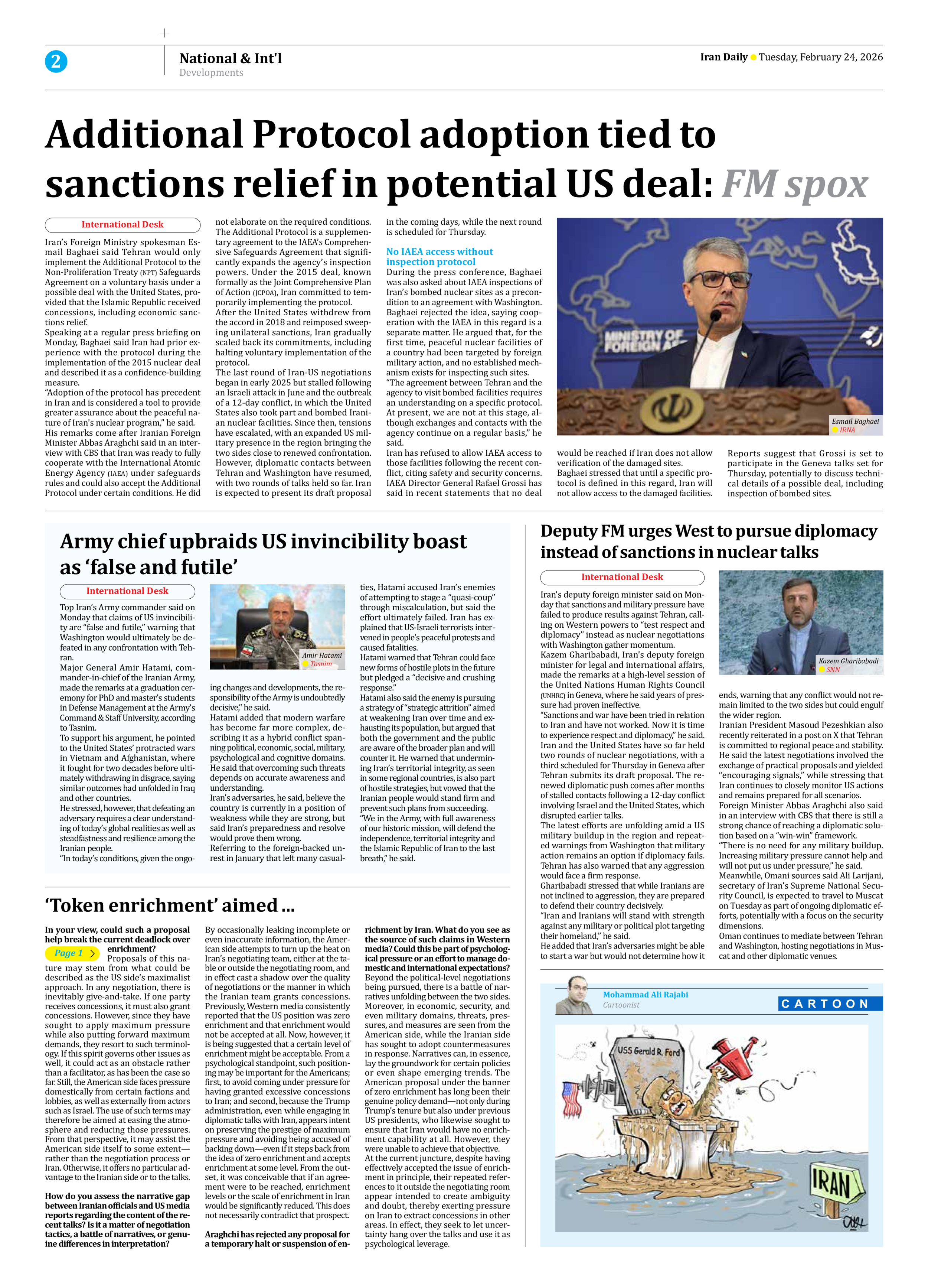
Iran’s Foreign Ministry spokesman Esmail Baghaei said Tehran would only implement the Additional Protocol to the Non-Proliferation Treaty (NPT) Safeguards Agreement on a voluntary basis under a possible deal with the United States, provided that the Islamic Republic received concessions, including economic sanctions relief.
Speaking at a regular press briefing on Monday, Baghaei said Iran had prior experience with the protocol during the implementation of the 2015 nuclear deal and described it as a confidence-building measure.
“Adoption of the protocol has precedent in Iran and is considered a tool to provide greater assurance about the peaceful nature of Iran’s nuclear program,” he said.
His remarks come after Iranian Foreign Minister Abbas Araghchi said in an interview with CBS that Iran was ready to fully cooperate with the International Atomic Energy Agency (IAEA) under safeguards rules and could also accept the Additional Protocol under certain conditions. He did not elaborate on the required conditions.
The Additional Protocol is a supplementary agreement to the IAEA’s Comprehensive Safeguards Agreement that significantly expands the agency’s inspection powers. Under the 2015 deal, known formally as the Joint Comprehensive Plan of Action (JCPOA), Iran committed to temporarily implementing the protocol.
After the United States withdrew from the accord in 2018 and reimposed sweeping unilateral sanctions, Iran gradually scaled back its commitments, including halting voluntary implementation of the protocol.
The last round of Iran-US negotiations began in early 2025 but stalled following an Israeli attack in June and the outbreak of a 12-day conflict, in which the United States also took part and bombed Iranian nuclear facilities. Since then, tensions have escalated, with an expanded US military presence in the region bringing the two sides close to renewed confrontation.
However, diplomatic contacts between Tehran and Washington have resumed, with two rounds of talks held so far. Iran is expected to present its draft proposal in the coming days, while the next round is scheduled for Thursday.
No IAEA access without inspection protocol
During the press conference, Baghaei was also asked about IAEA inspections of Iran’s bombed nuclear sites as a precondition to an agreement with Washington.
Baghaei rejected the idea, saying cooperation with the IAEA in this regard is a separate matter. He argued that, for the first time, peaceful nuclear facilities of a country had been targeted by foreign military action, and no established mechanism exists for inspecting such sites.
“The agreement between Tehran and the agency to visit bombed facilities requires an understanding on a specific protocol. At present, we are not at this stage, although exchanges and contacts with the agency continue on a regular basis,” he said.
Iran has refused to allow IAEA access to those facilities following the recent conflict, citing safety and security concerns. IAEA Director General Rafael Grossi has said in recent statements that no deal would be reached if Iran does not allow verification of the damaged sites.
Baghaei stressed that until a specific protocol is defined in this regard, Iran will not allow access to the damaged facilities.
Reports suggest that Grossi is set to participate in the Geneva talks set for Thursday, potentially to discuss technical details of a possible deal, including inspection of bombed sites.