







Hirmandi women weave hope, preserve culture
In a remote part of Iran, where scorching heat and harsh natural conditions make life especially challenging, the skilled hands and creative minds of women in Hirmand, a city in Sistan and Baluchestan Province, have emerged as a beacon of hope and a source of extraordinary craftsmanship. These artisans are not only the guardians of ancient cultural heritage but, through their traditional arts, play a vital role in supporting their families’ livelihoods and promoting sustainable regional development.
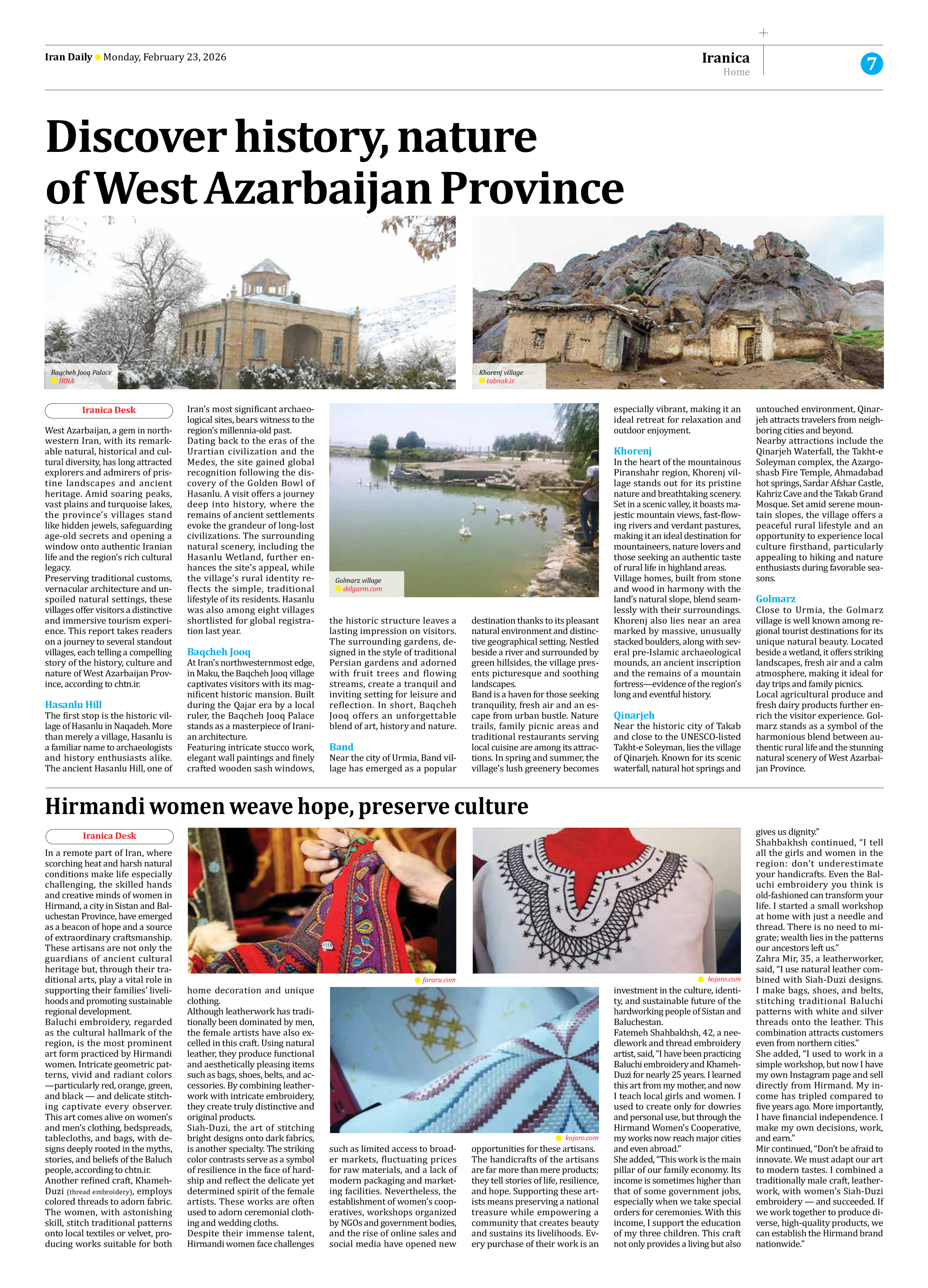
Baluchi embroidery, regarded as the cultural hallmark of the region, is the most prominent art form practiced by Hirmandi women. Intricate geometric patterns, vivid and radiant colors —particularly red, orange, green, and black — and delicate stitching captivate every observer. This art comes alive on women’s and men’s clothing, bedspreads, tablecloths, and bags, with designs deeply rooted in the myths, stories, and beliefs of the Baluch people, according to chtn.ir.
Another refined craft, Khameh-Duzi (thread embroidery), employs colored threads to adorn fabric. The women, with astonishing skill, stitch traditional patterns onto local textiles or velvet, producing works suitable for both home decoration and unique clothing.
Although leatherwork has traditionally been dominated by men, the female artists have also excelled in this craft. Using natural leather, they produce functional and aesthetically pleasing items such as bags, shoes, belts, and accessories. By combining leatherwork with intricate embroidery, they create truly distinctive and original products.
Siah-Duzi, the art of stitching bright designs onto dark fabrics, is another specialty. The striking color contrasts serve as a symbol of resilience in the face of hardship and reflect the delicate yet determined spirit of the female artists. These works are often used to adorn ceremonial clothing and wedding cloths.
Despite their immense talent, Hirmandi women face challenges such as limited access to broader markets, fluctuating prices for raw materials, and a lack of modern packaging and marketing facilities. Nevertheless, the establishment of women’s cooperatives, workshops organized by NGOs and government bodies, and the rise of online sales and social media have opened new opportunities for these artisans.
The handicrafts of the artisans are far more than mere products; they tell stories of life, resilience, and hope. Supporting these artists means preserving a national treasure while empowering a community that creates beauty and sustains its livelihoods. Every purchase of their work is an investment in the culture, identity, and sustainable future of the hardworking people of Sistan and Baluchestan.
Fatemeh Shahbakhsh, 42, a needlework and thread embroidery artist, said, “I have been practicing Baluchi embroidery and Khameh-Duzi for nearly 25 years. I learned this art from my mother, and now I teach local girls and women. I used to create only for dowries and personal use, but through the Hirmand Women’s Cooperative, my works now reach major cities and even abroad.”
She added, “This work is the main pillar of our family economy. Its income is sometimes higher than that of some government jobs, especially when we take special orders for ceremonies. With this income, I support the education of my three children. This craft not only provides a living but also gives us dignity.”
Shahbakhsh continued, “I tell all the girls and women in the region: don’t underestimate your handicrafts. Even the Baluchi embroidery you think is old-fashioned can transform your life. I started a small workshop at home with just a needle and thread. There is no need to migrate; wealth lies in the patterns our ancestors left us.”
Zahra Mir, 35, a leatherworker, said, “I use natural leather combined with Siah-Duzi designs. I make bags, shoes, and belts, stitching traditional Baluchi patterns with white and silver threads onto the leather. This combination attracts customers even from northern cities.”
She added, “I used to work in a simple workshop, but now I have my own Instagram page and sell directly from Hirmand. My income has tripled compared to five years ago. More importantly, I have financial independence. I make my own decisions, work, and earn.”
Mir continued, “Don’t be afraid to innovate. We must adapt our art to modern tastes. I combined a traditionally male craft, leatherwork, with women’s Siah-Duzi embroidery — and succeeded. If we work together to produce diverse, high-quality products, we can establish the Hirmand brand nationwide.”