







Force, power, and falsehood not America’s salvation
By Mehdi Qadiri
Bidakhvidi
Expert on criminal law
and criminology
The media portrays him as the guarantor of democracy. However, reality proclaims an altogether different verity. The policy of maximum pressure and the historical animus of America toward Iran constitute a clear example of the lies and interventions of great powers. In a world wherein powers fabricate narratives, consciousness and autonomous analysis possess greater salience than ever before.
In the contemporary world, many conjecture that America epitomizes liberty, democracy, and human rights. The media, cinema, universities, and even international institutions promote this portrayal. Nevertheless, empirical realities articulate a divergent account.
The United States considers itself the leader of the world and, pursuant to this supposition, intervenes not solely within its domestic polity but likewise within foreign policy, adopting decisions that exert influence upon the lives of millions. One conspicuous instance of the dissonance between the proclamation of democracy and America’s actual performance is this country’s comportment toward journalists and media. The president of the United States, when confronted with a critical interrogative, at times responds with discourtesy and even precludes the journalist from articulating his statement. This minor instance demonstrates that American democracy, in practice, is encumbered by severe constraints and, contrary to its official portrayal, does not invariably engender a free and egalitarian forum for inquiry.
From the perspective of international law, no state possesses the prerogative to designate itself the leader of the world or to interfere in the internal affairs of other states. The Charter of the United Nations emphasizes that states are equally sovereign, and the principle of non-intervention constitutes one of the cardinal pillars of international law.
Yet the United States, through hard power (military and economic) and soft power (media, culture, and influence within international institutions), circumvents these principles in practice. The United Nations Security Council, the International Court of Justice, and other institutions frequently lack independent executive authority to confront America, and these constraints have induced many states, in practice, to acquiesce to America’s self-proclaimed leadership.
The historical example of Libya following the 2011 revolution and the overthrow of Gaddafi likewise demonstrates how great powers, including the US and certain European countries, through direct and indirect intervention, precipitate disorder within a state. Western officials, subsequent to Gaddafi’s overthrow, declared to the people of Libya with sarcasm that “You got your wish… freedom and democracy,” while the country entered a cycle of civil war and economic collapse. This example demonstrates that great powers employ the slogans of democracy and human rights to legitimize their actions but, in practice, frequently operate pursuant to their own interests rather than the exigencies of the populace.
Another instance that great powers have utilized to justify interventions is the episode of “Nayirah’s testimony” during the First Persian Gulf War. A 15-year-old girl named Nayirah testified in a Human Rights Committee session that she witnessed Iraqi soldiers extracting infants from incubators and leaving them to perish.
This narrative was immediately disseminated in the media and speeches and became a pretext for legitimizing America’s military assault upon Iraq. It was later revealed that she was the daughter of the Kuwaiti ambassador to America, had never been a nurse, and that her testimony had been fabricated pursuant to a propaganda campaign of the Kuwaiti government and the design of public relations firms. This lucid example demonstrates how fake narratives may become pretexts for war and for the legitimation of the objectives of powers, even if their falsity is subsequently established.
With respect to Iran, the situation is more intricate. Since the 1979 revolution, the United States has consistently adopted hostile policies toward Iran and has endeavored to regard Iran in the same manner it regards certain regional countries, namely, “a milking cow” and “under pressure”. Accordingly, the objective of the US in its maximum pressure policy is the isolation of Iran and the exploitation of the country’s resources and strategic position. Some domestic opposition groups within Iran, in order to augment their efficacy, have sought recourse to the US as well since it possesses both hard power and soft power and is capable of intensifying internal and external pressure simultaneously.
This matter demonstrates that the conduct of great powers is frequently self-interested, political, and deceptive, and that the rights of peoples never constitute the crux of decision-making for them.
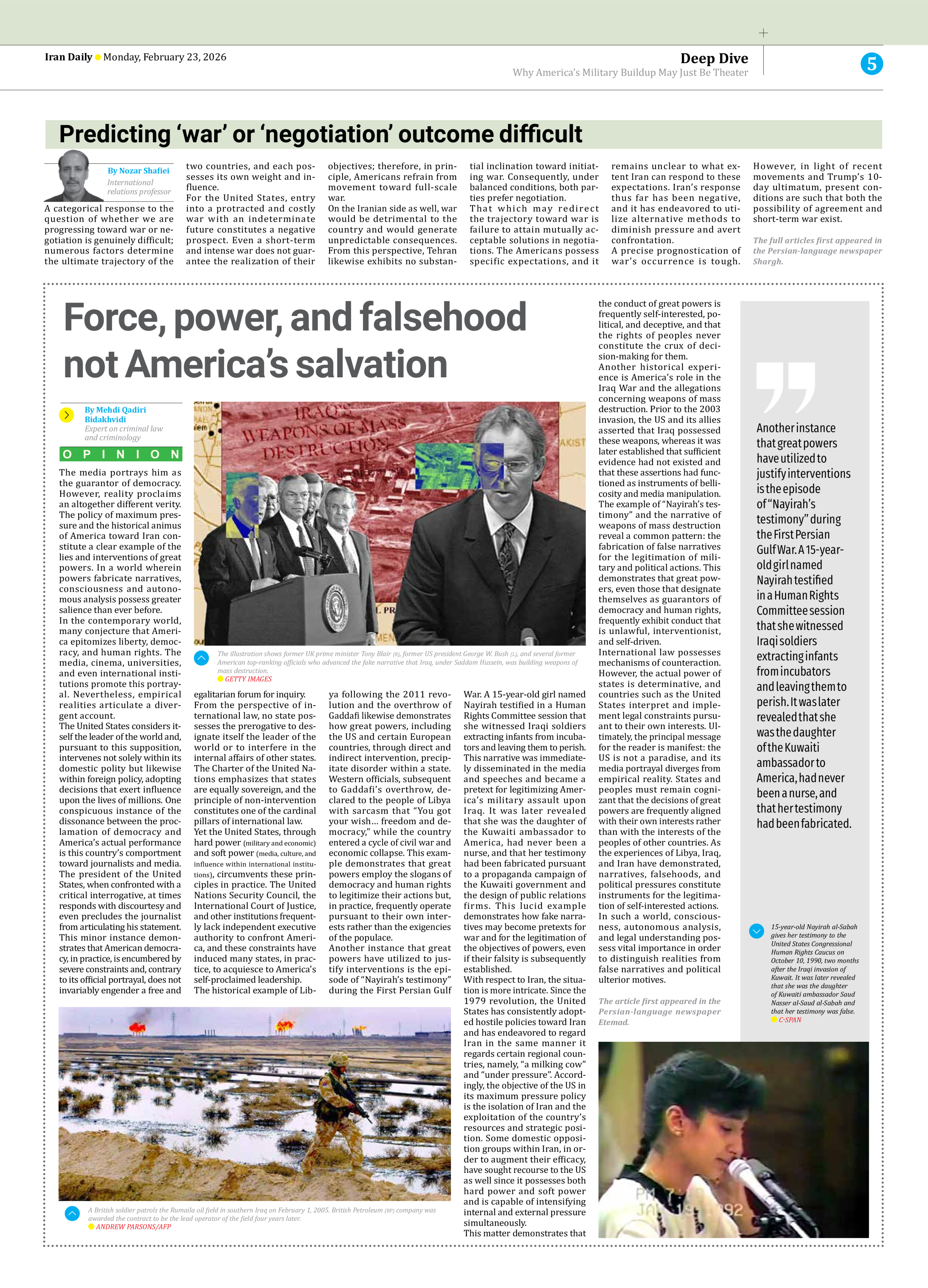
Another historical experience is America’s role in the Iraq War and the allegations concerning weapons of mass destruction. Prior to the 2003 invasion, the US and its allies asserted that Iraq possessed these weapons, whereas it was later established that sufficient evidence had not existed and that these assertions had functioned as instruments of bellicosity and media manipulation.
The example of “Nayirah’s testimony” and the narrative of weapons of mass destruction reveal a common pattern: the fabrication of false narratives for the legitimation of military and political actions. This demonstrates that great powers, even those that designate themselves as guarantors of democracy and human rights, frequently exhibit conduct that is unlawful, interventionist, and self-driven.
International law possesses mechanisms of counteraction. However, the actual power of states is determinative, and countries such as the United States interpret and implement legal constraints pursuant to their own interests. Ultimately, the principal message for the reader is manifest: the US is not a paradise, and its media portrayal diverges from empirical reality. States and peoples must remain cognizant that the decisions of great powers are frequently aligned with their own interests rather than with the interests of the peoples of other countries. As the experiences of Libya, Iraq, and Iran have demonstrated, narratives, falsehoods, and political pressures constitute instruments for the legitimation of self-interested actions.
In such a world, consciousness, autonomous analysis, and legal understanding possess vital importance in order to distinguish realities from false narratives and political ulterior motives.
The article first appeared in the Persian-language newspaper Etemad.