





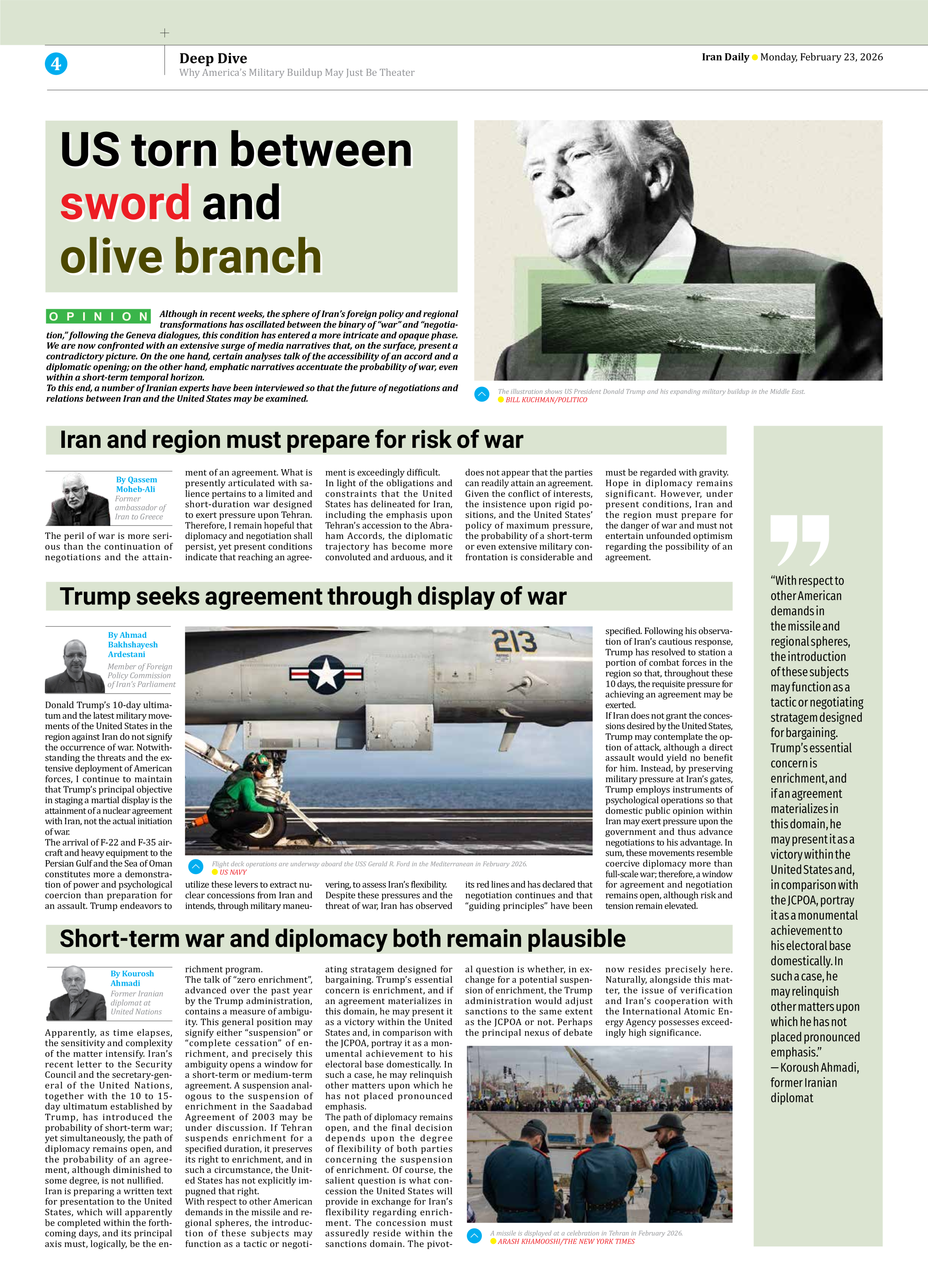


US torn between sword and olive branch
Although in recent weeks, the sphere of Iran’s foreign policy and regional transformations has oscillated between the binary of “war” and “negotiation,” following the Geneva dialogues, this condition has entered a more intricate and opaque phase. We are now confronted with an extensive surge of media narratives that, on the surface, present a contradictory picture. On the one hand, certain analyses talk of the accessibility of an accord and a diplomatic opening; on the other hand, emphatic narratives accentuate the probability of war, even within a short-term temporal horizon. To this end, a number of Iranian experts have been interviewed so that the future of negotiations and relations between Iran and the United States may be examined.
Iran and region must prepare for risk of war
By Qassem Moheb-Ali
Former ambassador of Iran to Greece
The peril of war is more serious than the continuation of negotiations and the attainment of an agreement. What is presently articulated with salience pertains to a limited and short-duration war designed to exert pressure upon Tehran. Therefore, I remain hopeful that diplomacy and negotiation shall persist, yet present conditions indicate that reaching an agreement is exceedingly difficult.
In light of the obligations and constraints that the United States has delineated for Iran, including the emphasis upon Tehran’s accession to the Abraham Accords, the diplomatic trajectory has become more convoluted and arduous, and it does not appear that the parties can readily attain an agreement.
Given the conflict of interests, the insistence upon rigid positions, and the United States’ policy of maximum pressure, the probability of a short-term or even extensive military confrontation is considerable and must be regarded with gravity.
Hope in diplomacy remains significant. However, under present conditions, Iran and the region must prepare for the danger of war and must not entertain unfounded optimism regarding the possibility of an agreement.
Trump seeks agreement through display of war
By Ahmad Bakhshayesh Ardestani
Member of Foreign Policy Commission of Iran’s Parliament
Donald Trump’s 10-day ultimatum and the latest military movements of the United States in the region against Iran do not signify the occurrence of war. Notwithstanding the threats and the extensive deployment of American forces, I continue to maintain that Trump’s principal objective in staging a martial display is the attainment of a nuclear agreement with Iran, not the actual initiation of war.
The arrival of F-22 and F-35 aircraft and heavy equipment to the Persian Gulf and the Sea of Oman constitutes more a demonstration of power and psychological coercion than preparation for an assault. Trump endeavors to utilize these levers to extract nuclear concessions from Iran and intends, through military maneuvering, to assess Iran’s flexibility.
Despite these pressures and the threat of war, Iran has observed its red lines and has declared that negotiation continues and that “guiding principles” have been specified. Following his observation of Iran’s cautious response, Trump has resolved to station a portion of combat forces in the region so that, throughout these 10 days, the requisite pressure for achieving an agreement may be exerted.
If Iran does not grant the concessions desired by the United States, Trump may contemplate the option of attack, although a direct assault would yield no benefit for him. Instead, by preserving military pressure at Iran’s gates, Trump employs instruments of psychological operations so that domestic public opinion within Iran may exert pressure upon the government and thus advance negotiations to his advantage. In sum, these movements resemble coercive diplomacy more than full-scale war; therefore, a window for agreement and negotiation remains open, although risk and tension remain elevated.
Short-term war and diplomacy both remain plausible
By Kourosh Ahmadi
Former Iranian diplomat at
United Nations
Apparently, as time elapses, the sensitivity and complexity of the matter intensify. Iran’s recent letter to the Security Council and the secretary-general of the United Nations, together with the 10 to 15-day ultimatum established by Trump, has introduced the probability of short-term war; yet simultaneously, the path of diplomacy remains open, and the probability of an agreement, although diminished to some degree, is not nullified.
Iran is preparing a written text for presentation to the United States, which will apparently be completed within the forthcoming days, and its principal axis must, logically, be the enrichment program.
The talk of “zero enrichment”, advanced over the past year by the Trump administration, contains a measure of ambiguity. This general position may signify either “suspension” or “complete cessation” of enrichment, and precisely this ambiguity opens a window for a short-term or medium-term agreement. A suspension analogous to the suspension of enrichment in the Saadabad Agreement of 2003 may be under discussion. If Tehran suspends enrichment for a specified duration, it preserves its right to enrichment, and in such a circumstance, the United States has not explicitly impugned that right.
With respect to other American demands in the missile and regional spheres, the introduction of these subjects may function as a tactic or negotiating stratagem designed for bargaining. Trump’s essential concern is enrichment, and if an agreement materializes in this domain, he may present it as a victory within the United States and, in comparison with the JCPOA, portray it as a monumental achievement to his electoral base domestically. In such a case, he may relinquish other matters upon which he has not placed pronounced emphasis.
The path of diplomacy remains open, and the final decision depends upon the degree of flexibility of both parties concerning the suspension of enrichment. Of course, the salient question is what concession the United States will provide in exchange for Iran’s flexibility regarding enrichment. The concession must assuredly reside within the sanctions domain. The pivotal question is whether, in exchange for a potential suspension of enrichment, the Trump administration would adjust sanctions to the same extent as the JCPOA or not. Perhaps the principal nexus of debate now resides precisely here. Naturally, alongside this matter, the issue of verification and Iran’s cooperation with the International Atomic Energy Agency possesses exceedingly high significance.
Predicting ‘war’ or ‘negotiation’ outcome difficult
By Nozar Shafiei
International relations professor
A categorical response to the question of whether we are progressing toward war or negotiation is genuinely difficult; numerous factors determine the ultimate trajectory of the two countries, and each possesses its own weight and influence.
For the United States, entry into a protracted and costly war with an indeterminate future constitutes a negative prospect. Even a short-term and intense war does not guarantee the realization of their objectives; therefore, in principle, Americans refrain from movement toward full-scale war.
On the Iranian side as well, war would be detrimental to the country and would generate unpredictable consequences. From this perspective, Tehran likewise exhibits no substantial inclination toward initiating war. Consequently, under balanced conditions, both parties prefer negotiation.
That which may redirect the trajectory toward war is failure to attain mutually acceptable solutions in negotiations. The Americans possess specific expectations, and it remains unclear to what extent Iran can respond to these expectations. Iran’s response thus far has been negative, and it has endeavored to utilize alternative methods to diminish pressure and avert confrontation.
A precise prognostication of war’s occurrence is tough. However, in light of recent movements and Trump’s 10-day ultimatum, present conditions are such that both the possibility of agreement and short-term war exist.
The full articles first appeared in the Persian-language newspaper Shargh.