





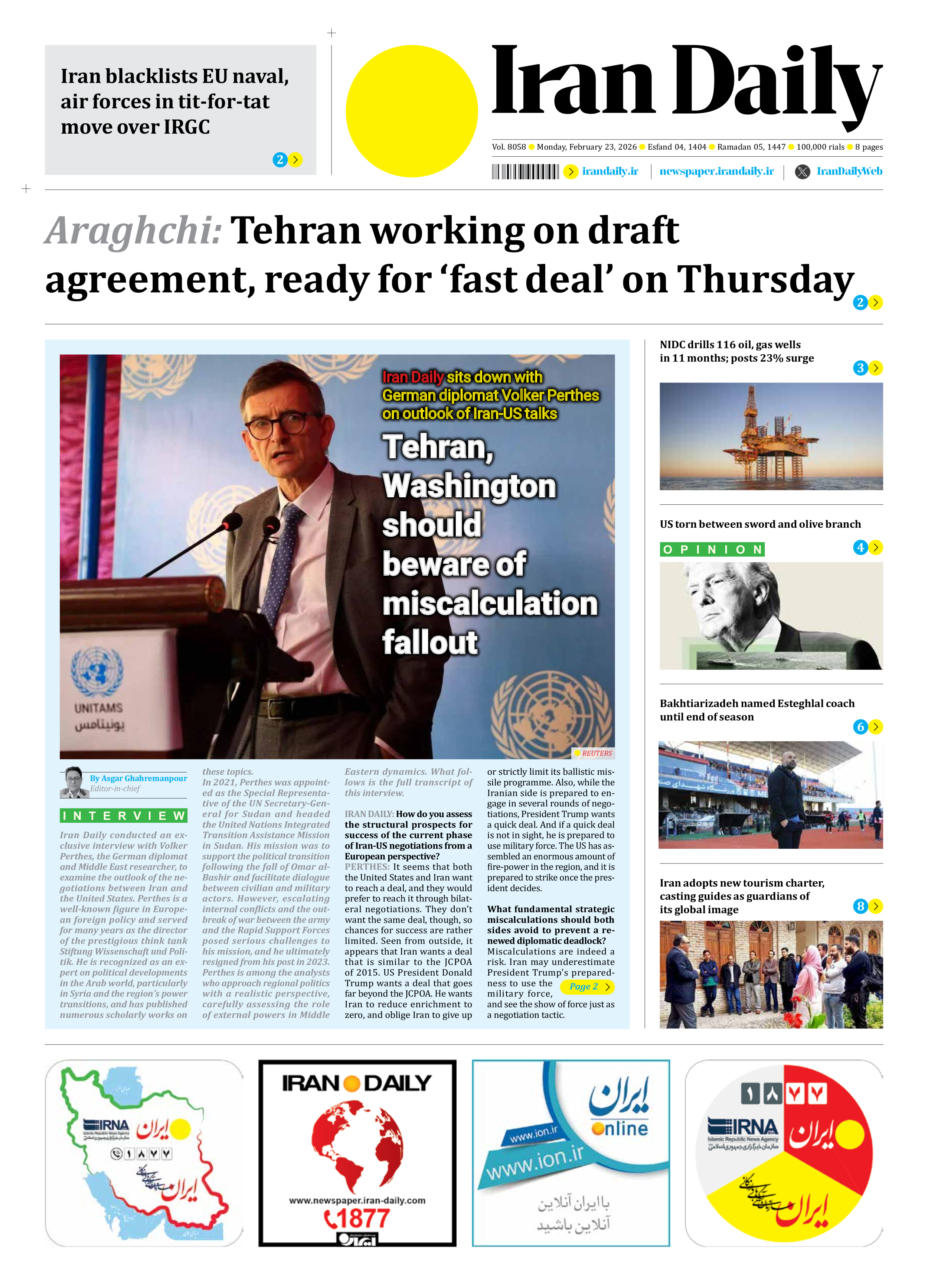


Iran Daily sits down with German diplomat Volker Perthes on outlook of Iran-US talks
Tehran, Washington should beware of miscalculation fallout
By Asgar Ghahremanpour
Editor-in-chief
Iran Daily conducted an exclusive interview with Volker Perthes, the German diplomat and Middle East researcher, to examine the outlook of the negotiations between Iran and the United States. Perthes is a well-known figure in European foreign policy and served for many years as the director of the prestigious think tank Stiftung Wissenschaft und Politik. He is recognized as an expert on political developments in the Arab world, particularly in Syria and the region’s power transitions, and has published numerous scholarly works on these topics.
In 2021, Perthes was appointed as the Special Representative of the UN Secretary-General for Sudan and headed the United Nations Integrated Transition Assistance Mission in Sudan. His mission was to support the political transition following the fall of Omar al-Bashir and facilitate dialogue between civilian and military actors. However, escalating internal conflicts and the outbreak of war between the army and the Rapid Support Forces posed serious challenges to his mission, and he ultimately resigned from his post in 2023.
Perthes is among the analysts who approach regional politics with a realistic perspective, carefully assessing the role of external powers in Middle Eastern dynamics. What follows is the full transcript of this interview.
IRAN DAILY: How do you assess the structural prospects for success of the current phase of Iran-US negotiations from a European perspective?
PERTHES: It seems that both the United States and Iran want to reach a deal, and they would prefer to reach it through bilateral negotiations. They don’t want the same deal, though, so chances for success are rather limited. Seen from outside, it appears that Iran wants a deal that is similar to the JCPOA of 2015. US President Donald Trump wants a deal that goes far beyond the JCPOA. He wants Iran to reduce enrichment to zero, and oblige Iran to give up or strictly limit its ballistic missile programme. Also, while the Iranian side is prepared to engage in several rounds of negotiations, President Trump wants a quick deal. And if a quick deal is not in sight, he is prepared to use military force. The US has assembled an enormous amount of fire-power in the region, and it is prepared to strike once the president decides.
What fundamental strategic miscalculations should both sides avoid to prevent a renewed diplomatic deadlock?
Miscalculations are indeed a risk. Iran may underestimate President Trump’s preparedness to use the military force, and see the show of force just as a negotiation tactic.
Page 2