







Copy in clipboard...
Vienna forum brings Iranian, European scholars together to revisit shared civilizational heritage
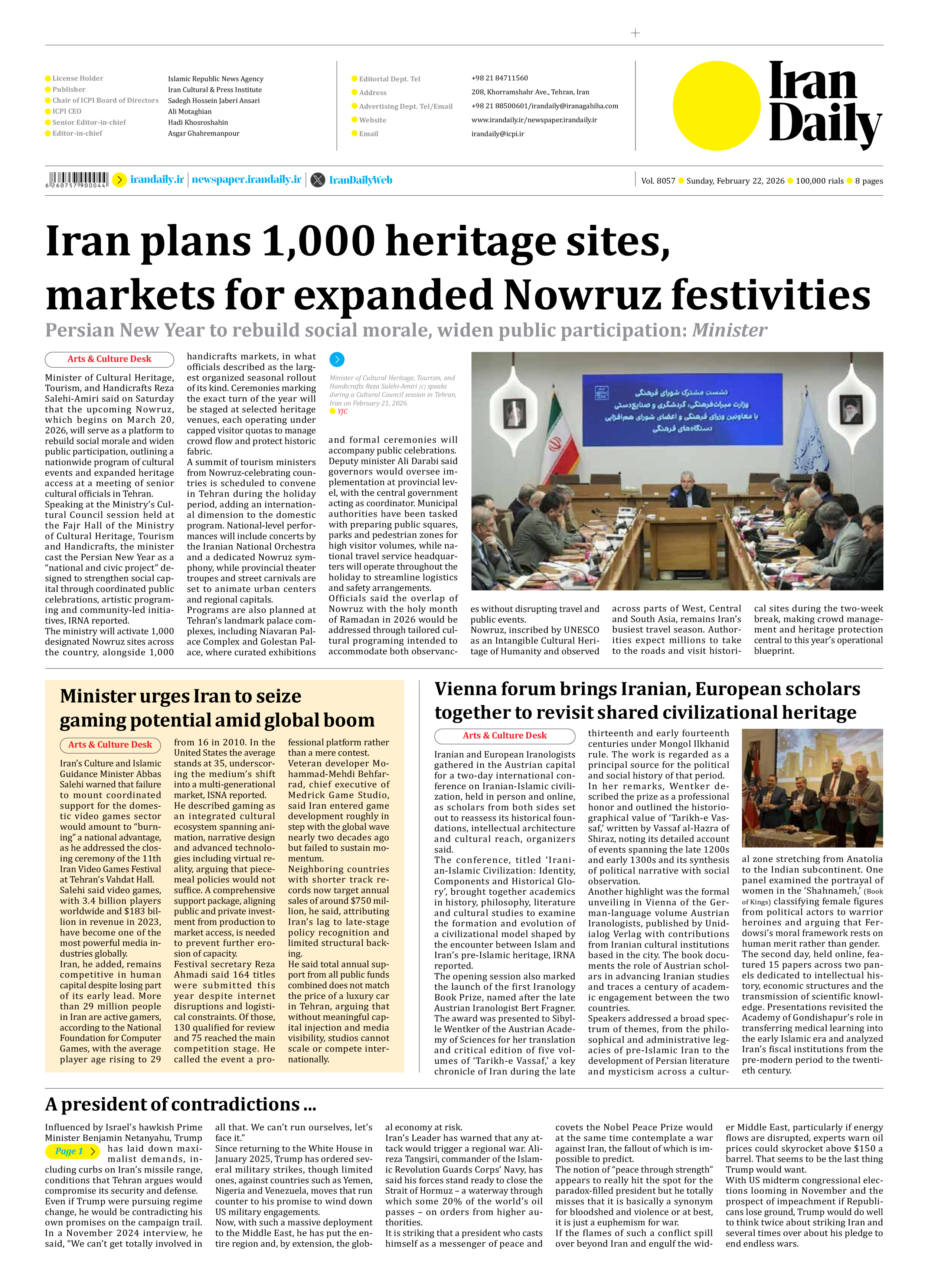
Iranian and European Iranologists gathered in the Austrian capital for a two-day international conference on Iranian-Islamic civilization, held in person and online, as scholars from both sides set out to reassess its historical foundations, intellectual architecture and cultural reach, organizers said.
The conference, titled ‘Iranian-Islamic Civilization: Identity, Components and Historical Glory’, brought together academics in history, philosophy, literature and cultural studies to examine the formation and evolution of a civilizational model shaped by the encounter between Islam and Iran’s pre-Islamic heritage, IRNA reported.
The opening session also marked the launch of the first Iranology Book Prize, named after the late Austrian Iranologist Bert Fragner. The award was presented to Sibylle Wentker of the Austrian Academy of Sciences for her translation and critical edition of five volumes of ‘Tarikh-e Vassaf,’ a key chronicle of Iran during the late thirteenth and early fourteenth centuries under Mongol Ilkhanid rule. The work is regarded as a principal source for the political and social history of that period.
In her remarks, Wentker described the prize as a professional honor and outlined the historiographical value of ‘Tarikh-e Vassaf,’ written by Vassaf al-Hazra of Shiraz, noting its detailed account of events spanning the late 1200s and early 1300s and its synthesis of political narrative with social observation.
Another highlight was the formal unveiling in Vienna of the German-language volume Austrian Iranologists, published by Unidialog Verlag with contributions from Iranian cultural institutions based in the city. The book documents the role of Austrian scholars in advancing Iranian studies and traces a century of academic engagement between the two countries.
Speakers addressed a broad spectrum of themes, from the philosophical and administrative legacies of pre-Islamic Iran to the development of Persian literature and mysticism across a cultural zone stretching from Anatolia to the Indian subcontinent. One panel examined the portrayal of women in the ‘Shahnameh,’ (Book of Kings) classifying female figures from political actors to warrior heroines and arguing that Ferdowsi’s moral framework rests on human merit rather than gender.
The second day, held online, featured 15 papers across two panels dedicated to intellectual history, economic structures and the transmission of scientific knowledge. Presentations revisited the Academy of Gondishapur’s role in transferring medical learning into the early Islamic era and analyzed Iran’s fiscal institutions from the pre-modern period to the twentieth century.