





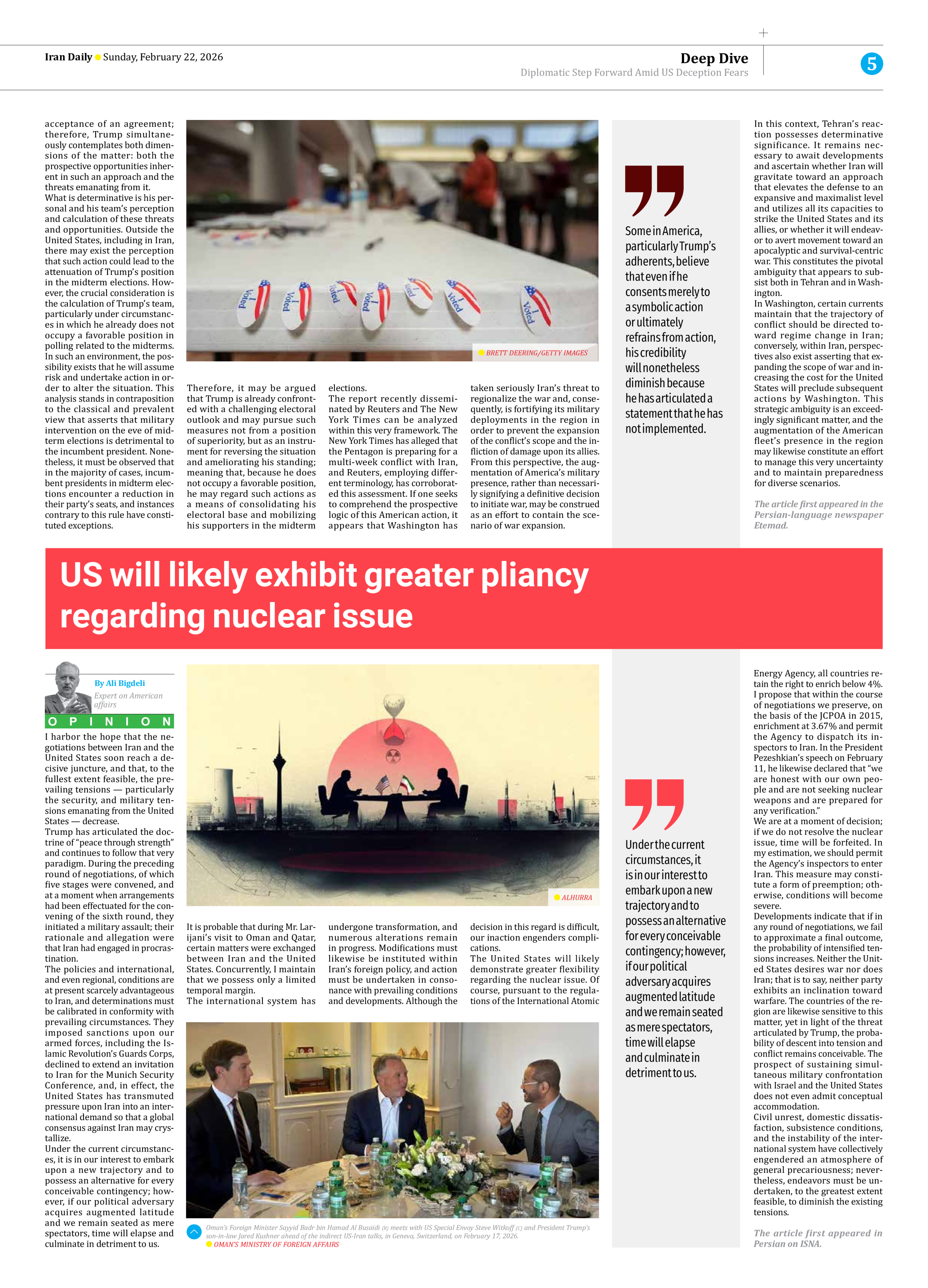


US will likely exhibit greater pliancy regarding nuclear issue
By Ali Bigdeli
Expert on American affairs
I harbor the hope that the negotiations between Iran and the United States soon reach a decisive juncture, and that, to the fullest extent feasible, the prevailing tensions — particularly the security, and military tensions emanating from the United States — decrease.
Trump has articulated the doctrine of “peace through strength” and continues to follow that very paradigm. During the preceding round of negotiations, of which five stages were convened, and at a moment when arrangements had been effectuated for the convening of the sixth round, they initiated a military assault; their rationale and allegation were that Iran had engaged in procrastination.
The policies and international, and even regional, conditions are at present scarcely advantageous to Iran, and determinations must be calibrated in conformity with prevailing circumstances. They imposed sanctions upon our armed forces, including the Islamic Revolution’s Guards Corps, declined to extend an invitation to Iran for the Munich Security Conference, and, in effect, the United States has transmuted pressure upon Iran into an international demand so that a global consensus against Iran may crystallize.
Under the current circumstances, it is in our interest to embark upon a new trajectory and to possess an alternative for every conceivable contingency; however, if our political adversary acquires augmented latitude and we remain seated as mere spectators, time will elapse and culminate in detriment to us.
It is probable that during Mr. Larijani’s visit to Oman and Qatar, certain matters were exchanged between Iran and the United States. Concurrently, I maintain that we possess only a limited temporal margin.
The international system has undergone transformation, and numerous alterations remain in progress. Modifications must likewise be instituted within Iran’s foreign policy, and action must be undertaken in consonance with prevailing conditions and developments. Although the decision in this regard is difficult, our inaction engenders complications.
The United States will likely demonstrate greater flexibility regarding the nuclear issue. Of course, pursuant to the regulations of the International Atomic Energy Agency, all countries retain the right to enrich below 4%.
I propose that within the course of negotiations we preserve, on the basis of the JCPOA in 2015, enrichment at 3.67% and permit the Agency to dispatch its inspectors to Iran. In the President Pezeshkian’s speech on February 11, he likewise declared that “we are honest with our own people and are not seeking nuclear weapons and are prepared for any verification.”
We are at a moment of decision; if we do not resolve the nuclear issue, time will be forfeited. In my estimation, we should permit the Agency’s inspectors to enter Iran. This measure may constitute a form of preemption; otherwise, conditions will become severe.
Developments indicate that if in any round of negotiations, we fail to approximate a final outcome, the probability of intensified tensions increases. Neither the United States desires war nor does Iran; that is to say, neither party exhibits an inclination toward warfare. The countries of the region are likewise sensitive to this matter, yet in light of the threat articulated by Trump, the probability of descent into tension and conflict remains conceivable. The prospect of sustaining simultaneous military confrontation with Israel and the United States does not even admit conceptual accommodation.
Civil unrest, domestic dissatisfaction, subsistence conditions, and the instability of the international system have collectively engendered an atmosphere of general precariousness; nevertheless, endeavors must be undertaken, to the greatest extent feasible, to diminish the existing tensions.
The article first appeared in Persian on ISNA.