







Geneva negotiations shape future trajectory of American, Israeli policy
By Rahman Ghahremanpour
International affairs analyst
At present, both the trajectory of diplomacy and the trajectory of military confrontation are advancing concomitantly. This signifies that, on the one hand, Iran and certain regional states are endeavoring to ensure that the diplomatic process attains fruition and to preclude the eruption of military hostilities; on the other hand, with respect to the option of military confrontation, the United States has arrived at the conclusion that Iran’s prospective response would likely be more expansive and more vehement than what was witnessed during the 12-day war. Accordingly, the Pentagon is augmenting its military capabilities in the Middle East in order to maintain preparedness for diverse contingencies.
Although it appears that the probability of military confrontation remains more pronounced, the prospect of diplomacy has not been extinguished and may be reinforced in the forthcoming weeks. Nevertheless, given the formidable impediments subsisting between the two parties, excessive optimism would be unwarranted, and a posture of prudence is requisite.
It appears that Netanyahu’s visit to America, beyond the declared objectives he himself articulated — including opposition to a prospective agreement with Iran or efforts to circumscribe the scope of diplomacy — also encompassed a more consequential and less conspicuous objective, namely military and intelligence coordination with the United States in the event of military action against Iran. Moreover, the composition of the individuals who accompanied the prime minister of Israel on this visit consisted predominantly of intelligence and military figures, and the visit transpired subsequent to the joint military exercise conducted by the United States and Israel in the Gulf of Aqaba; a drill characterized as preparation for responding to Iran’s potential and retaliatory measures in the event of an American attack on that country.
Accordingly, although superficially it appeared that Netanyahu’s principal objective was to forestall the formation of an agreement, the probability of reaching an agreement persisted; therefore, additional objectives must also be contemplated. It appears that this less-publicized or deliberately attenuated objective was, in actuality, the final coordination between the two parties regarding the manner of responding to Iranian measures or even the scenario of a prospective attack on Iran. Analogous visits were also observable prior to the 12-day war. Donald Trump did not explicitly repudiate such a scenario; rather, he declared that at present, he prefers to grant diplomacy an opportunity. This is precisely the same lexicon that had been heard from him in April 2025, at a juncture when, simultaneously, the United States and Israel were engaging in clandestine coordination for military action against Iran.
It is accurate that divergences of opinion exist within the Republican Party regarding the manner of addressing Iran; however, the salient point is that to the extent the prospect of attaining an agreement becomes more attenuated, the number and gravitas of the agreement’s proponents — both within the Republican Party and within Trump’s electoral constituency, namely the “MAGA” current — will diminish commensurately. In other words, this matter is contingent and dependent upon the conduct of both parties, namely Iran and the United States. The further the two states recede from an agreement, and the more the probability of attaining it declines, the greater Netanyahu’s latitude for maneuver in exploiting the fissure between Tehran and Washington becomes. Conversely, the greater the likelihood of an agreement, the more intensified Tel Aviv’s exertions will become in order to disrupt it or, at minimum, to incorporate its preferred stipulations into the text of the agreement.
On this basis, and in continuation of the preceding point, it appears that under present conditions, both the diplomatic trajectory and the trajectory of military confrontation are simultaneously active, and Israel is pursuing both in tandem; this actor, on the one hand, endeavors to ensure that no agreement materializes, yet if it reaches the conclusion that preventing an agreement is infeasible, it will then strive to embed its preferred conditions within that framework. Concurrently, Israel is collaborating with the United States to realize the scenario of military action against Iran and to design deterrent measures in response to Tehran’s potential reaction.
The reality is that Trump’s decision is exceedingly consequential and determinative. This decision could metamorphose into a serious threat to America’s standing and to Trump’s personal position in the international arena. If he proves incapable of actualizing his threats against Iran, or if, in the event of military action, he fails to attain his desired outcome, his credibility at the global level will be impaired. On the other hand, some in America, particularly Trump’s adherents, believe that even if he consents merely to a symbolic action or ultimately refrains from action, his credibility will nonetheless diminish because he has articulated a statement that he has not implemented; whereas one of the principal components of Trump’s political image has been that whatever he articulates, he executes. From this perspective, Trump occupies a predicament of considerable difficulty, and perhaps for this reason, a final decision has not yet been adopted, and he continues to endeavor, within the framework of diplomacy accompanied by pressure, to oscillate between the two options of diplomacy and military confrontation. Naturally, his preference is to attain his objectives at minimal cost, namely through a diplomatic agreement.
However, the issue is that Trump’s desired agreement, from the vantage point of the Islamic Republic, is construed as a species of strategic capitulation, and for this reason, Tehran is unlikely to acquiesce. Simultaneously, as reference was made to the menacing dimension of this decision, some also contend that such action could constitute a golden opportunity for Trump; an opportunity to demonstrate his resolve to his adversaries at the international level, including countries such as Cuba, North Korea, and even Mexico, and to convey the message that he is determined to enfeeble his rivals and to increase the cost of defiance for them. It suffices to note that Trump, concomitantly with exerting pressure upon Iran, has adopted a stringent approach toward Cuba and, in the context of combating drug cartels, has directed pressure toward Mexico.
Therefore, from the standpoint of the principle of opportunity-centric calculation, this situation could be attractive and even seductive for Trump. He may compute that if he succeeds in attaining his objective in confrontation with Iran, the pathway for his subsequent actions in the Middle East will become more facilitative.
Regarding the impact of this matter upon the midterm congressional elections, it must be noted that electoral campaigns have not yet commenced in earnest. Nevertheless, current polling indicates that Trump does not occupy a particularly favorable position. Consequently, contrary to certain analyses that attribute military action necessarily to the reinforcement of his position, it may be asserted that Trump likely approaches the matter from the vantage point of opportunity-centric calculation and computes that confrontation with Iran, if successful, could contribute to consolidating his electoral base and attracting a portion of undecided voters in the midterm elections, thereby improving his standing relative to the present condition.
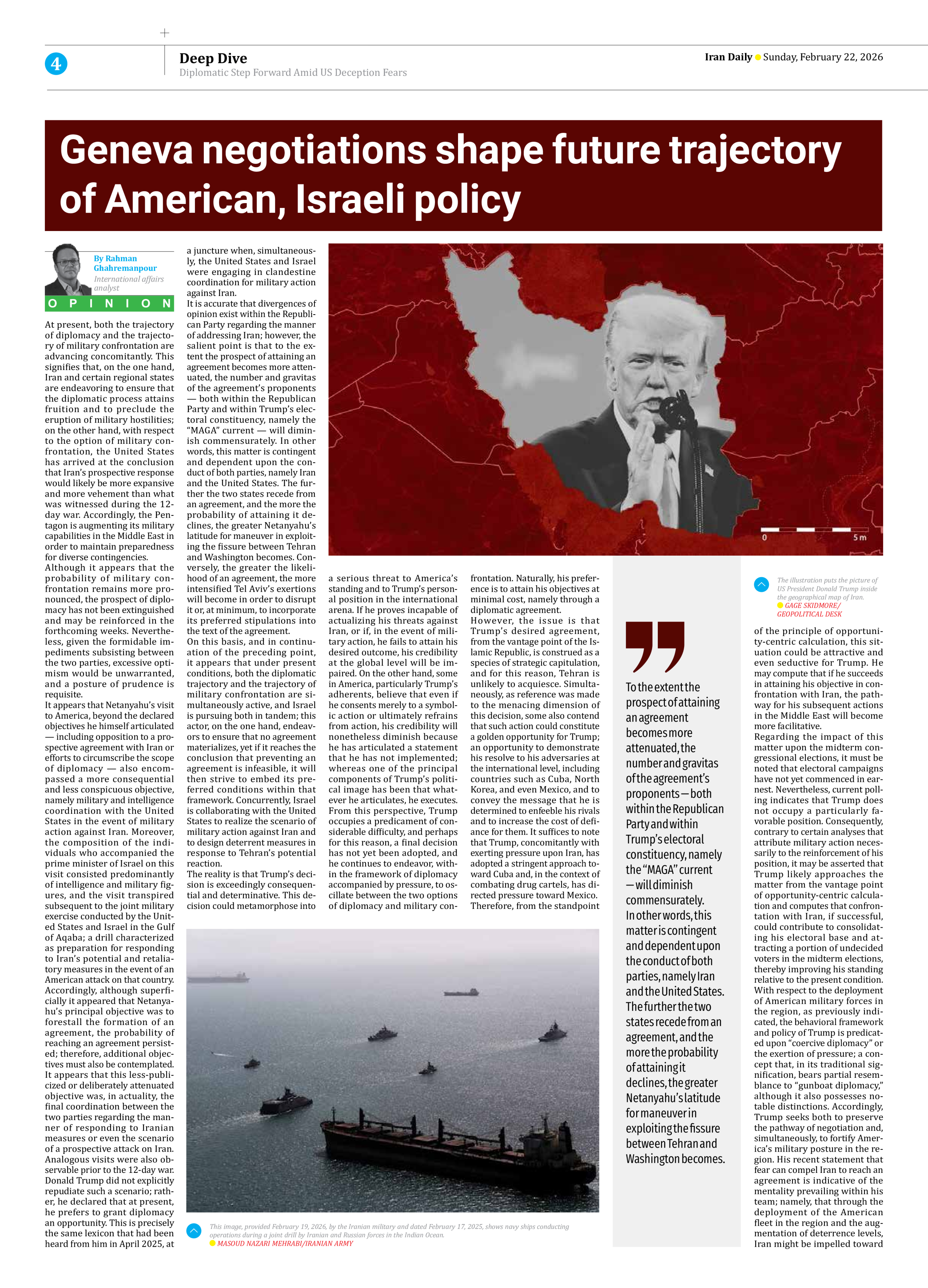
With respect to the deployment of American military forces in the region, as previously indicated, the behavioral framework and policy of Trump is predicated upon “coercive diplomacy” or the exertion of pressure; a concept that, in its traditional signification, bears partial resemblance to “gunboat diplomacy,” although it also possesses notable distinctions. Accordingly, Trump seeks both to preserve the pathway of negotiation and, simultaneously, to fortify America’s military posture in the region. His recent statement that fear can compel Iran to reach an agreement is indicative of the mentality prevailing within his team; namely, that through the deployment of the American fleet in the region and the augmentation of deterrence levels, Iran might be impelled toward acceptance of an agreement; therefore, Trump simultaneously contemplates both dimensions of the matter: both the prospective opportunities inherent in such an approach and the threats emanating from it.
What is determinative is his personal and his team’s perception and calculation of these threats and opportunities. Outside the United States, including in Iran, there may exist the perception that such action could lead to the attenuation of Trump’s position in the midterm elections. However, the crucial consideration is the calculation of Trump’s team, particularly under circumstances in which he already does not occupy a favorable position in polling related to the midterms. In such an environment, the possibility exists that he will assume risk and undertake action in order to alter the situation. This analysis stands in contraposition to the classical and prevalent view that asserts that military intervention on the eve of midterm elections is detrimental to the incumbent president. Nonetheless, it must be observed that in the majority of cases, incumbent presidents in midterm elections encounter a reduction in their party’s seats, and instances contrary to this rule have constituted exceptions.
Therefore, it may be argued that Trump is already confronted with a challenging electoral outlook and may pursue such measures not from a position of superiority, but as an instrument for reversing the situation and ameliorating his standing; meaning that, because he does not occupy a favorable position, he may regard such actions as a means of consolidating his electoral base and mobilizing his supporters in the midterm elections.
The report recently disseminated by Reuters and The New York Times can be analyzed within this very framework. The New York Times has alleged that the Pentagon is preparing for a multi-week conflict with Iran, and Reuters, employing different terminology, has corroborated this assessment. If one seeks to comprehend the prospective logic of this American action, it appears that Washington has taken seriously Iran’s threat to regionalize the war and, consequently, is fortifying its military deployments in the region in order to prevent the expansion of the conflict’s scope and the infliction of damage upon its allies. From this perspective, the augmentation of America’s military presence, rather than necessarily signifying a definitive decision to initiate war, may be construed as an effort to contain the scenario of war expansion.
In this context, Tehran’s reaction possesses determinative significance. It remains necessary to await developments and ascertain whether Iran will gravitate toward an approach that elevates the defense to an expansive and maximalist level and utilizes all its capacities to strike the United States and its allies, or whether it will endeavor to avert movement toward an apocalyptic and survival-centric war. This constitutes the pivotal ambiguity that appears to subsist both in Tehran and in Washington.
In Washington, certain currents maintain that the trajectory of conflict should be directed toward regime change in Iran; conversely, within Iran, perspectives also exist asserting that expanding the scope of war and increasing the cost for the United States will preclude subsequent actions by Washington. This strategic ambiguity is an exceedingly significant matter, and the augmentation of the American fleet’s presence in the region may likewise constitute an effort to manage this very uncertainty and to maintain preparedness for diverse scenarios.
The article first appeared in the Persian-language newspaper Etemad.