







Iran’s exports to Russia forecasted at $1.4b as trade expands, chamber says
By Sadeq Dehqan
Staff writer
Iran’s exports to Russia are projected to reach about $1.4 billion this year, up from $267 million in 2019 and more than $1 billion last year, Kambiz Mirkarimi, a board member of the Iran-Russia Joint Chamber of Commerce, told Iran Daily.
Iran and Russia have set a medium-term target of $30 billion in bilateral trade, which he said is fully achievable within five years if transport and banking infrastructure is completed.
The three-day joint commission on economic and trade cooperation between the two countries concluded on Wednesday with the signing of a cooperation document and four memorandums of understanding, he said.
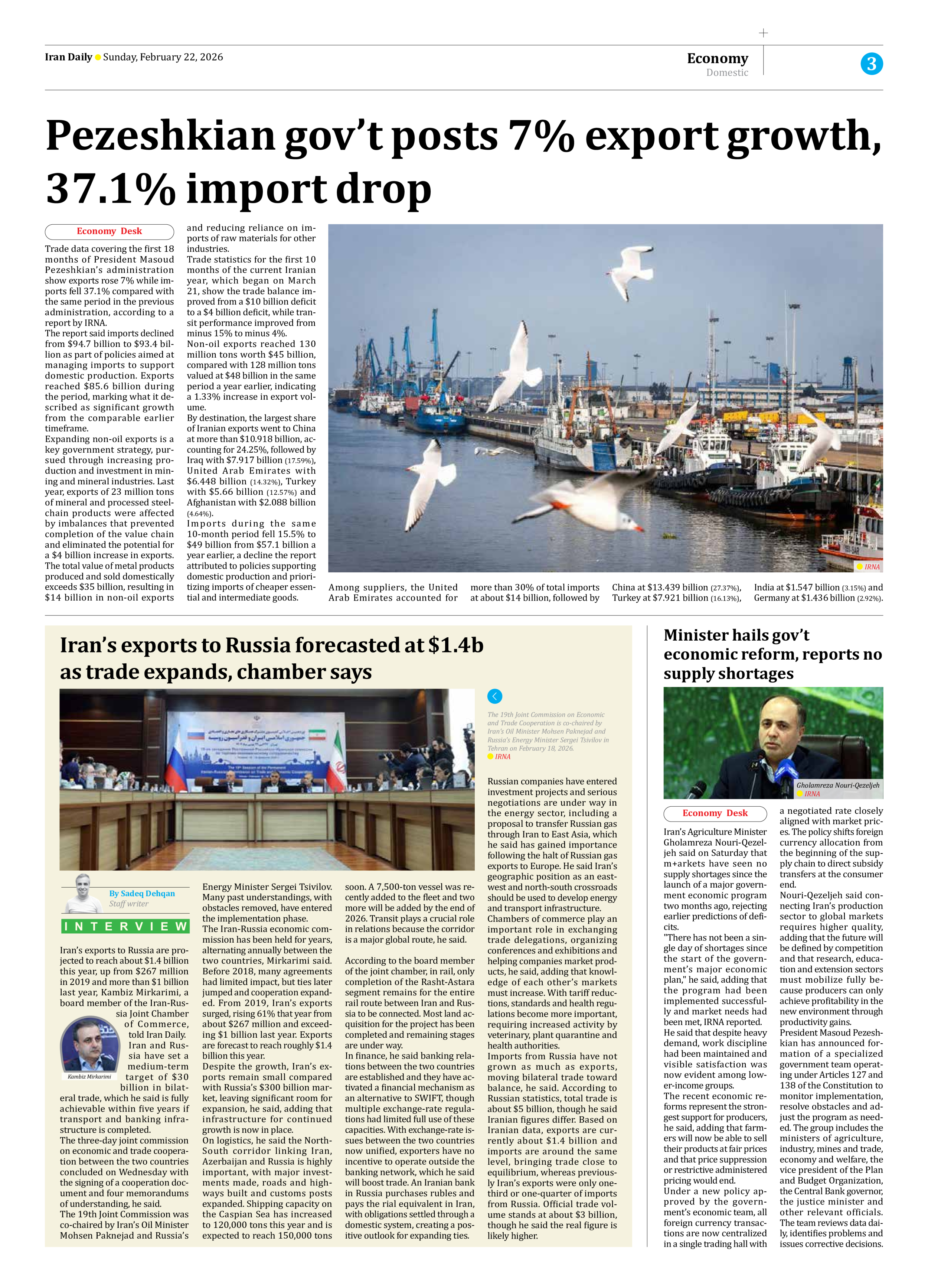
The 19th Joint Commission was co-chaired by Iran’s Oil Minister Mohsen Paknejad and Russia’s Energy Minister Sergei Tsivilov. Many past understandings, with obstacles removed, have entered the implementation phase.
The Iran-Russia economic commission has been held for years, alternating annually between the two countries, Mirkarimi said. Before 2018, many agreements had limited impact, but ties later jumped and cooperation expanded. From 2019, Iran’s exports surged, rising 61% that year from about $267 million and exceeding $1 billion last year. Exports are forecast to reach roughly $1.4 billion this year.
Despite the growth, Iran’s exports remain small compared with Russia’s $300 billion market, leaving significant room for expansion, he said, adding that infrastructure for continued growth is now in place.
On logistics, he said the North-South corridor linking Iran, Azerbaijan and Russia is highly important, with major investments made, roads and highways built and customs posts expanded. Shipping capacity on the Caspian Sea has increased to 120,000 tons this year and is expected to reach 150,000 tons soon. A 7,500-ton vessel was recently added to the fleet and two more will be added by the end of 2026. Transit plays a crucial role in relations because the corridor is a major global route, he said.
According to the board member of the joint chamber, in rail, only completion of the Rasht-Astara segment remains for the entire rail route between Iran and Russia to be connected. Most land acquisition for the project has been completed and remaining stages are under way.
In finance, he said banking relations between the two countries are established and they have activated a financial mechanism as an alternative to SWIFT, though multiple exchange-rate regulations had limited full use of these capacities. With exchange-rate issues between the two countries now unified, exporters have no incentive to operate outside the banking network, which he said will boost trade. An Iranian bank in Russia purchases rubles and pays the rial equivalent in Iran, with obligations settled through a domestic system, creating a positive outlook for expanding ties.
Russian companies have entered investment projects and serious negotiations are under way in the energy sector, including a proposal to transfer Russian gas through Iran to East Asia, which he said has gained importance following the halt of Russian gas exports to Europe. He said Iran’s geographic position as an east-west and north-south crossroads should be used to develop energy and transport infrastructure.
Chambers of commerce play an important role in exchanging trade delegations, organizing conferences and exhibitions and helping companies market products, he said, adding that knowledge of each other’s markets must increase. With tariff reductions, standards and health regulations become more important, requiring increased activity by veterinary, plant quarantine and health authorities.
Imports from Russia have not grown as much as exports, moving bilateral trade toward balance, he said. According to Russian statistics, total trade is about $5 billion, though he said Iranian figures differ. Based on Iranian data, exports are currently about $1.4 billion and imports are around the same level, bringing trade close to equilibrium, whereas previously Iran’s exports were only one-third or one-quarter of imports from Russia. Official trade volume stands at about $3 billion, though he said the real figure is likely higher.