







Riab blends ancient wisdom with modern desert technologies
Gonabad, located in the arid climate of Khorasan Razavi Province, has long been defined as a resilient and dynamic historical landscape — one whose 5,000-year-old civilization is attested not only by oral history, but also by written records and monumental structures.
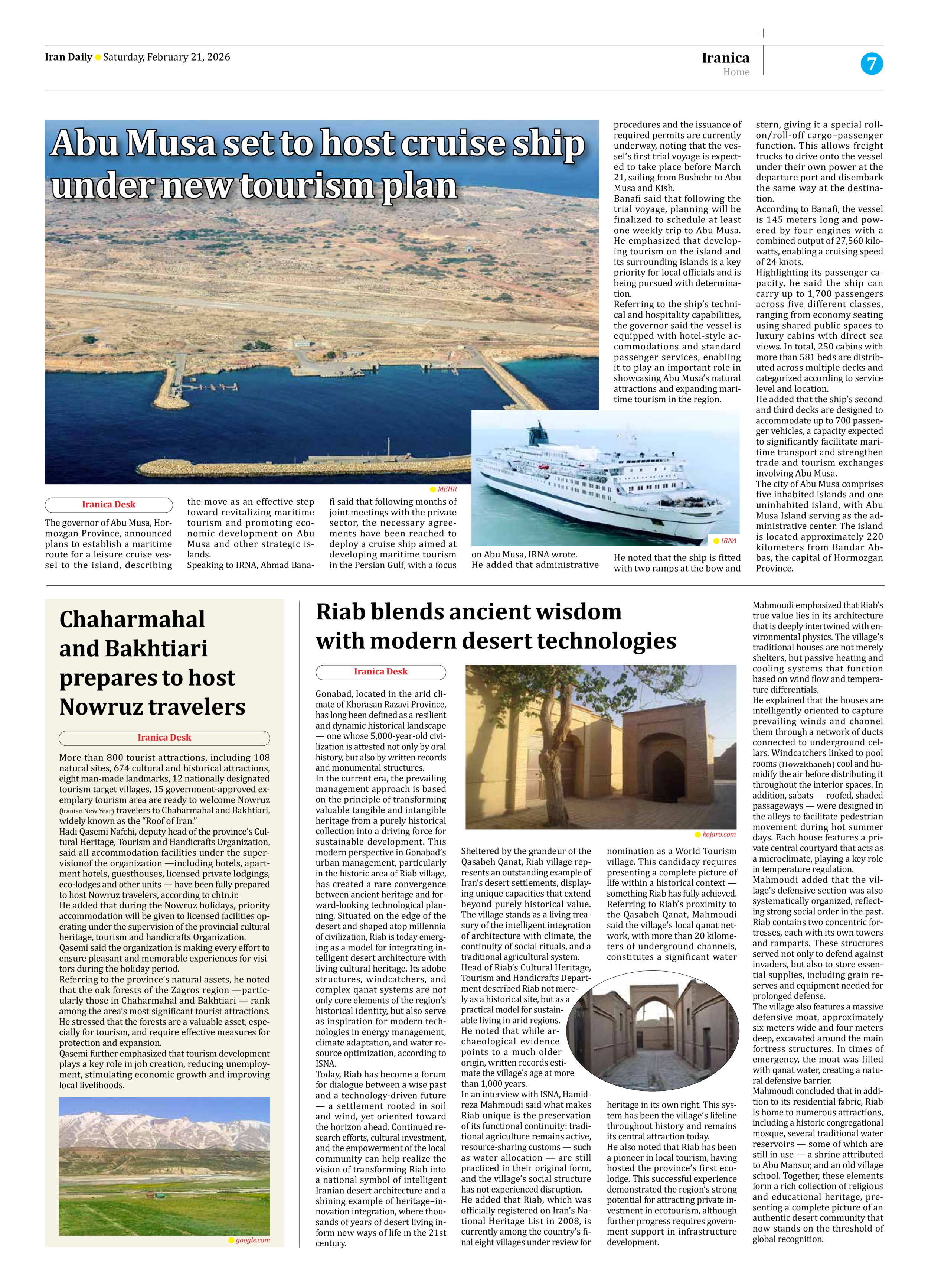
In the current era, the prevailing management approach is based on the principle of transforming valuable tangible and intangible heritage from a purely historical collection into a driving force for sustainable development. This modern perspective in Gonabad’s urban management, particularly in the historic area of Riab village, has created a rare convergence between ancient heritage and forward-looking technological planning. Situated on the edge of the desert and shaped atop millennia of civilization, Riab is today emerging as a model for integrating intelligent desert architecture with living cultural heritage. Its adobe structures, windcatchers, and complex qanat systems are not only core elements of the region’s historical identity, but also serve as inspiration for modern technologies in energy management, climate adaptation, and water resource optimization, according to ISNA.
Today, Riab has become a forum for dialogue between a wise past and a technology-driven future — a settlement rooted in soil and wind, yet oriented toward the horizon ahead. Continued research efforts, cultural investment, and the empowerment of the local community can help realize the vision of transforming Riab into a national symbol of intelligent Iranian desert architecture and a shining example of heritage–innovation integration, where thousands of years of desert living inform new ways of life in the 21st century.
Sheltered by the grandeur of the Qasabeh Qanat, Riab village represents an outstanding example of Iran’s desert settlements, displaying unique capacities that extend beyond purely historical value. The village stands as a living treasury of the intelligent integration of architecture with climate, the continuity of social rituals, and a traditional agricultural system.
Head of Riab’s Cultural Heritage, Tourism and Handicrafts Department described Riab not merely as a historical site, but as a practical model for sustainable living in arid regions. He noted that while archaeological evidence points to a much older origin, written records estimate the village’s age at more than 1,000 years.
In an interview with ISNA, Hamidreza Mahmoudi said what makes Riab unique is the preservation of its functional continuity: traditional agriculture remains active, resource-sharing customs — such as water allocation — are still practiced in their original form, and the village’s social structure has not experienced disruption.
He added that Riab, which was officially registered on Iran’s National Heritage List in 2008, is currently among the country’s final eight villages under review for nomination as a World Tourism village. This candidacy requires presenting a complete picture of life within a historical context — something Riab has fully achieved.
Referring to Riab’s proximity to the Qasabeh Qanat, Mahmoudi said the village’s local qanat network, with more than 20 kilometers of underground channels, constitutes a significant water heritage in its own right. This system has been the village’s lifeline throughout history and remains its central attraction today.
He also noted that Riab has been a pioneer in local tourism, having hosted the province’s first eco-lodge. This successful experience demonstrated the region’s strong potential for attracting private investment in ecotourism, although further progress requires government support in infrastructure development.
Mahmoudi emphasized that Riab’s true value lies in its architecture that is deeply intertwined with environmental physics. The village’s traditional houses are not merely shelters, but passive heating and cooling systems that function based on wind flow and temperature differentials.
He explained that the houses are intelligently oriented to capture prevailing winds and channel them through a network of ducts connected to underground cellars. Windcatchers linked to pool rooms (Howzkhaneh) cool and humidify the air before distributing it throughout the interior spaces. In addition, sabats — roofed, shaded passageways — were designed in the alleys to facilitate pedestrian movement during hot summer days. Each house features a private central courtyard that acts as a microclimate, playing a key role in temperature regulation.
Mahmoudi added that the village’s defensive section was also systematically organized, reflecting strong social order in the past. Riab contains two concentric fortresses, each with its own towers and ramparts. These structures served not only to defend against invaders, but also to store essential supplies, including grain reserves and equipment needed for prolonged defense.
The village also features a massive defensive moat, approximately six meters wide and four meters deep, excavated around the main fortress structures. In times of emergency, the moat was filled with qanat water, creating a natural defensive barrier.
Mahmoudi concluded that in addition to its residential fabric, Riab is home to numerous attractions, including a historic congregational mosque, several traditional water reservoirs — some of which are still in use — a shrine attributed to Abu Mansur, and an old village school. Together, these elements form a rich collection of religious and educational heritage, presenting a complete picture of an authentic desert community that now stands on the threshold of global recognition.