





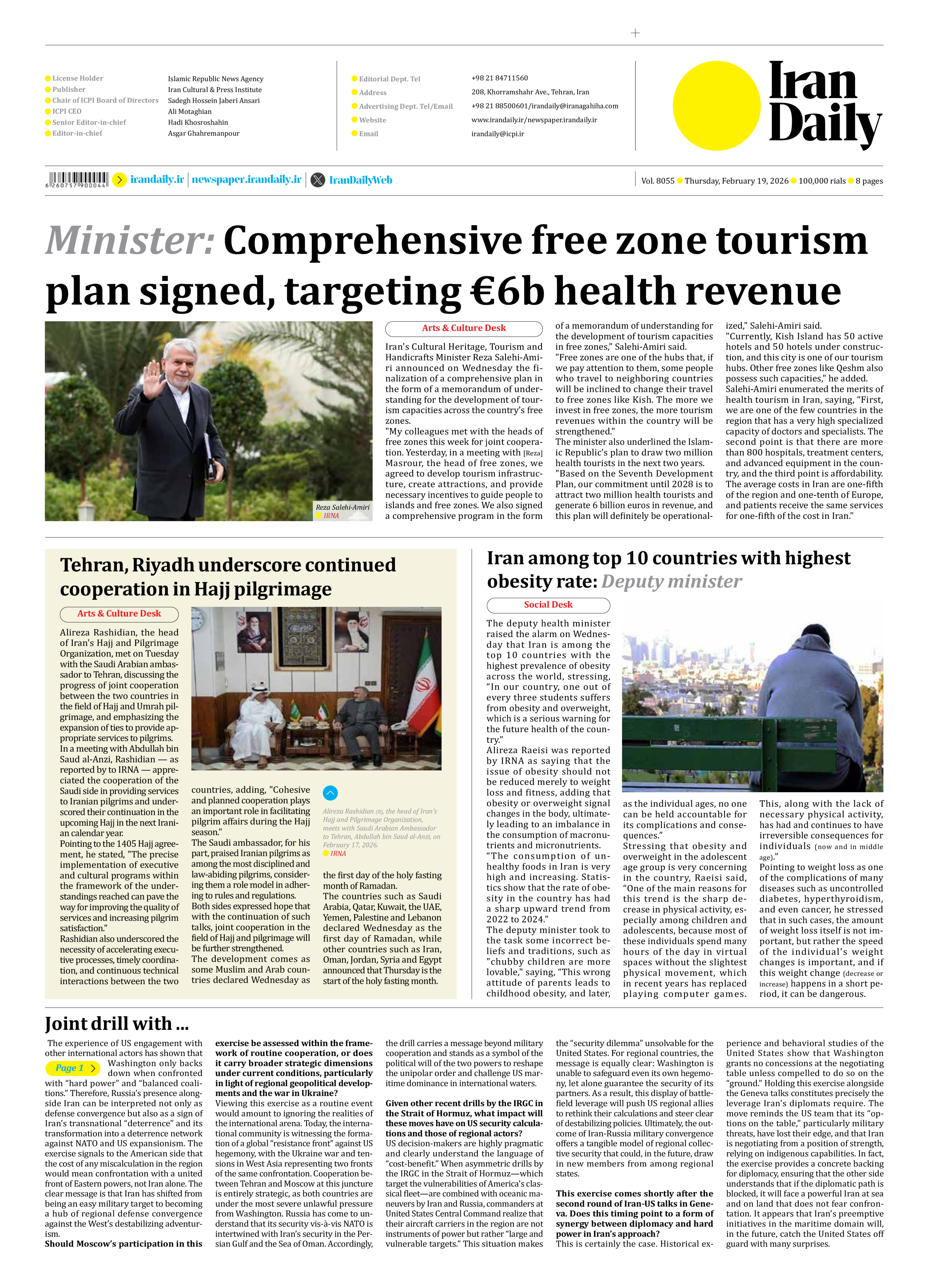


Minister: Comprehensive free zone tourism plan signed, targeting €6b health revenue
Iran's Cultural Heritage, Tourism and Handicrafts Minister Reza Salehi-Amiri announced on Wednesday the finalization of a comprehensive plan in the form of a memorandum of understanding for the development of tourism capacities across the country’s free zones.
"My colleagues met with the heads of free zones this week for joint cooperation. Yesterday, in a meeting with [Reza] Masrour, the head of free zones, we agreed to develop tourism infrastructure, create attractions, and provide necessary incentives to guide people to islands and free zones. We also signed a comprehensive program in the form of a memorandum of understanding for the development of tourism capacities in free zones," Salehi-Amiri said.
"Free zones are one of the hubs that, if we pay attention to them, some people who travel to neighboring countries will be inclined to change their travel to free zones like Kish. The more we invest in free zones, the more tourism revenues within the country will be strengthened."
The minister also underlined the Islamic Republic’s plan to draw two million health tourists in the next two years.
"Based on the Seventh Development Plan, our commitment until 2028 is to attract two million health tourists and generate 6 billion euros in revenue, and this plan will definitely be operationalized," Salehi-Amiri said.
"Currently, Kish Island has 50 active hotels and 50 hotels under construction, and this city is one of our tourism hubs. Other free zones like Qeshm also possess such capacities," he added.
Salehi-Amiri enumerated the merits of health tourism in Iran, saying, “First, we are one of the few countries in the region that has a very high specialized capacity of doctors and specialists. The second point is that there are more than 800 hospitals, treatment centers, and advanced equipment in the country, and the third point is affordability. The average costs in Iran are one-fifth of the region and one-tenth of Europe, and patients receive the same services for one-fifth of the cost in Iran.”