







Persian Gulf Act, int’l law of historical truth
By MohammadMehdi
Seyed Nasseri
Researcher at SBU’s Center for Medical Ethics and Law Studies
The dispute over the name of the Persian Gulf is more than a semantic debate; it represents a complex intersection of history, international law, and geopolitical identity. While Iran insists on the historically and internationally recognized term “Persian Gulf,” several Arab states advocate for an alternative fabricated designation, generating decades-long diplomatic tensions, inconsistent cartographic practices, and contestations in international fora. These disputes extend beyond regional politics, touching upon the principles of legal continuity, historical truth, and cultural heritage preservation under international law.
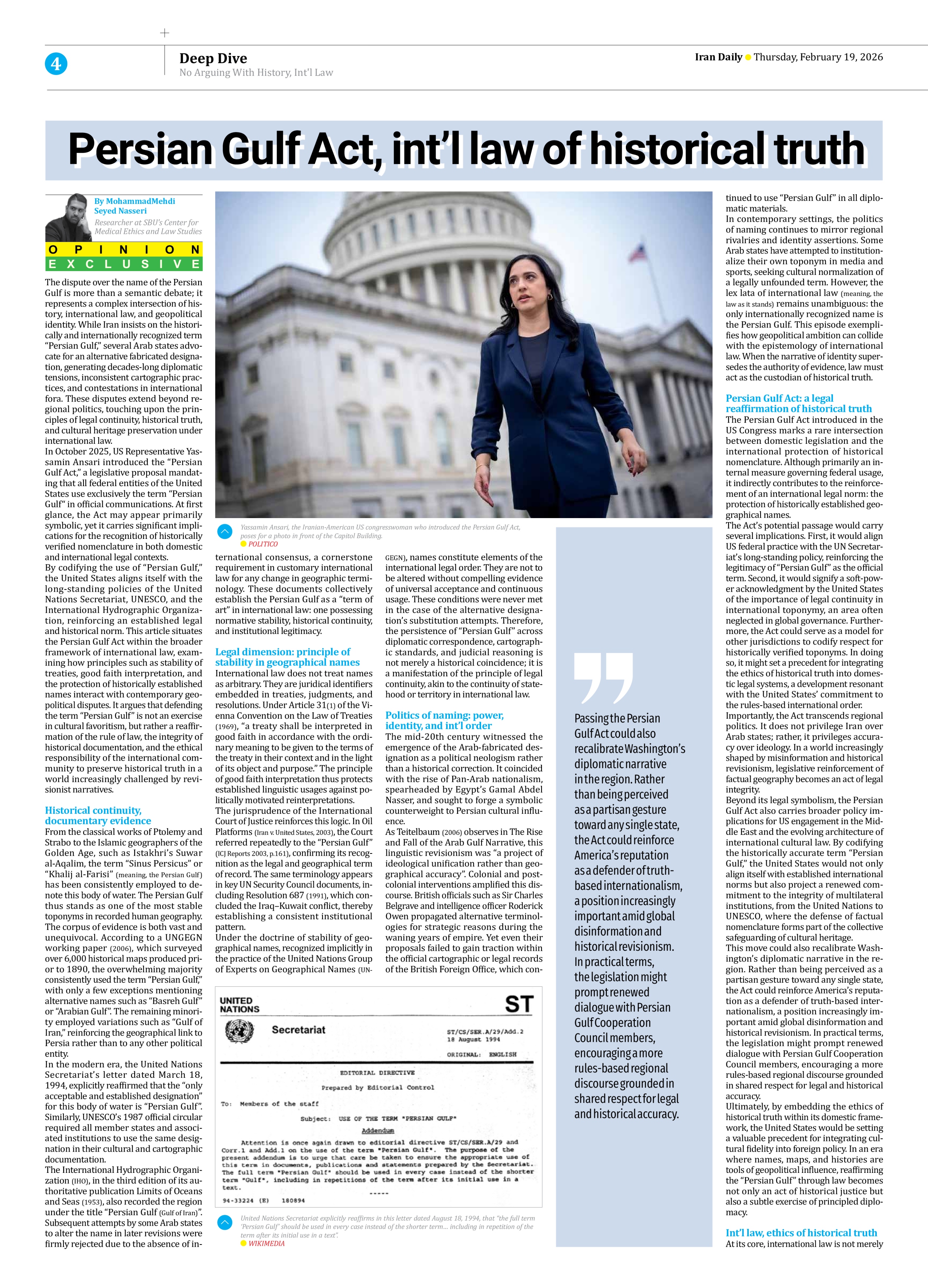
In October 2025, US Representative Yassamin Ansari introduced the “Persian Gulf Act,” a legislative proposal mandating that all federal entities of the United States use exclusively the term “Persian Gulf“ in official communications. At first glance, the Act may appear primarily symbolic, yet it carries significant implications for the recognition of historically verified nomenclature in both domestic and international legal contexts.
By codifying the use of “Persian Gulf,” the United States aligns itself with the long-standing policies of the United Nations Secretariat, UNESCO, and the International Hydrographic Organization, reinforcing an established legal and historical norm. This article situates the Persian Gulf Act within the broader framework of international law, examining how principles such as stability of treaties, good faith interpretation, and the protection of historically established names interact with contemporary geopolitical disputes. It argues that defending the term “Persian Gulf” is not an exercise in cultural favoritism, but rather a reaffirmation of the rule of law, the integrity of historical documentation, and the ethical responsibility of the international community to preserve historical truth in a world increasingly challenged by revisionist narratives.
Historical continuity, documentary evidence
From the classical works of Ptolemy and Strabo to the Islamic geographers of the Golden Age, such as Istakhri’s Suwar al-Aqalim, the term “Sinus Persicus” or “Khalij al-Farisi” (meaning, the Persian Gulf) has been consistently employed to denote this body of water. The Persian Gulf thus stands as one of the most stable toponyms in recorded human geography. The corpus of evidence is both vast and unequivocal. According to a UNGEGN working paper (2006), which surveyed over 6,000 historical maps produced prior to 1890, the overwhelming majority consistently used the term “Persian Gulf,” with only a few exceptions mentioning alternative names such as “Basreh Gulf” or “Arabian Gulf”. The remaining minority employed variations such as “Gulf of Iran,” reinforcing the geographical link to Persia rather than to any other political entity.
In the modern era, the United Nations Secretariat’s letter dated March 18, 1994, explicitly reaffirmed that the “only acceptable and established designation” for this body of water is “Persian Gulf”. Similarly, UNESCO’s 1987 official circular required all member states and associated institutions to use the same designation in their cultural and cartographic documentation.
The International Hydrographic Organization (IHO), in the third edition of its authoritative publication Limits of Oceans and Seas (1953), also recorded the region under the title “Persian Gulf (Gulf of Iran)”. Subsequent attempts by some Arab states to alter the name in later revisions were firmly rejected due to the absence of international consensus, a cornerstone requirement in customary international law for any change in geographic terminology. These documents collectively establish the Persian Gulf as a “term of art” in international law: one possessing normative stability, historical continuity, and institutional legitimacy.
Legal dimension: principle of stability in geographical names
International law does not treat names as arbitrary. They are juridical identifiers embedded in treaties, judgments, and resolutions. Under Article 31(1) of the Vienna Convention on the Law of Treaties (1969), “a treaty shall be interpreted in good faith in accordance with the ordinary meaning to be given to the terms of the treaty in their context and in the light of its object and purpose.” The principle of good faith interpretation thus protects established linguistic usages against politically motivated reinterpretations.
The jurisprudence of the International Court of Justice reinforces this logic. In Oil Platforms (Iran v. United States, 2003), the Court referred repeatedly to the “Persian Gulf” (ICJ Reports 2003, p.161), confirming its recognition as the legal and geographical term of record. The same terminology appears in key UN Security Council documents, including Resolution 687 (1991), which concluded the Iraq–Kuwait conflict, thereby establishing a consistent institutional pattern.
Under the doctrine of stability of geographical names, recognized implicitly in the practice of the United Nations Group of Experts on Geographical Names (UNGEGN), names constitute elements of the international legal order. They are not to be altered without compelling evidence of universal acceptance and continuous usage. These conditions were never met in the case of the alternative designation’s substitution attempts. Therefore, the persistence of “Persian Gulf” across diplomatic correspondence, cartographic standards, and judicial reasoning is not merely a historical coincidence; it is a manifestation of the principle of legal continuity, akin to the continuity of statehood or territory in international law.
Politics of naming: power, identity, and int’l order
The mid-20th century witnessed the emergence of the Arab-fabricated designation as a political neologism rather than a historical correction. It coincided with the rise of Pan-Arab nationalism, spearheaded by Egypt’s Gamal Abdel Nasser, and sought to forge a symbolic counterweight to Persian cultural influence.
As Teitelbaum (2006) observes in The Rise and Fall of the Arab Gulf Narrative, this linguistic revisionism was “a project of ideological unification rather than geographical accuracy”. Colonial and postcolonial interventions amplified this discourse. British officials such as Sir Charles Belgrave and intelligence officer Roderick Owen propagated alternative terminologies for strategic reasons during the waning years of empire. Yet even their proposals failed to gain traction within the official cartographic or legal records of the British Foreign Office, which continued to use “Persian Gulf” in all diplomatic materials.
In contemporary settings, the politics of naming continues to mirror regional rivalries and identity assertions. Some Arab states have attempted to institutionalize their own toponym in media and sports, seeking cultural normalization of a legally unfounded term. However, the lex lata of international law (meaning, the law as it stands) remains unambiguous: the only internationally recognized name is the Persian Gulf. This episode exemplifies how geopolitical ambition can collide with the epistemology of international law. When the narrative of identity supersedes the authority of evidence, law must act as the custodian of historical truth.
Persian Gulf Act: a legal reaffirmation of historical truth
The Persian Gulf Act introduced in the US Congress marks a rare intersection between domestic legislation and the international protection of historical nomenclature. Although primarily an internal measure governing federal usage, it indirectly contributes to the reinforcement of an international legal norm: the protection of historically established geographical names.
The Act’s potential passage would carry several implications. First, it would align US federal practice with the UN Secretariat’s long-standing policy, reinforcing the legitimacy of “Persian Gulf” as the official term. Second, it would signify a soft-power acknowledgment by the United States of the importance of legal continuity in international toponymy, an area often neglected in global governance. Furthermore, the Act could serve as a model for other jurisdictions to codify respect for historically verified toponyms. In doing so, it might set a precedent for integrating the ethics of historical truth into domestic legal systems, a development resonant with the United States’ commitment to the rules-based international order.
Importantly, the Act transcends regional politics. It does not privilege Iran over Arab states; rather, it privileges accuracy over ideology. In a world increasingly shaped by misinformation and historical revisionism, legislative reinforcement of factual geography becomes an act of legal integrity.
Beyond its legal symbolism, the Persian Gulf Act also carries broader policy implications for US engagement in the Middle East and the evolving architecture of international cultural law. By codifying the historically accurate term “Persian Gulf,” the United States would not only align itself with established international norms but also project a renewed commitment to the integrity of multilateral institutions, from the United Nations to UNESCO, where the defense of factual nomenclature forms part of the collective safeguarding of cultural heritage.
This move could also recalibrate Washington’s diplomatic narrative in the region. Rather than being perceived as a partisan gesture toward any single state, the Act could reinforce America’s reputation as a defender of truth-based internationalism, a position increasingly important amid global disinformation and historical revisionism. In practical terms, the legislation might prompt renewed dialogue with Persian Gulf Cooperation Council members, encouraging a more rules-based regional discourse grounded in shared respect for legal and historical accuracy.
Ultimately, by embedding the ethics of historical truth within its domestic framework, the United States would be setting a valuable precedent for integrating cultural fidelity into foreign policy. In an era where names, maps, and histories are tools of geopolitical influence, reaffirming the “Persian Gulf” through law becomes not only an act of historical justice but also a subtle exercise of principled diplomacy.
Int’l law, ethics of historical truth
At its core, international law is not merely a set of procedural norms; it is a repository of collective memory. To distort the name of the Persian Gulf is to distort the textual fabric of global civilization. The legal protection of names is therefore part of the moral duty of the international community to preserve historical truth. The ethics of naming draw from several overlapping legal principles:
• The principle of good faith (bona fides), requiring honest interpretation of established facts;
• The doctrine of legitimate expectation, which protects consistent usage in international relations;
• The principle of cultural heritage preservation, embodied in UNESCO’s conventions.
Together, these principles establish that altering a name with entrenched historical and legal foundations constitutes a breach of international comity. It introduces instability into the semantic order of law, much like arbitrary redrawing of borders introduces instability into the territorial order. Therefore, defending the name “Persian Gulf” is not an act of nationalism, but an act of epistemic justice, a defense of the truth embedded in international legal memory.
The name Persian Gulf is not a relic of the past but a living legal institution. It exists in treaties, judgments, UN resolutions, and collective consciousness. Like the course of a river, its trajectory cannot be redirected by political slogans. The Persian Gulf Act provides an opportunity for the United States and the international community to reaffirm a simple yet profound principle: that law must speak the language of truth. In an age where historical narratives are weaponized, affirming factual nomenclature becomes a defense of international order itself. As such, the Persian Gulf stands not merely as a geographical entity, but as a testament to the endurance of law over politics, truth over ideology, and continuity over revisionism. In the lexicon of international law, certain names, like certain rights, are inalienable. In reaffirming the Persian Gulf, the international community is not reviving a relic of history but preserving the rule of law against revisionism — a small yet vital act of truth in an age of disinformation.