







Tehran, Moscow sign cooperation document, MoUs at 19th joint economic commission
Paknejad: Past agreements with Moscow now moving into implementation
A cooperation document and four memorandums of understanding were signed between Iran and Russia on Wednesday during the 19th session of their Joint Commission on Economic Cooperation, co-chaired by Iran’s Oil Minister Mohsen Paknejad and Russia’s Energy Minister Sergei Tsivilov.
On the final day, a memorandum of understanding on an executive cooperation program for 2026–2028 between Iran’s National Standards Organization and Russia’s Federal Agency for Technical Regulation and Metrology was signed by Farzaneh Ansari, Iran’s vice president and head of the standards body, and Anton Pavlovich Shalaev, head of the Russian agency, IRNA reported.
Another MoU between Russia’s Federal Accreditation Service and Iran’s National Accreditation Center was signed by Mehdi Alipour, head of the Iranian center, and Dmitry Valeryevich Volvach, head of the Russian service.
Parvaneh Rezaei, Iran’s deputy labor minister, and Mikhail Yuryevich Ivankov, head of Russia’s Federal Service for Labor and Employment, also signed an MoU on cooperation in employment development and labor inspection.
A final memorandum between Art Khimia Joint Stock Company and the Petroleum Industry Research Institute was signed by Azim Kalantari Asl, head of the institute, and Andrey Vladimirovich Shpak, chief executive of the company.
Iran’s oil minister noted in a live interview with IRIB that the 19th Joint Commission on Economic and Trade Cooperation between the two countries concluded after three days of intensive negotiations, and “with obstacles removed, many past understandings have entered the implementation phase.”
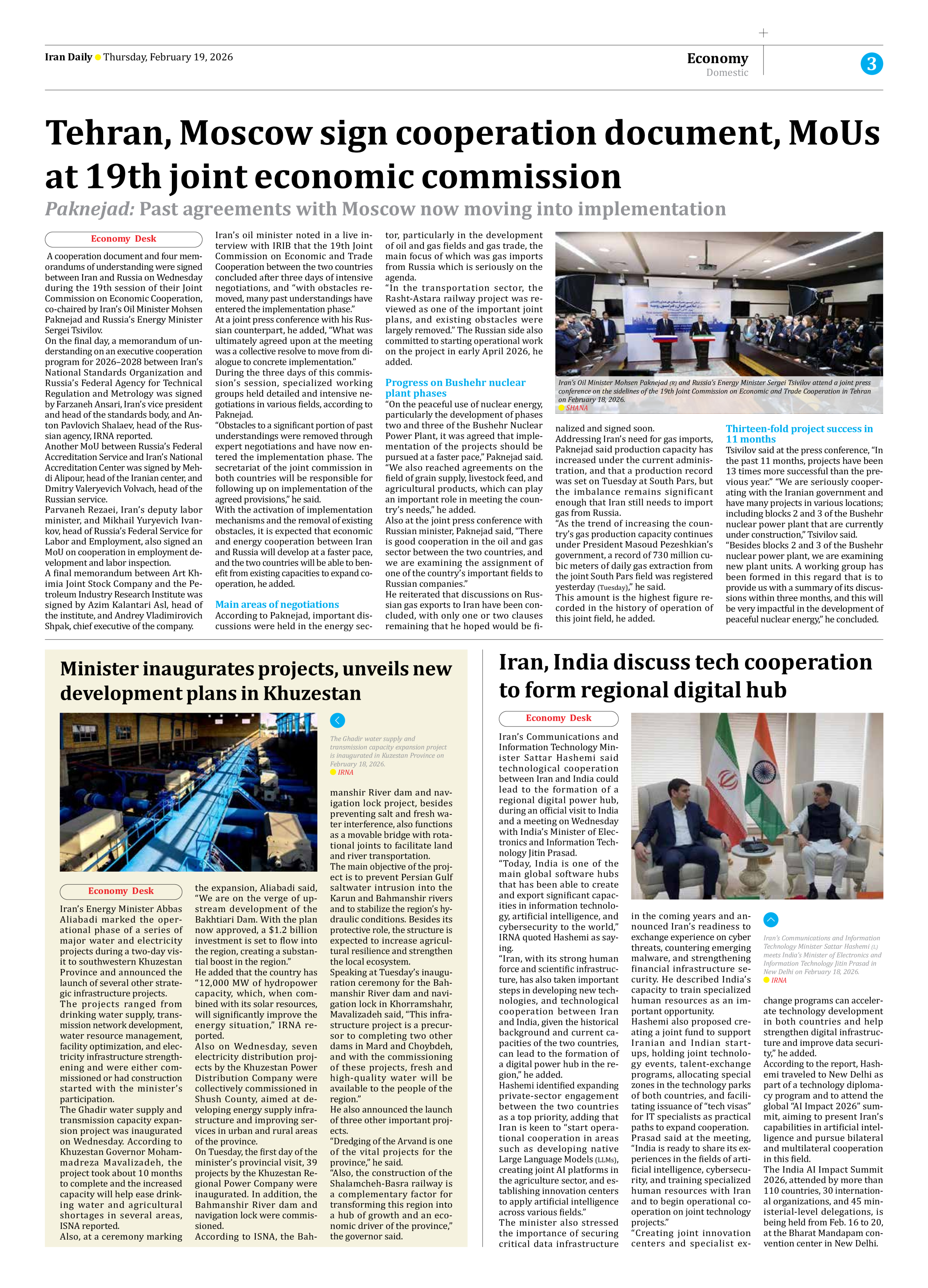
At a joint press conference with his Russian counterpart, he added, “What was ultimately agreed upon at the meeting was a collective resolve to move from dialogue to concrete implementation.”
During the three days of this commission’s session, specialized working groups held detailed and intensive negotiations in various fields, according to Paknejad.
“Obstacles to a significant portion of past understandings were removed through expert negotiations and have now entered the implementation phase. The secretariat of the joint commission in both countries will be responsible for following up on implementation of the agreed provisions,” he said.
With the activation of implementation mechanisms and the removal of existing obstacles, it is expected that economic and energy cooperation between Iran and Russia will develop at a faster pace, and the two countries will be able to benefit from existing capacities to expand cooperation, he added.
Main areas of negotiations
According to Paknejad, important discussions were held in the energy sector, particularly in the development of oil and gas fields and gas trade, the main focus of which was gas imports from Russia which is seriously on the agenda.
“In the transportation sector, the Rasht-Astara railway project was reviewed as one of the important joint plans, and existing obstacles were largely removed.” The Russian side also committed to starting operational work on the project in early April 2026, he added.
Progress on Bushehr nuclear plant phases
“On the peaceful use of nuclear energy, particularly the development of phases two and three of the Bushehr Nuclear Power Plant, it was agreed that implementation of the projects should be pursued at a faster pace,” Paknejad said.
“We also reached agreements on the field of grain supply, livestock feed, and agricultural products, which can play an important role in meeting the country’s needs,” he added.
Also at the joint press conference with Russian minister, Paknejad said, “There is good cooperation in the oil and gas sector between the two countries, and we are examining the assignment of one of the country’s important fields to Russian companies.”
He reiterated that discussions on Russian gas exports to Iran have been concluded, with only one or two clauses remaining that he hoped would be finalized and signed soon.
Addressing Iran’s need for gas imports, Paknejad said production capacity has increased under the current administration, and that a production record was set on Tuesday at South Pars, but the imbalance remains significant enough that Iran still needs to import gas from Russia.
“As the trend of increasing the country’s gas production capacity continues under President Masoud Pezeshkian’s government, a record of 730 million cubic meters of daily gas extraction from the joint South Pars field was registered yesterday (Tuesday),” he said.
This amount is the highest figure recorded in the history of operation of this joint field, he added.
Thirteen-fold project success in 11 months
Tsivilov said at the press conference, “In the past 11 months, projects have been 13 times more successful than the previous year.” “We are seriously cooperating with the Iranian government and have many projects in various locations; including blocks 2 and 3 of the Bushehr nuclear power plant that are currently under construction,” Tsivilov said.
“Besides blocks 2 and 3 of the Bushehr nuclear power plant, we are examining new plant units. A working group has been formed in this regard that is to provide us with a summary of its discussions within three months, and this will be very impactful in the development of peaceful nuclear energy,” he concluded.