





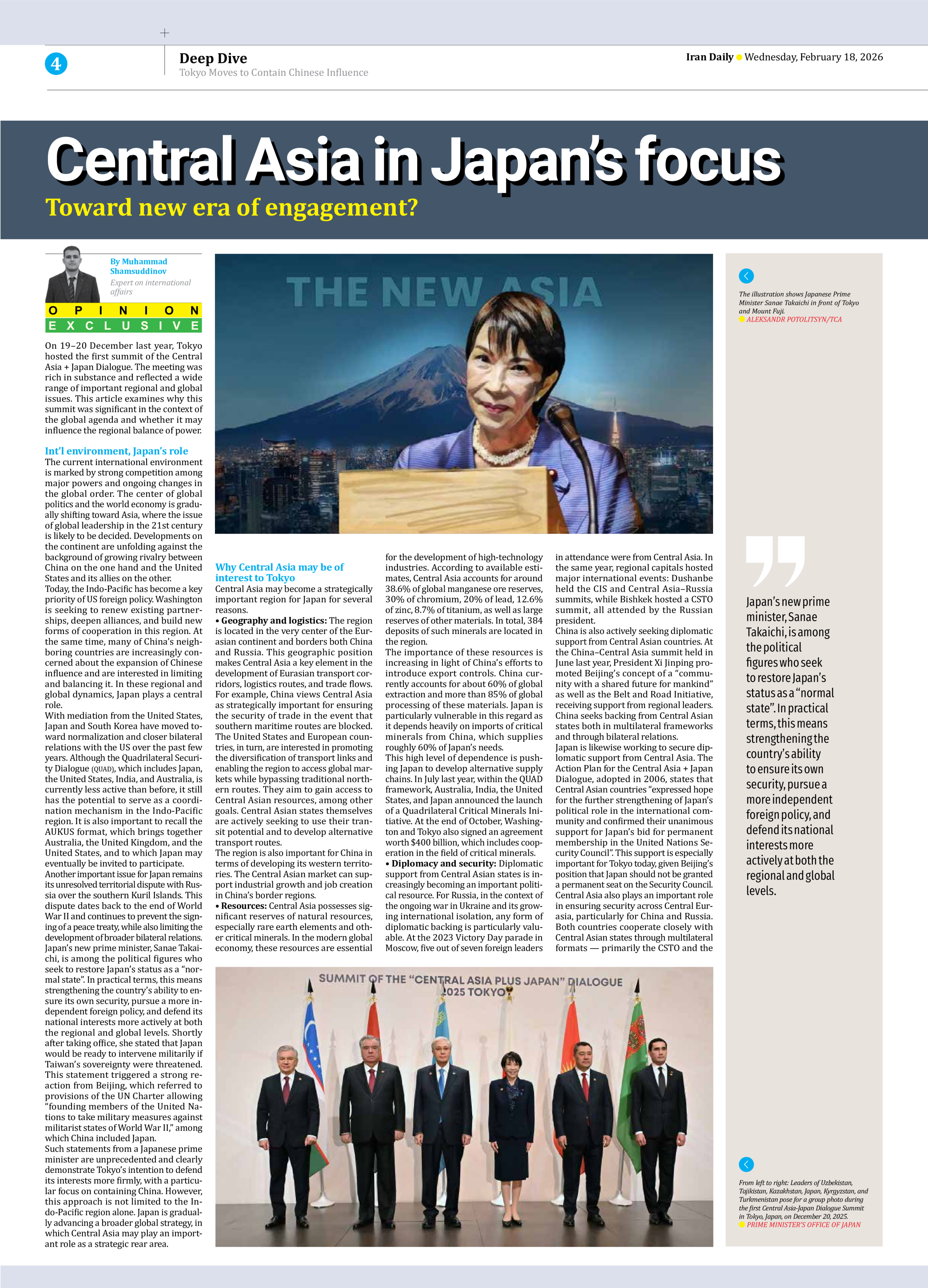


Central Asia in Japan’s focus
Toward new era of engagement?
By Muhammad Shamsuddinov
Expert on international affairs
On 19–20 December last year, Tokyo hosted the first summit of the Central Asia + Japan Dialogue. The meeting was rich in substance and reflected a wide range of important regional and global issues. This article examines why this summit was significant in the context of the global agenda and whether it may influence the regional balance of power.
Int’l environment, Japan’s role
The current international environment is marked by strong competition among major powers and ongoing changes in the global order. The center of global politics and the world economy is gradually shifting toward Asia, where the issue of global leadership in the 21st century is likely to be decided. Developments on the continent are unfolding against the background of growing rivalry between China on the one hand and the United States and its allies on the other.
Today, the Indo-Pacific has become a key priority of US foreign policy. Washington is seeking to renew existing partnerships, deepen alliances, and build new forms of cooperation in this region. At the same time, many of China’s neighboring countries are increasingly concerned about the expansion of Chinese influence and are interested in limiting and balancing it. In these regional and global dynamics, Japan plays a central role.
With mediation from the United States, Japan and South Korea have moved toward normalization and closer bilateral relations with the US over the past few years. Although the Quadrilateral Security Dialogue (QUAD), which includes Japan, the United States, India, and Australia, is currently less active than before, it still has the potential to serve as a coordination mechanism in the Indo-Pacific region. It is also important to recall the AUKUS format, which brings together Australia, the United Kingdom, and the United States, and to which Japan may eventually be invited to participate.
Another important issue for Japan remains its unresolved territorial dispute with Russia over the southern Kuril Islands. This dispute dates back to the end of World War II and continues to prevent the signing of a peace treaty, while also limiting the development of broader bilateral relations.
Japan’s new prime minister, Sanae Takaichi, is among the political figures who seek to restore Japan’s status as a “normal state”. In practical terms, this means strengthening the country’s ability to ensure its own security, pursue a more independent foreign policy, and defend its national interests more actively at both the regional and global levels. Shortly after taking office, she stated that Japan would be ready to intervene militarily if Taiwan’s sovereignty were threatened. This statement triggered a strong reaction from Beijing, which referred to provisions of the UN Charter allowing “founding members of the United Nations to take military measures against militarist states of World War II,” among which China included Japan.
Such statements from a Japanese prime minister are unprecedented and clearly demonstrate Tokyo’s intention to defend its interests more firmly, with a particular focus on containing China. However, this approach is not limited to the Indo-Pacific region alone. Japan is gradually advancing a broader global strategy, in which Central Asia may play an important role as a strategic rear area.
Why Central Asia may be of interest to Tokyo
Central Asia may become a strategically important region for Japan for several reasons.
• Geography and logistics: The region is located in the very center of the Eurasian continent and borders both China and Russia. This geographic position makes Central Asia a key element in the development of Eurasian transport corridors, logistics routes, and trade flows. For example, China views Central Asia as strategically important for ensuring the security of trade in the event that southern maritime routes are blocked. The United States and European countries, in turn, are interested in promoting the diversification of transport links and enabling the region to access global markets while bypassing traditional northern routes. They aim to gain access to Central Asian resources, among other goals. Central Asian states themselves are actively seeking to use their transit potential and to develop alternative transport routes.
The region is also important for China in terms of developing its western territories. The Central Asian market can support industrial growth and job creation in China’s border regions.
• Resources: Central Asia possesses significant reserves of natural resources, especially rare earth elements and other critical minerals. In the modern global economy, these resources are essential for the development of high-technology industries. According to available estimates, Central Asia accounts for around 38.6% of global manganese ore reserves, 30% of chromium, 20% of lead, 12.6% of zinc, 8.7% of titanium, as well as large reserves of other materials. In total, 384 deposits of such minerals are located in the region.
The importance of these resources is increasing in light of China’s efforts to introduce export controls. China currently accounts for about 60% of global extraction and more than 85% of global processing of these materials. Japan is particularly vulnerable in this regard as it depends heavily on imports of critical minerals from China, which supplies roughly 60% of Japan’s needs.
This high level of dependence is pushing Japan to develop alternative supply chains. In July last year, within the QUAD framework, Australia, India, the United States, and Japan announced the launch of a Quadrilateral Critical Minerals Initiative. At the end of October, Washington and Tokyo also signed an agreement worth $400 billion, which includes cooperation in the field of critical minerals.
• Diplomacy and security: Diplomatic support from Central Asian states is increasingly becoming an important political resource. For Russia, in the context of the ongoing war in Ukraine and its growing international isolation, any form of diplomatic backing is particularly valuable. At the 2023 Victory Day parade in Moscow, five out of seven foreign leaders in attendance were from Central Asia. In the same year, regional capitals hosted major international events: Dushanbe held the CIS and Central Asia–Russia summits, while Bishkek hosted a CSTO summit, all attended by the Russian president.
China is also actively seeking diplomatic support from Central Asian countries. At the China–Central Asia summit held in June last year, President Xi Jinping promoted Beijing’s concept of a “community with a shared future for mankind” as well as the Belt and Road Initiative, receiving support from regional leaders. China seeks backing from Central Asian states both in multilateral frameworks and through bilateral relations.
Japan is likewise working to secure diplomatic support from Central Asia. The Action Plan for the Central Asia + Japan Dialogue, adopted in 2006, states that Central Asian countries “expressed hope for the further strengthening of Japan’s political role in the international community and confirmed their unanimous support for Japan’s bid for permanent membership in the United Nations Security Council”. This support is especially important for Tokyo today, given Beijing’s position that Japan should not be granted a permanent seat on the Security Council.
Central Asia also plays an important role in ensuring security across Central Eurasia, particularly for China and Russia. Both countries cooperate closely with Central Asian states through multilateral formats — primarily the CSTO and the SCO — as well as through bilateral mechanisms. Attacks on Chinese enterprises in late November and early December last year highlighted how closely China’s security is linked to stability in Central Asia, as well as the broader global implications of instability in the region.
Central Asian states themselves are interested in security cooperation. The aforementioned Action Plan notes Japan’s readiness to contribute to stability in the region, particularly along the Tajik-Afghan border. In 2023, Japan introduced a new security assistance framework known as Official Security Assistance (OSA). Although Central Asian countries are not yet included in this program, expanding it to cover the region may become relevant in the future.
Japan’s areas of comparative advantage (case of Tajikistan)
Japan’s strategy in Central Asia initially focused on preventing excessive dependence of the region on its larger neighbors, while identifying areas where Japan could realistically compete. Geographic distance and the economic conditions of Central Asia — including a weak investment climate and low income levels — limited the development of strong trade and economic ties with Tokyo.
At the same time, the region faced numerous socio-economic and political challenges following the collapse of the Soviet Union, and required support for comprehensive development and long-term stability. Japan chose to focus on this area, where it could offer a competitive advantage. Tokyo began providing financial assistance, technical support, and expertise to Central Asian countries in areas such as combating transnational crime, healthcare, environmental protection and disaster prevention, water management, energy, trade and investment, transport and logistics, and poverty reduction.
To advance its regional objectives, Japan adopted the Silk Road Diplomacy strategy in 1997 and launched the Central Asia + Japan Dialogue in 2004. Japan has mainly implemented its regional policy through Official Development Assistance (ODA), administered by the Japan International Cooperation Agency (JICA).
In Tajikistan, JICA’s project portfolio over the first 30 years of its activities (1993–2023) included 49 projects with a total value exceeding $427.4 million. Of this amount, $97.2 million was allocated to technical assistance and $330.2 million to grant aid.
One of JICA’s key programs involves training Tajik civil servants in Japan to improve their professional qualifications. Each year, JICA provides 15 scholarships for Tajik officials to pursue master’s or doctoral degrees, as well as training courses for around 100 participants. More than 2,500 specialists have already completed training in Japan and currently hold positions within the Tajik government.
JICA also implements projects in Tajikistan in areas such as infrastructure development, healthcare, cross-border cooperation, poverty reduction, and agriculture. Its project portfolio includes the modernization of Dushanbe International Airport; improvements to road maintenance equipment in Sughd Region and eastern Khatlon Region; projects aimed at improving living standards in Tajik-Afghan border areas (jointly with UNDP); rural development projects in the Tajik-Afghan border zone of the Gorno-Badakhshan Autonomous Region; the Food Security Project for Vulnerable Farmers (2KR); and projects providing specialized medical equipment for the control of infectious diseases (EPI), implemented in two phases.
Summit outcomes: new Japanese approach?
Before drawing conclusions from the summit, it is important to consider the broader context. Today, Central Asian states are interested not only in receiving development assistance but also in attracting investment and advanced technologies across different sectors of their economies, as well as in building full-scale economic partnerships. Governments in the region are promoting initiatives in digitalization, artificial intelligence, green energy, infrastructure modernization, and transport connectivity.
Central Asian countries are also seeking to diversify their foreign relations and attract new sources of support. From this perspective, Japan — one of the world’s leading innovative economies with significant financial and technological resources — is an attractive partner. It is within this framework that the first Central Asia + Japan summit should be understood.
Japan, for its part, is increasingly viewing Central Asia through a geopolitical and geo-economic lens. During the summit, Prime Minister Takaichi stated that the region has strategic importance and strong potential in geopolitics, economic security, and business cooperation.
Under the Tokyo Declaration adopted after the summit, Central Asian states expressed support for strengthening Japan’s role in global affairs, for the denuclearization of the Korean Peninsula, and for reform of the UN Security Council, where Japan seeks permanent membership.
Prime Minister Takaichi also announced Japan’s intention to invest approximately $20 billion over the next five years to support private-sector projects in Central Asia. She highlighted the development and diversification of rare earth supply chains, deeper cooperation in artificial intelligence, and the expansion of key transport corridors such as the Trans-Caspian International Transport Route.
Central Asian leaders also expressed interest in cooperation in priority areas. Kazakhstan’s President Kassym-Jomart Tokayev emphasized his country’s readiness to create favorable conditions for Japanese investors and identified nuclear energy, green energy, rare earth metals, logistics, and digital technologies as promising sectors. Supporting Japan’s initiatives in artificial intelligence, he proposed hosting a regional platform at the Astana Hub technopark and the Alem.ai International Center. Overall, more than 60 bilateral documents worth over $3.7 billion were signed during his visit.
Uzbekistan’s President Shavkat Mirziyoyev called for expanding the presence of Japanese investors in the region. He proposed creating an investment fund for infrastructure and industrial development in Central Asia, as well as establishing a regional network of Japanese technoparks to support industrial cooperation and technology transfer. He also suggested creating a Central Asia–Japan digital hub for cooperation in artificial intelligence, cybersecurity, and digital solutions, and invited Japan to participate in major transport projects, including high-speed railways, highways, airports, and digital transport corridors.
The leaders of Turkmenistan, Kyrgyzstan, and Tajikistan also expressed interest in cooperation in key areas, including energy, transport, the green economy, artificial intelligence, and human capital development. As for the broader impact of the summit and Japan’s attempt to shape a new regional agenda, it is too early to draw firm conclusions. Similar initiatives in Central Asia often do not lead to significant changes in the regional balance of power and remain largely declarative. Japan will also face strong competition from established regional actors. Whether Tokyo will be able to compete effectively remains an open question, and for now, cautious assessments appear more appropriate.
Overall, more than 150 documents involving both public and private sectors were signed following the summit. Moreover, the Tokyo Initiative CA+JAD (Central Asia + Japan Advanced Dialogue) was launched, and the Tokyo Declaration was adopted.
In conclusion, several key points can be highlighted:
1. Against the background of global changes driven largely by China’s rising power, Japan is reassessing its international role, with the containment of Chinese influence becoming a central concern for Tokyo.
2. Within this strategy, Central Asia — due to its geographic location, resource base, and growing diplomatic importance — may serve as a strategic rear area for Japan.
3. For Central Asian states, increased Japanese interest is also beneficial as it supports diversification of foreign relations and access to additional resources.
4. For more than 30 years, Japan has pursued a soft power approach in Central Asia, focusing on socio-economic and political development. Today, however, Tokyo appears to be moving toward a more active policy aimed at strengthening its geo-economic and geopolitical position in the region.
5. At the same time, it is still too early to speak of a full shift in Japan’s regional policy. It remains to be seen whether current expectations of a “new era” of relations will translate into concrete results or remain largely rhetorical.