







Saffron export destinations top 70: Union leader
By Sadeq Dehqan
Staff writer
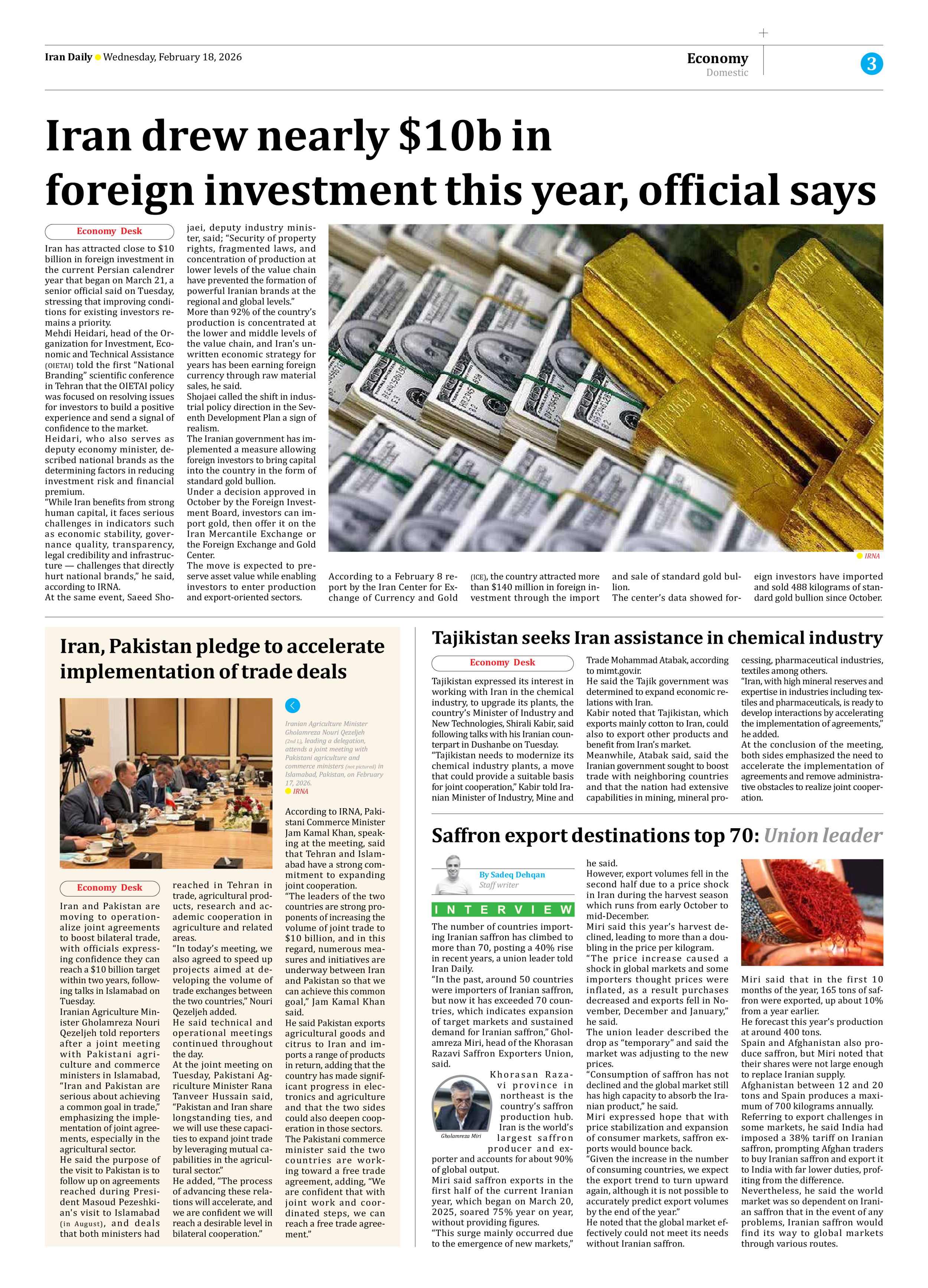
The number of countries importing Iranian saffron has climbed to more than 70, posting a 40% rise in recent years, a union leader told Iran Daily.
“In the past, around 50 countries were importers of Iranian saffron, but now it has exceeded 70 countries, which indicates expansion of target markets and sustained demand for Iranian saffron,” Gholamreza Miri, head of the Khorasan Razavi Saffron Exporters Union, said.
Khorasan Razavi province in northeast is the country’s saffron production hub. Iran is the world’s largest saffron producer and exporter and accounts for about 90% of global output.
Miri said saffron exports in the first half of the current Iranian year, which began on March 20, 2025, soared 75% year on year, without providing figures.
“This surge mainly occurred due to the emergence of new markets,” he said.
However, export volumes fell in the second half due to a price shock in Iran during the harvest season which runs from early October to mid-December.
Miri said this year’s harvest declined, leading to more than a doubling in the price per kilogram.
“The price increase caused a shock in global markets and some importers thought prices were inflated, as a result purchases decreased and exports fell in November, December and January,” he said.
The union leader described the drop as “temporary” and said the market was adjusting to the new prices.
“Consumption of saffron has not declined and the global market still has high capacity to absorb the Iranian product,” he said.
Miri expressed hope that with price stabilization and expansion of consumer markets, saffron exports would bounce back.
“Given the increase in the number of consuming countries, we expect the export trend to turn upward again, although it is not possible to accurately predict export volumes by the end of the year.”
He noted that the global market effectively could not meet its needs without Iranian saffron.
Miri said that in the first 10 months of the year, 165 tons of saffron were exported, up about 10% from a year earlier.
He forecast this year’s production at around 400 tons.
Spain and Afghanistan also produce saffron, but Miri noted that their shares were not large enough to replace Iranian supply.
Afghanistan between 12 and 20 tons and Spain produces a maximum of 700 kilograms annually.
Referring to export challenges in some markets, he said India had imposed a 38% tariff on Iranian saffron, prompting Afghan traders to buy Iranian saffron and export it to India with far lower duties, profiting from the difference.
Nevertheless, he said the world market was so dependent on Iranian saffron that in the event of any problems, Iranian saffron would find its way to global markets through various routes.