







Copy in clipboard...
Iran, US agree on ‘guiding principles’ to advance talks: Araghchi
Oman says Geneva meeting concluded with ‘tangible progress’
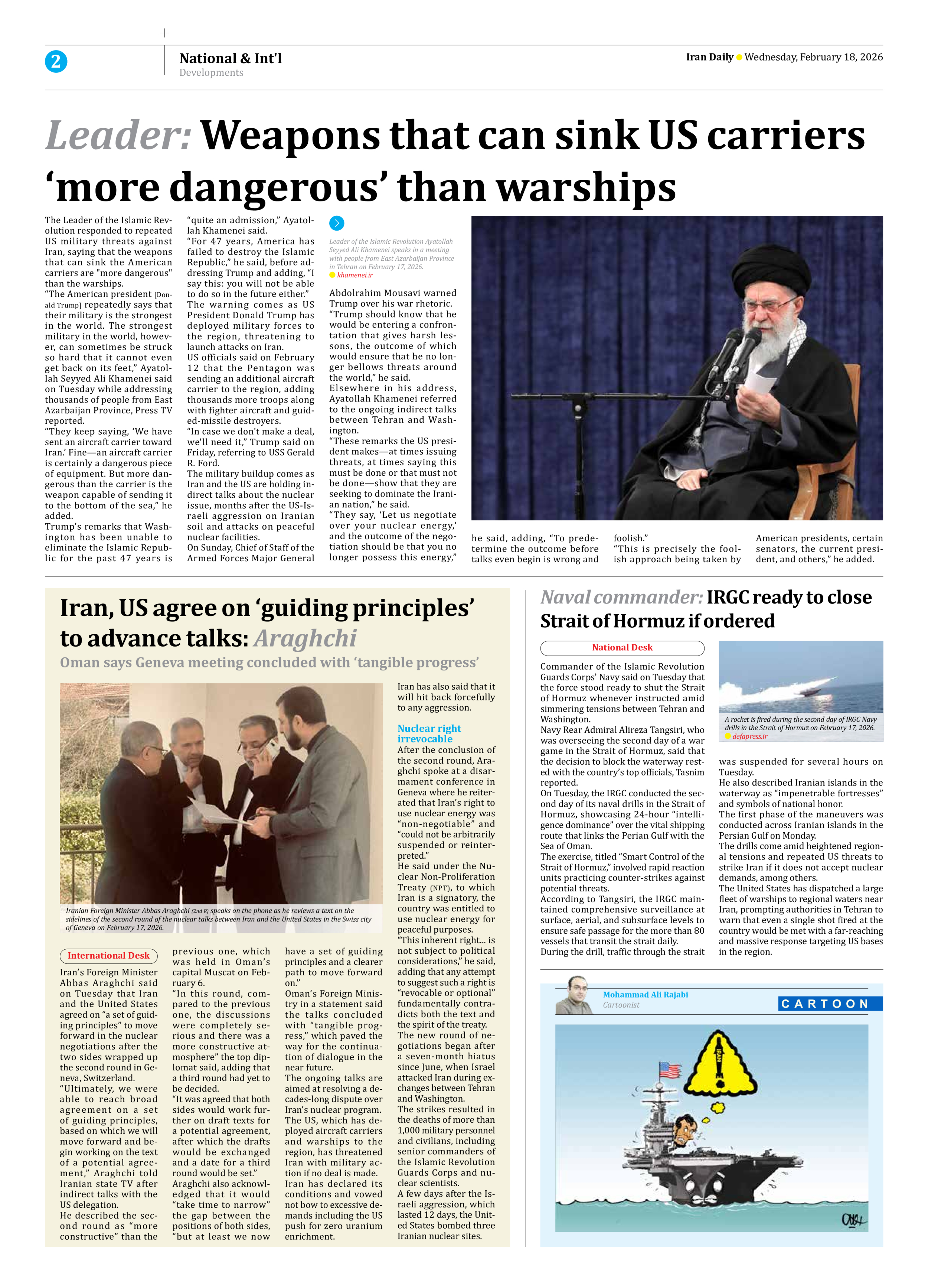
“Ultimately, we were able to reach broad agreement on a set of guiding principles, based on which we will move forward and begin working on the text of a potential agreement,” Araghchi told Iranian state TV after indirect talks with the US delegation.
He described the second round as “more constructive” than the previous one, which was held in Oman’s capital Muscat on February 6.
“In this round, compared to the previous one, the discussions were completely serious and there was a more constructive atmosphere” the top diplomat said, adding that a third round had yet to be decided.
“It was agreed that both sides would work further on draft texts for a potential agreement, after which the drafts would be exchanged and a date for a third round would be set.”
Araghchi also acknowledged that it would “take time to narrow” the gap between the positions of both sides, “but at least we now have a set of guiding principles and a clearer path to move forward on.”
Oman’s Foreign Ministry in a statement said the talks concluded with “tangible progress,” which paved the way for the continuation of dialogue in the near future.
The ongoing talks are aimed at resolving a decades-long dispute over Iran’s nuclear program.
The US, which has deployed aircraft carriers and warships to the region, has threatened Iran with military action if no deal is made.
Iran has declared its conditions and vowed not bow to excessive demands including the US push for zero uranium enrichment.
Iran has also said that it will hit back forcefully to any aggression.
Nuclear right irrevocable
After the conclusion of the second round, Araghchi spoke at a disarmament conference in Geneva where he reiterated that Iran’s right to use nuclear energy was “non-negotiable” and “could not be arbitrarily suspended or reinterpreted.”
He said under the Nuclear Non-Proliferation Treaty (NPT), to which Iran is a signatory, the country was entitled to use nuclear energy for peaceful purposes.
“This inherent right... is not subject to political considerations,” he said, adding that any attempt to suggest such a right is “revocable or optional” fundamentally contradicts both the text and the spirit of the treaty.
The new round of negotiations began after a seven-month hiatus since June, when Israel attacked Iran during exchanges between Tehran and Washington.
The strikes resulted in the deaths of more than 1,000 military personnel and civilians, including senior commanders of the Islamic Revolution Guards Corps and nuclear scientists.
A few days after the Israeli aggression, which lasted 12 days, the United States bombed three Iranian nuclear sites.