





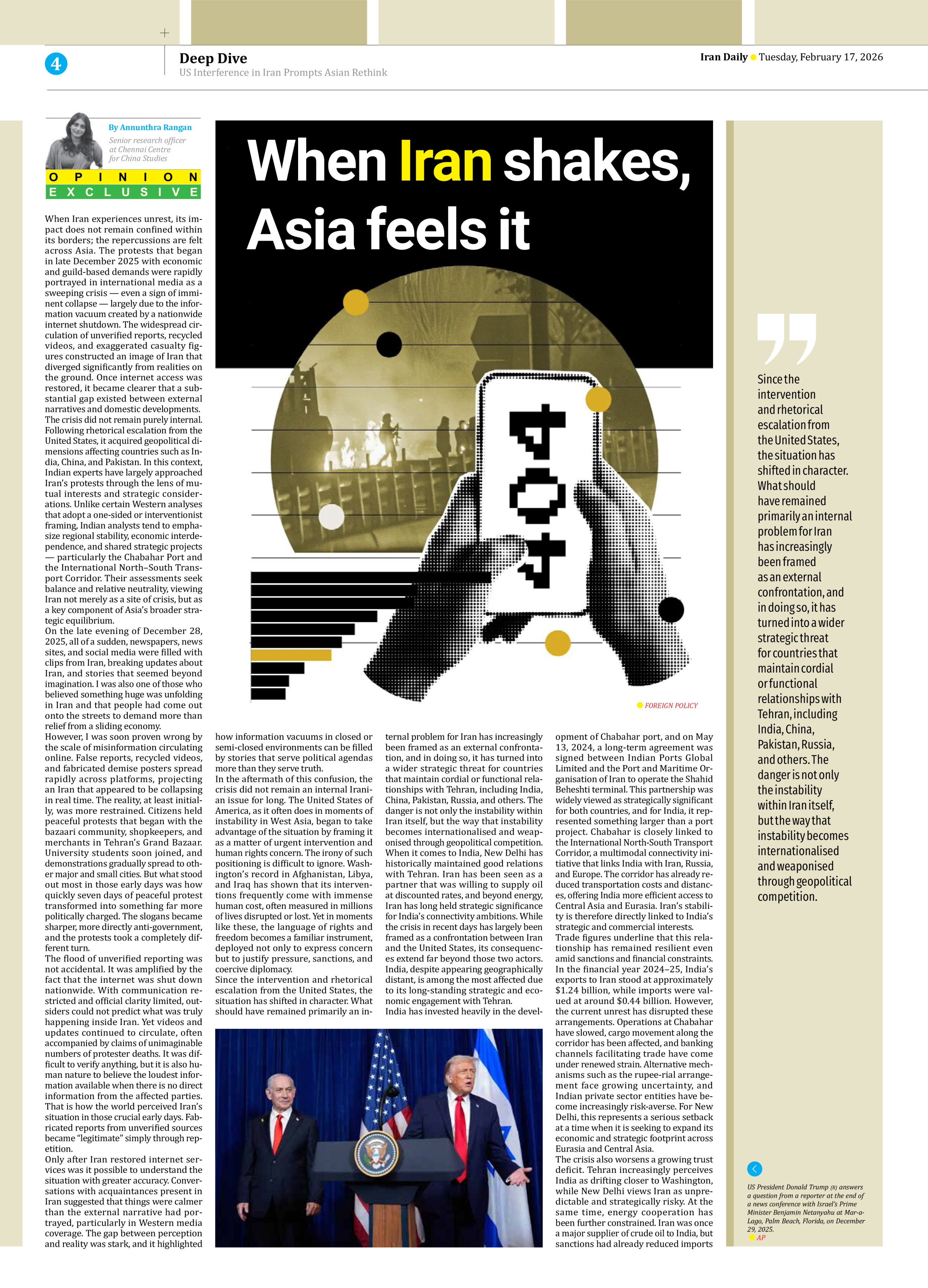


When Iran shakes, Asia feels it
By Annunthra Rangan
Senior research officer
at Chennai Centre
for China Studies
When Iran experiences unrest, its impact does not remain confined within its borders; the repercussions are felt across Asia. The protests that began in late December 2025 with economic and guild-based demands were rapidly portrayed in international media as a sweeping crisis — even a sign of imminent collapse — largely due to the information vacuum created by a nationwide internet shutdown. The widespread circulation of unverified reports, recycled videos, and exaggerated casualty figures constructed an image of Iran that diverged significantly from realities on the ground. Once internet access was restored, it became clearer that a substantial gap existed between external narratives and domestic developments.
The crisis did not remain purely internal. Following rhetorical escalation from the United States, it acquired geopolitical dimensions affecting countries such as India, China, and Pakistan. In this context, Indian experts have largely approached Iran’s protests through the lens of mutual interests and strategic considerations. Unlike certain Western analyses that adopt a one-sided or interventionist framing, Indian analysts tend to emphasize regional stability, economic interdependence, and shared strategic projects — particularly the Chabahar Port and the International North–South Transport Corridor. Their assessments seek balance and relative neutrality, viewing Iran not merely as a site of crisis, but as a key component of Asia’s broader strategic equilibrium.
On the late evening of December 28, 2025, all of a sudden, newspapers, news sites, and social media were filled with clips from Iran, breaking updates about Iran, and stories that seemed beyond imagination. I was also one of those who believed something huge was unfolding in Iran and that people had come out onto the streets to demand more than relief from a sliding economy.
However, I was soon proven wrong by the scale of misinformation circulating online. False reports, recycled videos, and fabricated demise posters spread rapidly across platforms, projecting an Iran that appeared to be collapsing in real time. The reality, at least initially, was more restrained. Citizens held peaceful protests that began with the bazaari community, shopkeepers, and merchants in Tehran’s Grand Bazaar. University students soon joined, and demonstrations gradually spread to other major and small cities. But what stood out most in those early days was how quickly seven days of peaceful protest transformed into something far more politically charged. The slogans became sharper, more directly anti-government, and the protests took a completely different turn.
The flood of unverified reporting was not accidental. It was amplified by the fact that the internet was shut down nationwide. With communication restricted and official clarity limited, outsiders could not predict what was truly happening inside Iran. Yet videos and updates continued to circulate, often accompanied by claims of unimaginable numbers of protester deaths. It was difficult to verify anything, but it is also human nature to believe the loudest information available when there is no direct information from the affected parties. That is how the world perceived Iran’s situation in those crucial early days. Fabricated reports from unverified sources became “legitimate” simply through repetition.
Only after Iran restored internet services was it possible to understand the situation with greater accuracy. Conversations with acquaintances present in Iran suggested that things were calmer than the external narrative had portrayed, particularly in Western media coverage. The gap between perception and reality was stark, and it highlighted how information vacuums in closed or semi-closed environments can be filled by stories that serve political agendas more than they serve truth.
In the aftermath of this confusion, the crisis did not remain an internal Iranian issue for long. The United States of America, as it often does in moments of instability in West Asia, began to take advantage of the situation by framing it as a matter of urgent intervention and human rights concern. The irony of such positioning is difficult to ignore. Washington’s record in Afghanistan, Libya, and Iraq has shown that its interventions frequently come with immense human cost, often measured in millions of lives disrupted or lost. Yet in moments like these, the language of rights and freedom becomes a familiar instrument, deployed not only to express concern but to justify pressure, sanctions, and coercive diplomacy.
Since the intervention and rhetorical escalation from the United States, the situation has shifted in character. What should have remained primarily an internal problem for Iran has increasingly been framed as an external confrontation, and in doing so, it has turned into a wider strategic threat for countries that maintain cordial or functional relationships with Tehran, including India, China, Pakistan, Russia, and others. The danger is not only the instability within Iran itself, but the way that instability becomes internationalised and weaponised through geopolitical competition.
When it comes to India, New Delhi has historically maintained good relations with Tehran. Iran has been seen as a partner that was willing to supply oil at discounted rates, and beyond energy, Iran has long held strategic significance for India’s connectivity ambitions. While the crisis in recent days has largely been framed as a confrontation between Iran and the United States, its consequences extend far beyond those two actors. India, despite appearing geographically distant, is among the most affected due to its long-standing strategic and economic engagement with Tehran.
India has invested heavily in the development of Chabahar port, and on May 13, 2024, a long-term agreement was signed between Indian Ports Global Limited and the Port and Maritime Organisation of Iran to operate the Shahid Beheshti terminal. This partnership was widely viewed as strategically significant for both countries, and for India, it represented something larger than a port project. Chabahar is closely linked to the International North-South Transport Corridor, a multimodal connectivity initiative that links India with Iran, Russia, and Europe. The corridor has already reduced transportation costs and distances, offering India more efficient access to Central Asia and Eurasia. Iran’s stability is therefore directly linked to India’s strategic and commercial interests.
Trade figures underline that this relationship has remained resilient even amid sanctions and financial constraints. In the financial year 2024–25, India’s exports to Iran stood at approximately $1.24 billion, while imports were valued at around $0.44 billion. However, the current unrest has disrupted these arrangements. Operations at Chabahar have slowed, cargo movement along the corridor has been affected, and banking channels facilitating trade have come under renewed strain. Alternative mechanisms such as the rupee-rial arrangement face growing uncertainty, and Indian private sector entities have become increasingly risk-averse. For New Delhi, this represents a serious setback at a time when it is seeking to expand its economic and strategic footprint across Eurasia and Central Asia.
The crisis also worsens a growing trust deficit. Tehran increasingly perceives India as drifting closer to Washington, while New Delhi views Iran as unpredictable and strategically risky. At the same time, energy cooperation has been further constrained. Iran was once a major supplier of crude oil to India, but sanctions had already reduced imports well before the current unrest. The escalation effectively closes the door on any near-term revival of energy ties.
One of the most consequential yet understated outcomes of the crisis is China’s expanding role in Iran. Beijing and Tehran are bound by a 25-year strategic partnership covering energy, infrastructure, and security cooperation. Unlike India and Western actors, China has demonstrated a willingness to absorb sanctions-related risks in pursuit of long-term strategic gains. As Iran becomes increasingly isolated, it is likely to lean more heavily on China for economic and diplomatic support. In the event of war or prolonged instability, this dependency will only deepen, marginalising India’s influence and altering the balance of power in the region.
It is important, however, to understand the nature of China’s posture in this unfolding crisis. Beijing’s stand has been particularly striking for its restraint. Given China’s history of involvement in West Asian affairs and its desire to expand its regional footprint, its limited response has disappointed some observers. Official statements from Chinese leaders have been cautious. Foreign Ministry spokesperson Mao Ning called on Iran’s government and people to overcome difficulties and maintain stability, while Foreign Minister Wang Yi condemned American threats as a return to the law of the jungle and offered China as a constructive mediator. Beyond rhetoric, however, Beijing has taken no decisive action.
This restraint reflects China’s broader strategic calculus. Beijing’s economic and diplomatic investments in Gulf states far outweigh those in Iran. With relatively limited stakes and few viable tools to shape outcomes, a wait-and-see approach aligns with China’s interests. The current crisis is largely beyond Beijing’s control, and China’s global partners appear to recognise this.
China’s credibility as a responsible global actor has not been significantly damaged by its inaction. Analysts have noted that Beijing never positioned itself as Iran’s security guarantor or as an anti-Western crusader. Instead, it seeks to function as an alternative partner within a global system from which it also derives enormous benefit. Its diplomacy aims to expand influence while managing rivalry, not to overturn the existing order outright.
Economically, Iran occupies a middling position in China’s overseas portfolio. Projects such as the Qom-Yiwu rail freight corridor have symbolic importance but do not place Iran among Beijing’s top development financing recipients. The two countries also maintain a security partnership that includes intelligence sharing, joint exercises, and coordination on counterterrorism. China has supplied Iran with various military and dual-use technologies in exchange for discounted energy, infrastructure access, and diplomatic alignment.
The limits of this partnership were evident in June 2025, when US strikes targeted Iranian nuclear facilities. China’s response was confined to diplomatic condemnation and calls for dialogue. No material support followed. This episode highlighted the fundamentally opportunistic nature of the relationship. China benefits from Iran’s isolation but is unwilling to incur serious costs on its behalf.
Even a disruption in Iranian oil exports would be manageable for China, which has ample reserves and alternative suppliers. The loss of a consistently anti-American partner would be inconvenient but not catastrophic. The deeper concern for Beijing would be symbolic.
While there are no signs of comparable unrest within China, its leaders are unlikely to take chances. Increased surveillance, tighter information controls, and a heightened security presence would be the predictable response. Iran is not existential for China. Domestic stability is.
Now that the important covers are discussed, it is also crucial to understand how Pakistan is one of the most affected parties in this crisis. With Pakistan’s disputed border with Afghanistan already tense and prone to frequent clashes, officials have warned that Pakistan cannot afford its border with Iran to become volatile as well. Although not all of this is due purely to the current protests, Pakistan’s border trade with Iran has been disrupted in previous regional tensions, hurting border economies. Local communities rely on cross-border commerce, and closures or stricter controls disrupt livelihoods. Wider instability in West Asia, not limited to Iran alone, tends to raise global oil prices, which puts pressure on Pakistan’s balance of payments and inflation, especially given its reliance on imported energy.
At the same time, the crisis has revived questions about the US-Pakistan relationship, which has improved significantly in Trump’s second term. With Trump continuing to threaten Iran with attacks, a key concern is whether the United States could seek access to Pakistan’s airspace or military bases in the event of a strike. Such a demand would place Pakistan in a difficult position. Denying the request would risk annoying Trump and jeopardising the recent improvement in bilateral relations. Accepting it, however, would risk alienating Pakistan’s Shia population and the Islamic world more broadly. Pakistan has around 20% Shia Muslims who sympathise with Tehran, and Iran is a Shia-majority state. There is a serious concern that a US attack on Iran, combined with pressure on Pakistan to facilitate such an attack, could foment unrest within Pakistan itself. Officials fear that any attack on Iran or a regime-change scenario could trigger widespread protests across Pakistan and create additional pressure along the Pakistan-Iran border due to a potential inflow of refugees.
Ultimately, Iran’s unrest must be viewed within the broader West Asian context. Rising Iran-US tensions heighten Israel’s security concerns, particularly regarding Iran-backed groups in the region and Iran’s military capabilities. Persian Gulf states are watching cautiously, wary of being drawn into a wider confrontation while simultaneously fearing disruptions to energy markets and maritime security. The regional order remains fragile, shaped by unresolved conflicts and shifting alliances. A military conflict involving Iran would not remain confined within its borders. It would disrupt shipping lanes, destabilise oil markets, and force regional actors to recalibrate alliances, fundamentally reshaping West Asia’s strategic landscape.