







Iran, Russia open economic meeting; final deals due Wednesday
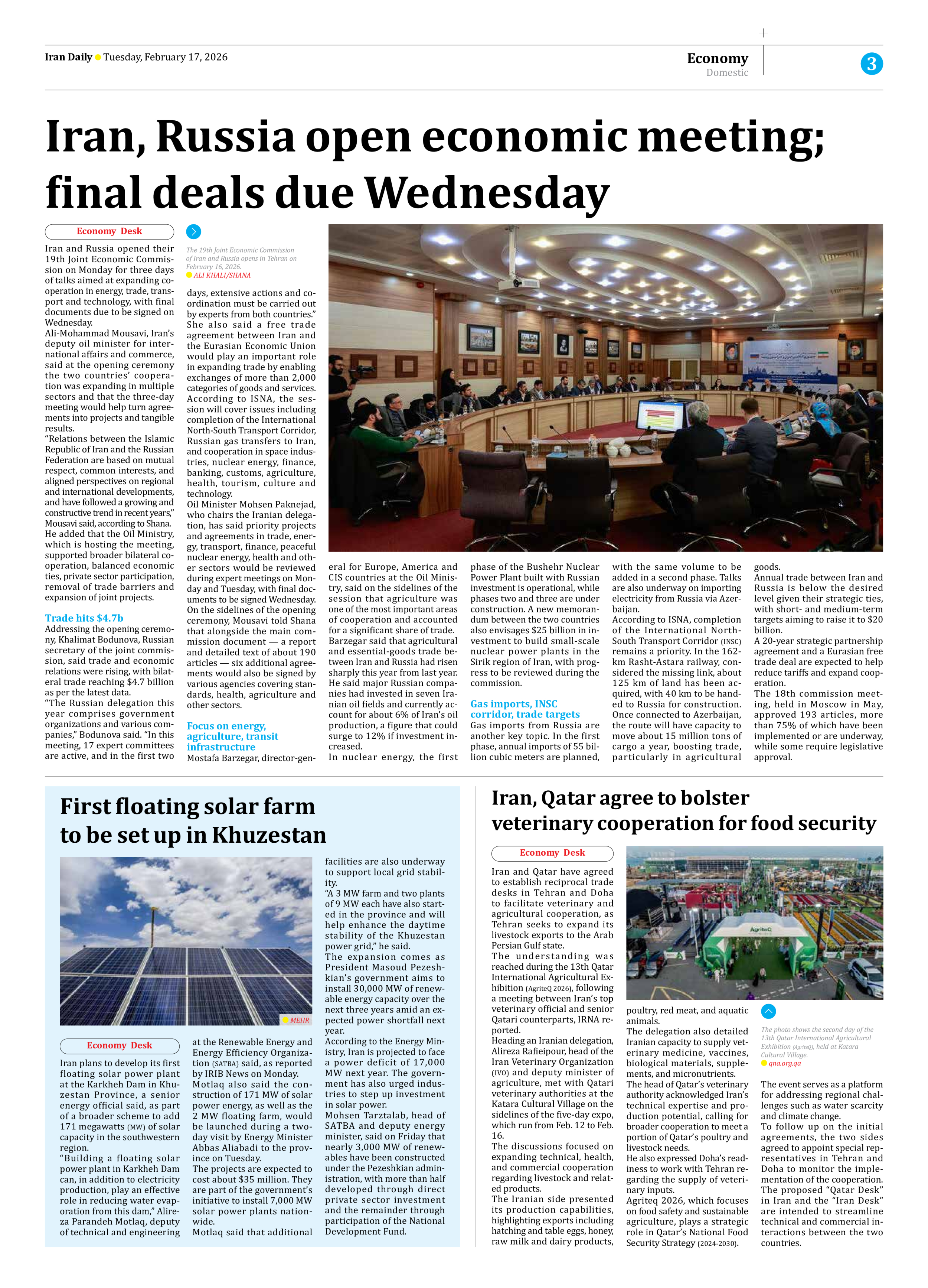
Iran and Russia opened their 19th Joint Economic Commission on Monday for three days of talks aimed at expanding cooperation in energy, trade, transport and technology, with final documents due to be signed on Wednesday.
Ali-Mohammad Mousavi, Iran’s deputy oil minister for international affairs and commerce, said at the opening ceremony the two countries’ cooperation was expanding in multiple sectors and that the three-day meeting would help turn agreements into projects and tangible results.
“Relations between the Islamic Republic of Iran and the Russian Federation are based on mutual respect, common interests, and aligned perspectives on regional and international developments, and have followed a growing and constructive trend in recent years,” Mousavi said, according to Shana.
He added that the Oil Ministry, which is hosting the meeting, supported broader bilateral cooperation, balanced economic ties, private sector participation, removal of trade barriers and expansion of joint projects.
Trade hits $4.7b
Addressing the opening ceremony, Khalimat Bodunova, Russian secretary of the joint commission, said trade and economic relations were rising, with bilateral trade reaching $4.7 billion as per the latest data.
“The Russian delegation this year comprises government organizations and various companies,” Bodunova said. “In this meeting, 17 expert committees are active, and in the first two days, extensive actions and coordination must be carried out by experts from both countries.”
She also said a free trade agreement between Iran and the Eurasian Economic Union would play an important role in expanding trade by enabling exchanges of more than 2,000 categories of goods and services.
According to ISNA, the session will cover issues including completion of the International North-South Transport Corridor, Russian gas transfers to Iran, and cooperation in space industries, nuclear energy, finance, banking, customs, agriculture, health, tourism, culture and technology.
Oil Minister Mohsen Paknejad, who chairs the Iranian delegation, has said priority projects and agreements in trade, energy, transport, finance, peaceful nuclear energy, health and other sectors would be reviewed during expert meetings on Monday and Tuesday, with final documents to be signed Wednesday.
On the sidelines of the opening ceremony, Mousavi told Shana that alongside the main commission document — a report and detailed text of about 190 articles — six additional agreements would also be signed by various agencies covering standards, health, agriculture and other sectors.
Focus on energy, agriculture, transit infrastructure
Mostafa Barzegar, director-general for Europe, America and CIS countries at the Oil Ministry, said on the sidelines of the session that agriculture was one of the most important areas of cooperation and accounted for a significant share of trade.
Barzegar said that agricultural and essential-goods trade between Iran and Russia had risen sharply this year from last year.
He said major Russian companies had invested in seven Iranian oil fields and currently account for about 6% of Iran’s oil production, a figure that could surge to 12% if investment increased.
In nuclear energy, the first phase of the Bushehr Nuclear Power Plant built with Russian investment is operational, while phases two and three are under construction. A new memorandum between the two countries also envisages $25 billion in investment to build small-scale nuclear power plants in the Sirik region of Iran, with progress to be reviewed during the commission.
Gas imports, INSC corridor, trade targets
Gas imports from Russia are another key topic. In the first phase, annual imports of 55 billion cubic meters are planned, with the same volume to be added in a second phase. Talks are also underway on importing electricity from Russia via Azerbaijan.
According to ISNA, completion of the International North-South Transport Corridor (INSC) remains a priority. In the 162-km Rasht-Astara railway, considered the missing link, about 125 km of land has been acquired, with 40 km to be handed to Russia for construction. Once connected to Azerbaijan, the route will have capacity to move about 15 million tons of cargo a year, boosting trade, particularly in agricultural goods.
Annual trade between Iran and Russia is below the desired level given their strategic ties, with short- and medium-term targets aiming to raise it to $20 billion.
A 20-year strategic partnership agreement and a Eurasian free trade deal are expected to help reduce tariffs and expand cooperation.
The 18th commission meeting, held in Moscow in May, approved 193 articles, more than 75% of which have been implemented or are underway, while some require legislative approval.