







44th Fajr Film Festival
Human portrait of Gen. Soleimani’s formative years in ‘Migration’
By Sadeq Dehqan
Staff writer
The feature film ‘Migration,’ directed by Mohammad Esfandiari and produced by Mehdi Motahar, stood out as one of the more unconventional entries at the 44th Fajr Film Festival. Taking a fresh narrative angle, the film explores the childhood and adolescence of Lieutenant General Qassem Soleimani. As the festival’s sole literary adaptation this year, it won the Crystal Simorgh for Makeup (Soudabeh Khosravi) and Costume Design (Majid Leilaji), and received an Honorary Diploma for Best Adapted Screenplay.
Departing from the conventional, hero-centric biopic template, Migration adopts a grounded, humanistic lens to chart the psychological and moral architecture of a future commander, from early curiosities and hardships to his first encounters with personal and social responsibility. By foregrounding the familial and socio-cultural milieu that shaped general Soleimani, the film offers a rarely depicted portrait of his path toward maturity, making it particularly resonant for audiences drawn to historical cinema and biographical storytelling.
On this occasion, we spoke with Mehdi Motahar, the film’s producer and co-writer, about the project’s genesis, its adaptive strategy, and the production challenges behind the camera.
IRAN DAILY: Could you elaborate on the production trajectory of Migration? As one of your screenplays, it received the Honorary Diploma for Best Adapted Screenplay at the 44th Fajr Film Festival. What drew you to this subject?
MOTAHAR: I studied political science and hold a Ph.D. in history, so employing media as a vehicle to articulate the concerns that emerged from years of academic research felt like a natural progression. I initially worked in documentary filmmaking and became relatively recognized in that arena, then transitioned into short fiction and eventually feature narratives.
The story of the Resistance Front, the life of General Qassem Soleimani, and the martyrs who sacrificed their lives for Iran have long preoccupied me. I had previously directed several key documentaries about Soleimani, including ‘72 Hours,’ which chronicles the final three days of his life.
After a substantial body of documentaries had been produced and much had been said in that format, we decided to pursue the subject through dramatic storytelling. We collaborated with the “Maktab-e Haj Qassem” (School of General Qassem Soleimani) foundation, which is committed to distancing Soleimani’s image from mythologized exaggeration and instead presenting a precise, authentic portrayal. For more than six years following his martyrdom, they had refrained from greenlighting any fictional dramatization, focusing instead on oral histories, memoirs, and documentaries. Notable publications included ‘I Wasn’t Afraid of Anything,’ based on Soleimani’s own handwritten memoirs, and ‘The Rain Has Set In’ by Ahmad Yousefzadeh.
Through our discussions, we realized that ‘The Rain Has Set In’ had strong cinematic potential. Initially, however, the foundation was resistant to a narrative feature. Under the pretext of producing a promotional trailer for the book, we secured a commission, but with the same budget, we produced a short film titled ‘At Thirteen,’ depicting Soleimani’s childhood and adolescence. The short was screened at the Tehran International Short Film Festival and the International Resistance Film Festival, and its reception ultimately persuaded the commissioning body to back a feature-length project in the same vein. In effect, that short opened the door for adapting the book into a full-scale feature.
You collaborated with Mohammad Esfandiari, a first-time feature director. Given his debut status, how confident were you about the project’s success?
In documentaries, shorts, and previous features, I’ve consistently preferred working with first-time directors. They tend to bring compressed energy and bold conceptual instincts to the table. Their relative inexperience can be offset by surrounding them with seasoned department heads, particularly in makeup, production design, and the assistant directing team.
I had previously collaborated with Mr. Esfandiari on ‘At Thirteen,’ so there was already creative synergy. We also made a strategic decision to channel the budget into production value, set construction, makeup, costume design, and technical departments, rather than into marquee actors. That investment paid off, as evidenced by our Crystal Simorgh wins in Makeup and Costume Design.
Regarding the screenplay, we remained faithful to the source material. Although we were not initially shortlisted in the screenplay category, the festival secretariat chose to recognize us with an Honorary Diploma, both to encourage adaptation and because we were the only adapted work in the competition.
Why did you choose to focus on Soleimani’s childhood and adolescence? What made that period cinematically compelling?
Had we chosen to dramatize the final chapter of the general’s life, there were undoubtedly filmmakers better positioned to mount a large-scale war epic. Such productions require considerable resources, and with a debut director, our team represented a risk for the commissioning body.
Instead, we gravitated toward a chapter of his life that few had attempted to depict, his formative years, which he himself repeatedly emphasized as pivotal. This period, shaped by rural life, tribal migration, and the central role of family, was instrumental in forging his character.
For me, entering a hero’s narrative at the point of formation is far more dramaturgically sound than starting at the apex of their heroism. It allows audiences to witness the gradual accretion of values and convictions.
What elements from his early life contributed to the making of a great commander?
Childhood is foundational to character formation. One must examine the family structure in which a figure was raised, the hardships endured, the friendships formed, the economic conditions navigated. A person acquainted with hardship can better empathize with the suffering of others.
From an early age, general Qassem Soleimani was in a state of striving and discovery. As the title ‘Migration’ suggests, he was perpetually in motion, migrating for livelihood, for deeper understanding, and ultimately for transformation.
The concept of migration in the film operates on both literal and philosophical planes. He moved from village to city to work and repay his father’s debts; later, he returned to uplift his village; then he migrated to defend his country, and eventually to confront Daesh terrorist group and the United States. Nearly every chapter of his life is marked by a form of exodus, physical, moral, or ideological.
How did you ensure the character remained believable and avoid hagiographic exaggeration?
That principle was embedded both in the narrative structure and in the ethos of the School of General Qassem Soleimani foundation. We foregrounded the realist dimensions of his personality in the screenplay. The source text, ‘The Rain Has Set In,’ did not portray an invulnerable hero, and we maintained that tonal register.
Our objective was to demonstrate that if General Soleimani rose to such prominence, he emerged from an entirely ordinary family with modest economic means. The underlying message is one of accessibility and hope, that anyone, even from the most remote corners of Iran, can ascend to positions of responsibility and serve their people.
As the film’s producer, how did you approach location scouting and the reconstruction of his birthplace and migratory lifestyle?
Much of Soleimani’s childhood and adolescence unfolded in rural settings shaped by seasonal migration. The film spans roughly 15 to 16 years of his early life, requiring us to reconstruct multiple timeframes across the 1960s and 1970s.
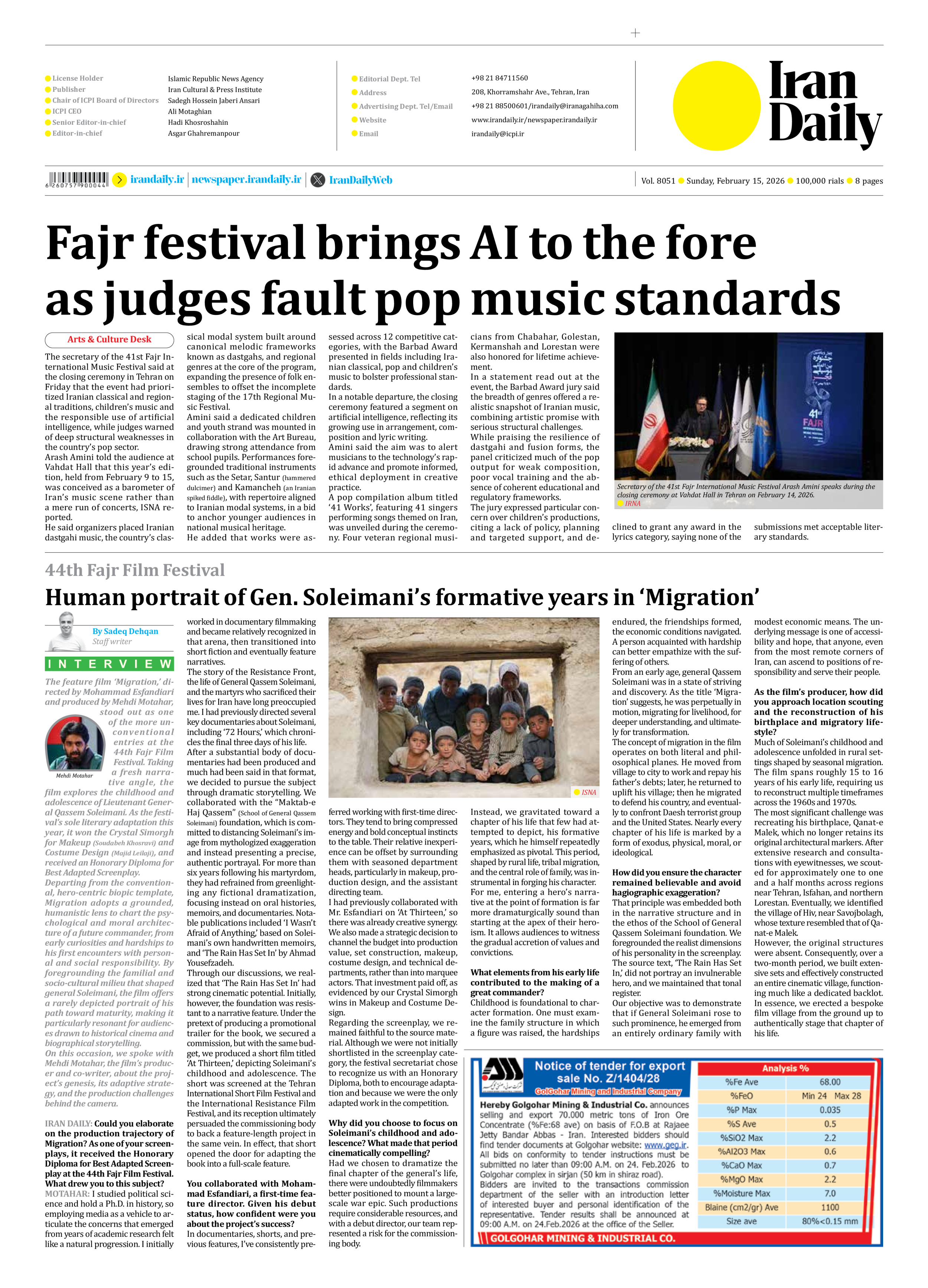
The most significant challenge was recreating his birthplace, Qanat-e Malek, which no longer retains its original architectural markers. After extensive research and consultations with eyewitnesses, we scouted for approximately one to one and a half months across regions near Tehran, Isfahan, and northern Lorestan. Eventually, we identified the village of Hiv, near Savojbolagh, whose texture resembled that of Qanat-e Malek.
However, the original structures were absent. Consequently, over a two-month period, we built extensive sets and effectively constructed an entire cinematic village, functioning much like a dedicated backlot. In essence, we erected a bespoke film village from the ground up to authentically stage that chapter of his life.