







Sangan Mosque preserves faith, heritage in Khorasan Razavi
Khorasan Razavi Province, located in northeastern Iran, has long been one of the country’s most important centers of civilization, culture, and spirituality. For centuries, this region stood at the crossroads of major trade routes, welcoming caravans, scholars, and travelers, and in doing so, it played a vital role in shaping Iran’s historical and cultural identity. Within this ancient landscape lies the city of Khaf and its surrounding settlements, including Sangan—an area marked by both the harsh realities of nature and the enduring achievements of human creativity.
At the heart of Sangan’s historic urban fabric stands the Sangan Grand Mosque, a monument that embodies the deep connection between faith, architecture, and collective memory in eastern Iran. More than a place of worship, the mosque represents centuries of architectural knowledge, spiritual devotion, and communal life. Its survival through earthquakes, environmental challenges, and historical transformations highlights not only the technical mastery of its builders but also the cultural and religious importance it has held for generations of the people of Khorasan.
The Sangan Grand Mosque is not merely a refuge for worshippers, but a mirror reflecting the Iranian spirit — a building whose every brick and arch speaks of an ancient era, of a faith intertwined with art, and of architects who sought the secret of endurance in order, balance, and brickwork.
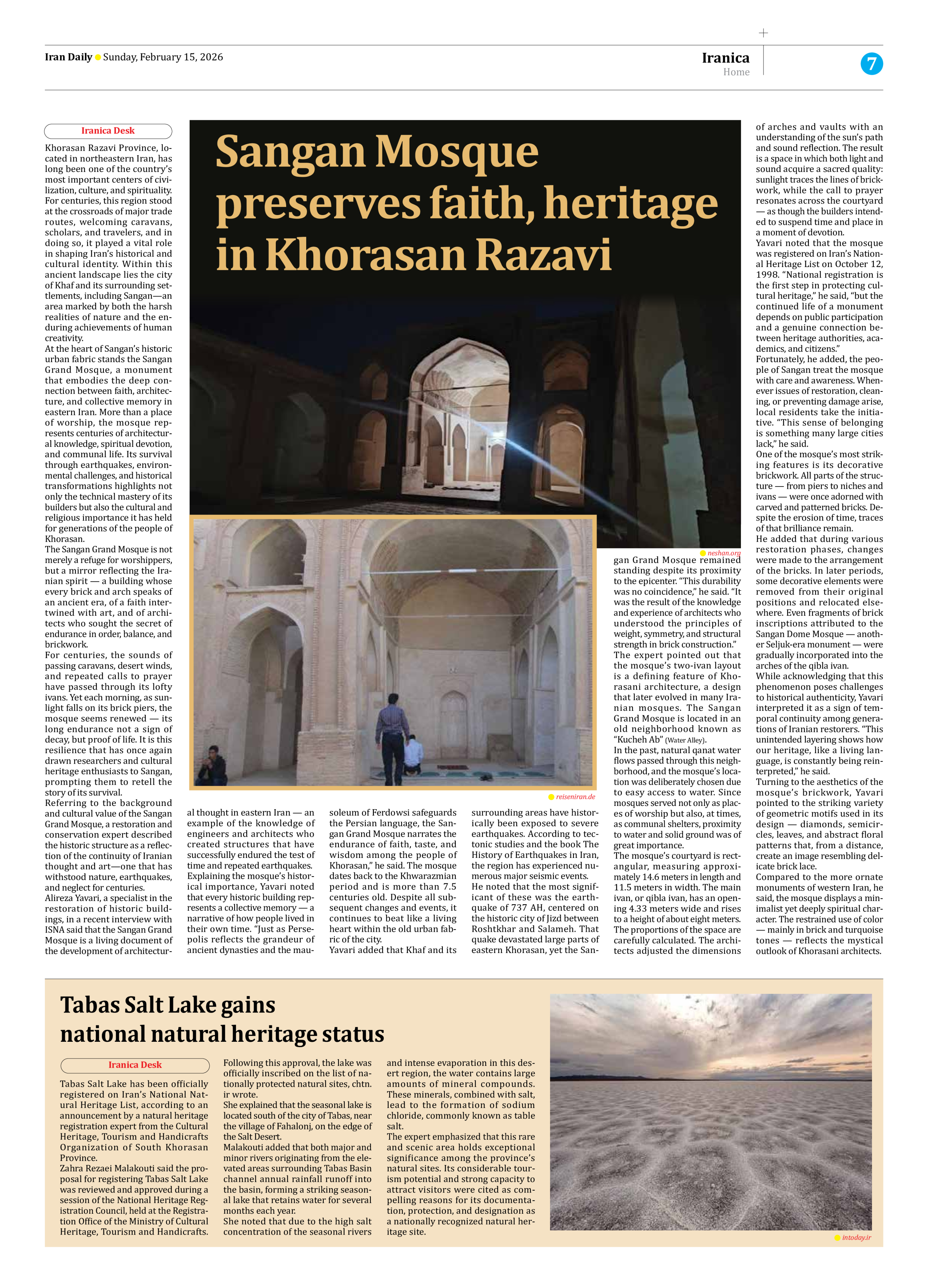
For centuries, the sounds of passing caravans, desert winds, and repeated calls to prayer have passed through its lofty ivans. Yet each morning, as sunlight falls on its brick piers, the mosque seems renewed — its long endurance not a sign of decay, but proof of life. It is this resilience that has once again drawn researchers and cultural heritage enthusiasts to Sangan, prompting them to retell the story of its survival.
Referring to the background and cultural value of the Sangan Grand Mosque, a restoration and conservation expert described the historic structure as a reflection of the continuity of Iranian thought and art—one that has withstood nature, earthquakes, and neglect for centuries.
Alireza Yavari, a specialist in the restoration of historic buildings, in a recent interview with ISNA said that the Sangan Grand Mosque is a living document of the development of architectural thought in eastern Iran — an example of the knowledge of engineers and architects who created structures that have successfully endured the test of time and repeated earthquakes.
Explaining the mosque’s historical importance, Yavari noted that every historic building represents a collective memory — a narrative of how people lived in their own time. “Just as Persepolis reflects the grandeur of ancient dynasties and the mausoleum of Ferdowsi safeguards the Persian language, the Sangan Grand Mosque narrates the endurance of faith, taste, and wisdom among the people of Khorasan,” he said. The mosque dates back to the Khwarazmian period and is more than 7.5 centuries old. Despite all subsequent changes and events, it continues to beat like a living heart within the old urban fabric of the city.
Yavari added that Khaf and its surrounding areas have historically been exposed to severe earthquakes. According to tectonic studies and the book The History of Earthquakes in Iran, the region has experienced numerous major seismic events.
He noted that the most significant of these was the earthquake of 737 AH, centered on the historic city of Jizd between Roshtkhar and Salameh. That quake devastated large parts of eastern Khorasan, yet the Sangan Grand Mosque remained standing despite its proximity to the epicenter. “This durability was no coincidence,” he said. “It was the result of the knowledge and experience of architects who understood the principles of weight, symmetry, and structural strength in brick construction.”
The expert pointed out that the mosque’s two-ivan layout is a defining feature of Khorasani architecture, a design that later evolved in many Iranian mosques. The Sangan Grand Mosque is located in an old neighborhood known as “Kucheh Ab” (Water Alley).
In the past, natural qanat water flows passed through this neighborhood, and the mosque’s location was deliberately chosen due to easy access to water. Since mosques served not only as places of worship but also, at times, as communal shelters, proximity to water and solid ground was of great importance.
The mosque’s courtyard is rectangular, measuring approximately 14.6 meters in length and 11.5 meters in width. The main ivan, or qibla ivan, has an opening 4.33 meters wide and rises to a height of about eight meters.
The proportions of the space are carefully calculated. The architects adjusted the dimensions of arches and vaults with an understanding of the sun’s path and sound reflection. The result is a space in which both light and sound acquire a sacred quality: sunlight traces the lines of brickwork, while the call to prayer resonates across the courtyard — as though the builders intended to suspend time and place in a moment of devotion.
Yavari noted that the mosque was registered on Iran’s National Heritage List on October 12, 1998. “National registration is the first step in protecting cultural heritage,” he said, “but the continued life of a monument depends on public participation and a genuine connection between heritage authorities, academics, and citizens.”
Fortunately, he added, the people of Sangan treat the mosque with care and awareness. Whenever issues of restoration, cleaning, or preventing damage arise, local residents take the initiative. “This sense of belonging is something many large cities lack,” he said.
One of the mosque’s most striking features is its decorative brickwork. All parts of the structure — from piers to niches and ivans — were once adorned with carved and patterned bricks. Despite the erosion of time, traces of that brilliance remain.
He added that during various restoration phases, changes were made to the arrangement of the bricks. In later periods, some decorative elements were removed from their original positions and relocated elsewhere. Even fragments of brick inscriptions attributed to the Sangan Dome Mosque — another Seljuk-era monument — were gradually incorporated into the arches of the qibla ivan.
While acknowledging that this phenomenon poses challenges to historical authenticity, Yavari interpreted it as a sign of temporal continuity among generations of Iranian restorers. “This unintended layering shows how our heritage, like a living language, is constantly being reinterpreted,” he said.
Turning to the aesthetics of the mosque’s brickwork, Yavari pointed to the striking variety of geometric motifs used in its design — diamonds, semicircles, leaves, and abstract floral patterns that, from a distance, create an image resembling delicate brick lace.
Compared to the more ornate monuments of western Iran, he said, the mosque displays a minimalist yet deeply spiritual character. The restrained use of color — mainly in brick and turquoise tones — reflects the mystical outlook of Khorasani architects.