







Seven agreements signed to advance national rail, road corridor infrastructure
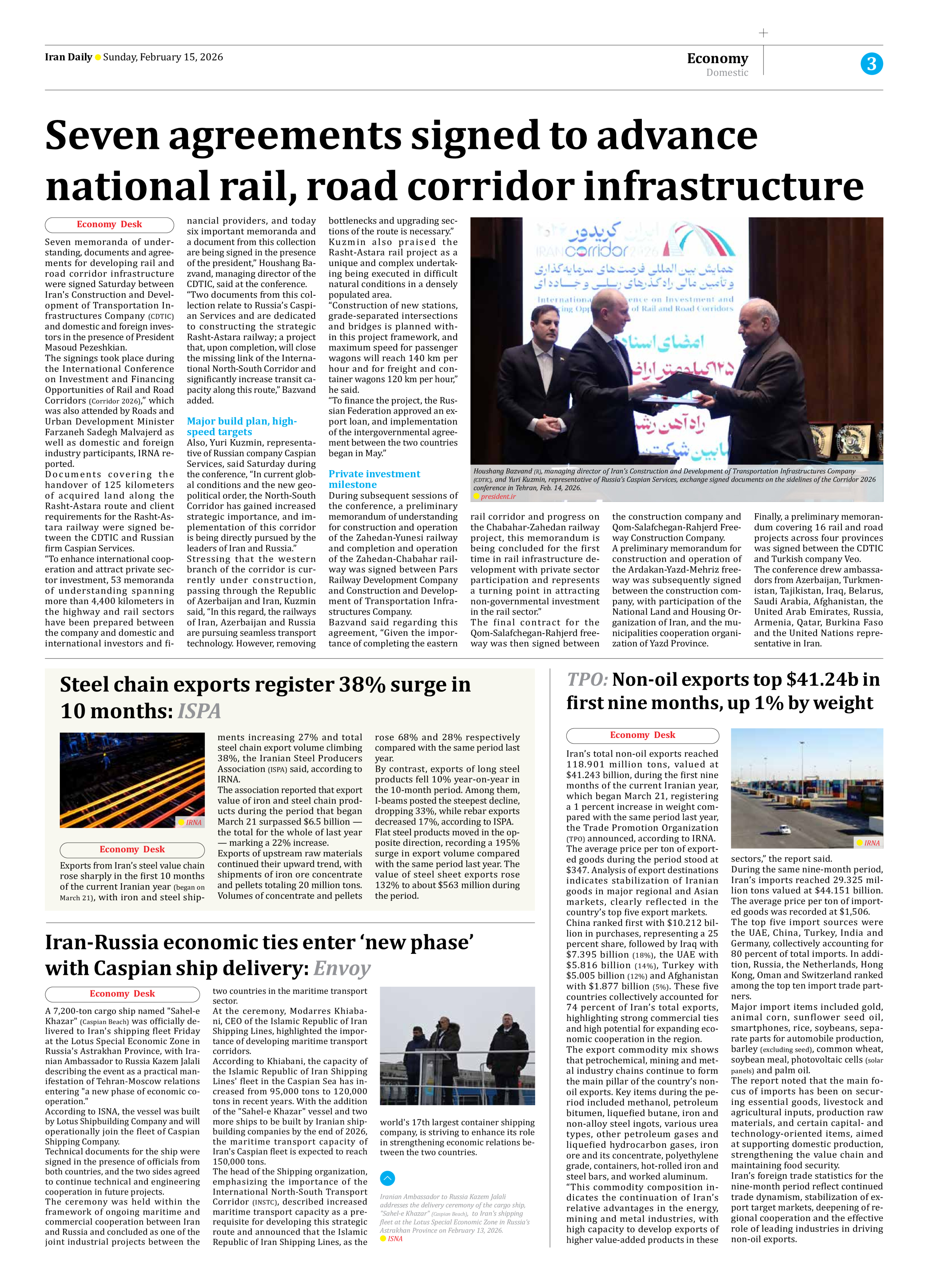
Seven memoranda of understanding, documents and agreements for developing rail and road corridor infrastructure were signed Saturday between Iran's Construction and Development of Transportation Infrastructures Company (CDTIC) and domestic and foreign investors in the presence of President Masoud Pezeshkian.
The signings took place during the International Conference on Investment and Financing Opportunities of Rail and Road Corridors (Corridor 2026),” which was also attended by Roads and Urban Development Minister Farzaneh Sadegh Malvajerd as well as domestic and foreign industry participants, IRNA reported.
Documents covering the handover of 125 kilometers of acquired land along the Rasht-Astara route and client requirements for the Rasht-Astara railway were signed between the CDTIC and Russian firm Caspian Services.
“To enhance international cooperation and attract private sector investment, 53 memoranda of understanding spanning more than 4,400 kilometers in the highway and rail sectors have been prepared between the company and domestic and international investors and financial providers, and today six important memoranda and a document from this collection are being signed in the presence of the president,” Houshang Bazvand, managing director of the CDTIC, said at the conference.
“Two documents from this collection relate to Russia’s Caspian Services and are dedicated to constructing the strategic Rasht-Astara railway; a project that, upon completion, will close the missing link of the International North-South Corridor and significantly increase transit capacity along this route,” Bazvand added.
Major build plan, high-speed targets
Also, Yuri Kuzmin, representative of Russian company Caspian Services, said Saturday during the conference, “In current global conditions and the new geopolitical order, the North-South Corridor has gained increased strategic importance, and implementation of this corridor is being directly pursued by the leaders of Iran and Russia.”
Stressing that the western branch of the corridor is currently under construction, passing through the Republic of Azerbaijan and Iran, Kuzmin said, “In this regard, the railways of Iran, Azerbaijan and Russia are pursuing seamless transport technology. However, removing bottlenecks and upgrading sections of the route is necessary.”
Kuzmin also praised the Rasht-Astara rail project as a unique and complex undertaking being executed in difficult natural conditions in a densely populated area.
“Construction of new stations, grade-separated intersections and bridges is planned within this project framework, and maximum speed for passenger wagons will reach 140 km per hour and for freight and container wagons 120 km per hour,” he said.
“To finance the project, the Russian Federation approved an export loan, and implementation of the intergovernmental agreement between the two countries began in May.”
Private investment milestone
During subsequent sessions of the conference, a preliminary memorandum of understanding for construction and operation of the Zahedan-Yunesi railway and completion and operation of the Zahedan-Chabahar railway was signed between Pars Railway Development Company and Construction and Development of Transportation Infrastructures Company.
Bazvand said regarding this agreement, “Given the importance of completing the eastern rail corridor and progress on the Chabahar-Zahedan railway project, this memorandum is being concluded for the first time in rail infrastructure development with private sector participation and represents a turning point in attracting non-governmental investment in the rail sector.”
The final contract for the Qom-Salafchegan-Rahjerd freeway was then signed between the construction company and Qom-Salafchegan-Rahjerd Freeway Construction Company.
A preliminary memorandum for construction and operation of the Ardakan-Yazd-Mehriz freeway was subsequently signed between the construction company, with participation of the National Land and Housing Organization of Iran, and the municipalities cooperation organization of Yazd Province.
Finally, a preliminary memorandum covering 16 rail and road projects across four provinces was signed between the CDTIC and Turkish company Veo.
The conference drew ambassadors from Azerbaijan, Turkmenistan, Tajikistan, Iraq, Belarus, Saudi Arabia, Afghanistan, the United Arab Emirates, Russia, Armenia, Qatar, Burkina Faso and the United Nations representative in Iran.