







Handicrafts value chain to be bolstered via gov’t-drafted comprehensive policy
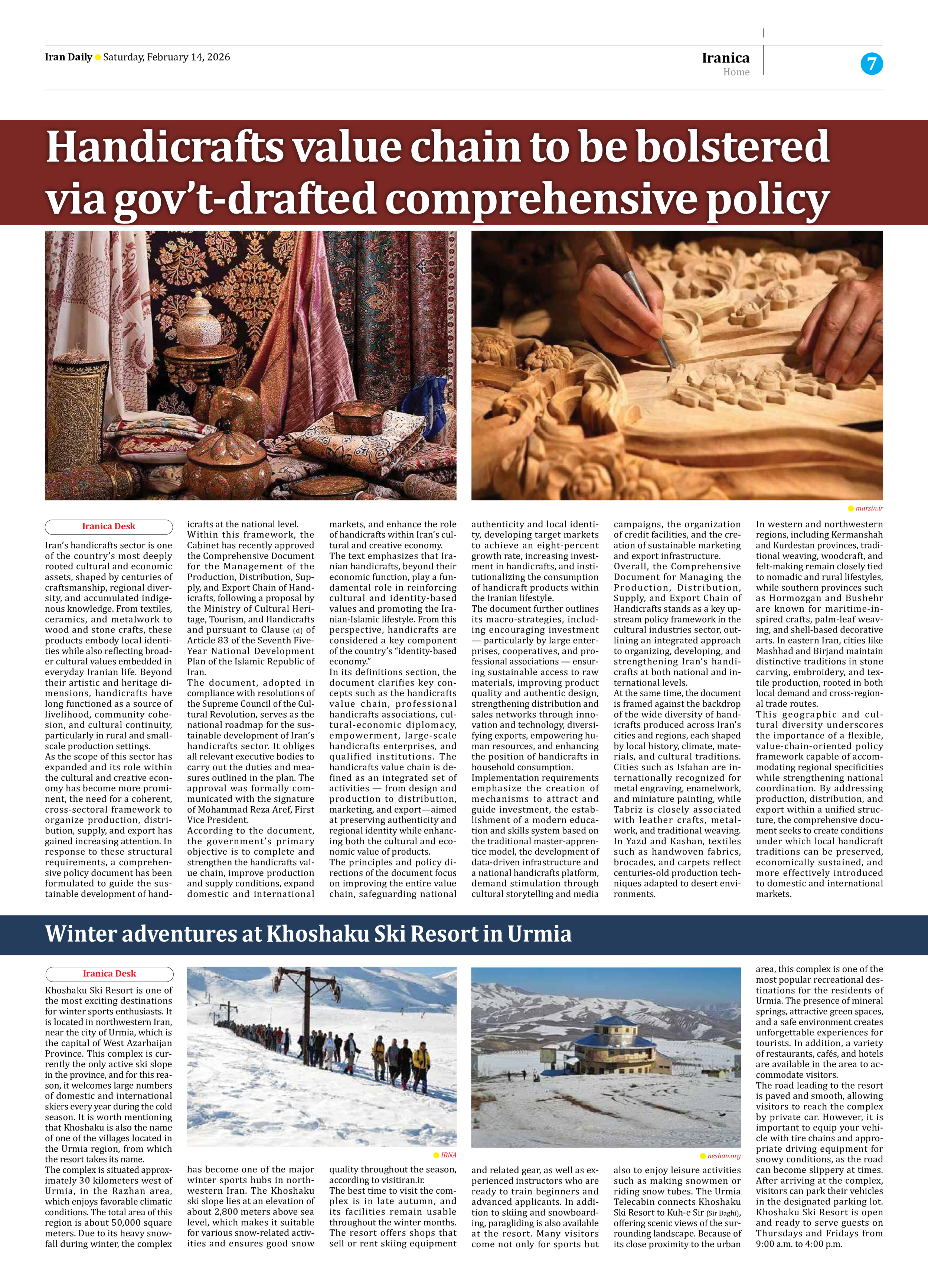
Iran’s handicrafts sector is one of the country’s most deeply rooted cultural and economic assets, shaped by centuries of craftsmanship, regional diversity, and accumulated indigenous knowledge. From textiles, ceramics, and metalwork to wood and stone crafts, these products embody local identities while also reflecting broader cultural values embedded in everyday Iranian life. Beyond their artistic and heritage dimensions, handicrafts have long functioned as a source of livelihood, community cohesion, and cultural continuity, particularly in rural and small-scale production settings.
As the scope of this sector has expanded and its role within the cultural and creative economy has become more prominent, the need for a coherent, cross-sectoral framework to organize production, distribution, supply, and export has gained increasing attention. In response to these structural requirements, a comprehensive policy document has been formulated to guide the sustainable development of handicrafts at the national level.
Within this framework, the Cabinet has recently approved the Comprehensive Document for the Management of the Production, Distribution, Supply, and Export Chain of Handicrafts, following a proposal by the Ministry of Cultural Heritage, Tourism, and Handicrafts and pursuant to Clause (d) of Article 83 of the Seventh Five-Year National Development Plan of the Islamic Republic of Iran.
The document, adopted in compliance with resolutions of the Supreme Council of the Cultural Revolution, serves as the national roadmap for the sustainable development of Iran’s handicrafts sector. It obliges all relevant executive bodies to carry out the duties and measures outlined in the plan. The approval was formally communicated with the signature of Mohammad Reza Aref, First Vice President.
According to the document, the government’s primary objective is to complete and strengthen the handicrafts value chain, improve production and supply conditions, expand domestic and international markets, and enhance the role of handicrafts within Iran’s cultural and creative economy.
The text emphasizes that Iranian handicrafts, beyond their economic function, play a fundamental role in reinforcing cultural and identity-based values and promoting the Iranian-Islamic lifestyle. From this perspective, handicrafts are considered a key component of the country’s “identity-based economy.”
In its definitions section, the document clarifies key concepts such as the handicrafts value chain, professional handicrafts associations, cultural-economic diplomacy, empowerment, large-scale handicrafts enterprises, and qualified institutions. The handicrafts value chain is defined as an integrated set of activities — from design and production to distribution, marketing, and export—aimed at preserving authenticity and regional identity while enhancing both the cultural and economic value of products.
The principles and policy directions of the document focus on improving the entire value chain, safeguarding national authenticity and local identity, developing target markets to achieve an eight-percent growth rate, increasing investment in handicrafts, and institutionalizing the consumption of handicraft products within the Iranian lifestyle.
The document further outlines its macro-strategies, including encouraging investment — particularly by large enterprises, cooperatives, and professional associations — ensuring sustainable access to raw materials, improving product quality and authentic design, strengthening distribution and sales networks through innovation and technology, diversifying exports, empowering human resources, and enhancing the position of handicrafts in household consumption.
Implementation requirements emphasize the creation of mechanisms to attract and guide investment, the establishment of a modern education and skills system based on the traditional master-apprentice model, the development of data-driven infrastructure and a national handicrafts platform, demand stimulation through cultural storytelling and media campaigns, the organization of credit facilities, and the creation of sustainable marketing and export infrastructure.
Overall, the Comprehensive Document for Managing the Production, Distribution, Supply, and Export Chain of Handicrafts stands as a key upstream policy framework in the cultural industries sector, outlining an integrated approach to organizing, developing, and strengthening Iran’s handicrafts at both national and international levels.
At the same time, the document is framed against the backdrop of the wide diversity of handicrafts produced across Iran’s cities and regions, each shaped by local history, climate, materials, and cultural traditions. Cities such as Isfahan are internationally recognized for metal engraving, enamelwork, and miniature painting, while Tabriz is closely associated with leather crafts, metalwork, and traditional weaving. In Yazd and Kashan, textiles such as handwoven fabrics, brocades, and carpets reflect centuries-old production techniques adapted to desert environments.
In western and northwestern regions, including Kermanshah and Kurdestan provinces, traditional weaving, woodcraft, and felt-making remain closely tied to nomadic and rural lifestyles, while southern provinces such as Hormozgan and Bushehr are known for maritime-inspired crafts, palm-leaf weaving, and shell-based decorative arts. In eastern Iran, cities like Mashhad and Birjand maintain distinctive traditions in stone carving, embroidery, and textile production, rooted in both local demand and cross-regional trade routes.
This geographic and cultural diversity underscores the importance of a flexible, value-chain-oriented policy framework capable of accommodating regional specificities while strengthening national coordination. By addressing production, distribution, and export within a unified structure, the comprehensive document seeks to create conditions under which local handicraft traditions can be preserved, economically sustained, and more effectively introduced to domestic and international markets.