







President says 70,000 MW power contracts signed to fix energy imbalance
President Masoud Pezeshkian announced Thursday that Iran has signed power generation contracts totaling 70,000 megawatts as the government's top priority to resolve the country's energy imbalance, with a target capacity exceeding 120,000 megawatts.
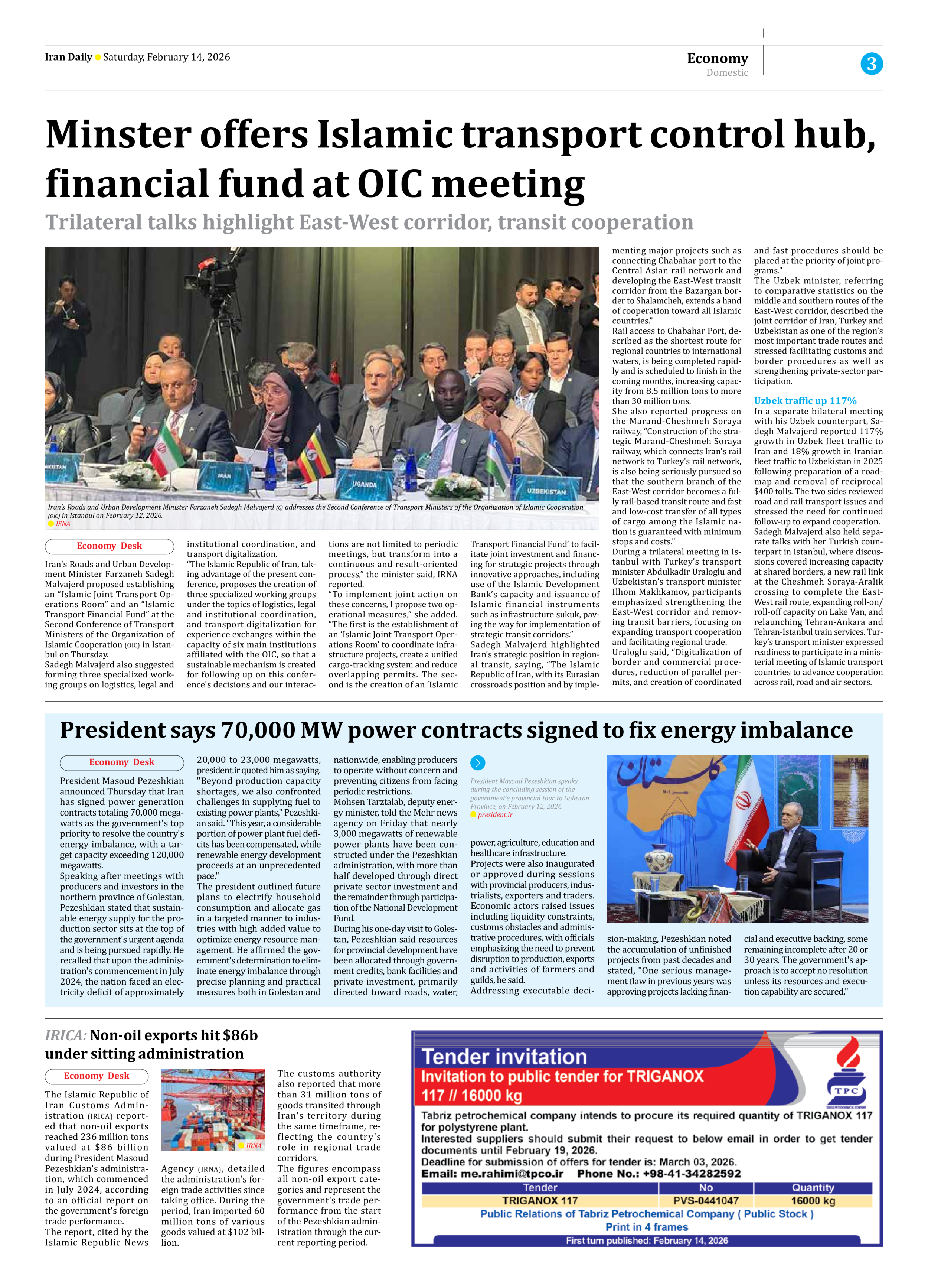
Speaking after meetings with producers and investors in the northern province of Golestan, Pezeshkian stated that sustainable energy supply for the production sector sits at the top of the government's urgent agenda and is being pursued rapidly. He recalled that upon the administration's commencement in July 2024, the nation faced an electricity deficit of approximately 20,000 to 23,000 megawatts, president.ir quoted him as saying.
"Beyond production capacity shortages, we also confronted challenges in supplying fuel to existing power plants," Pezeshkian said. "This year, a considerable portion of power plant fuel deficits has been compensated, while renewable energy development proceeds at an unprecedented pace."
The president outlined future plans to electrify household consumption and allocate gas in a targeted manner to industries with high added value to optimize energy resource management. He affirmed the government's determination to eliminate energy imbalance through precise planning and practical measures both in Golestan and nationwide, enabling producers to operate without concern and preventing citizens from facing periodic restrictions.
Mohsen Tarztalab, deputy energy minister, told the Mehr news agency on Friday that nearly 3,000 megawatts of renewable power plants have been constructed under the Pezeshkian administration, with more than half developed through direct private sector investment and the remainder through participation of the National Development Fund.
During his one-day visit to Golestan, Pezeshkian said resources for provincial development have been allocated through government credits, bank facilities and private investment, primarily directed toward roads, water, power, agriculture, education and healthcare infrastructure.
Projects were also inaugurated or approved during sessions with provincial producers, industrialists, exporters and traders. Economic actors raised issues including liquidity constraints, customs obstacles and administrative procedures, with officials emphasizing the need to prevent disruption to production, exports and activities of farmers and guilds, he said.
Addressing executable decision-making, Pezeshkian noted the accumulation of unfinished projects from past decades and stated, "One serious management flaw in previous years was approving projects lacking financial and executive backing, some remaining incomplete after 20 or 30 years. The government's approach is to accept no resolution unless its resources and execution capability are secured."