





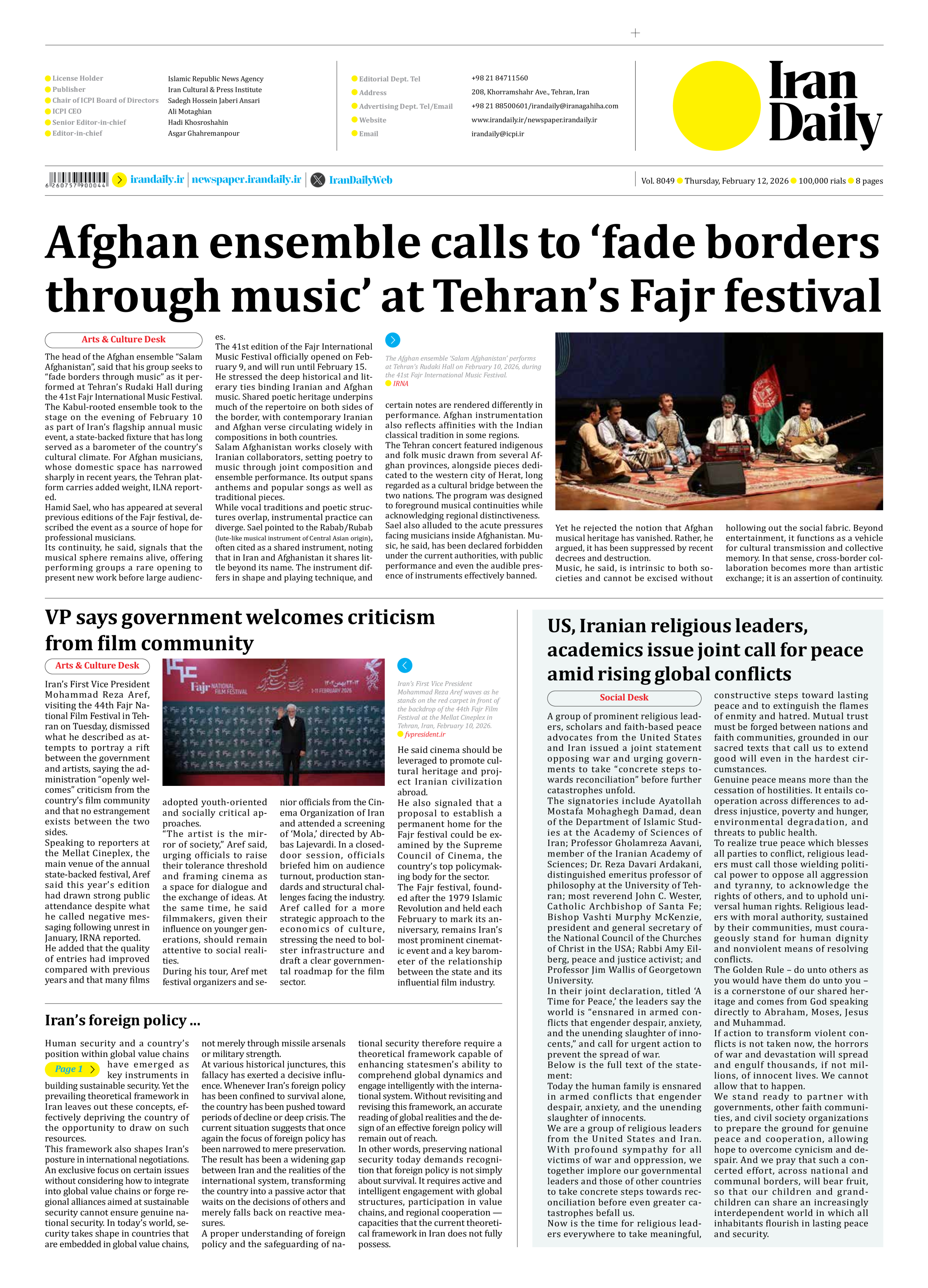


VP says government welcomes criticism from film community
Iran’s First Vice President Mohammad Reza Aref, visiting the 44th Fajr National Film Festival in Tehran on Tuesday, dismissed what he described as attempts to portray a rift between the government and artists, saying the administration “openly welcomes” criticism from the country’s film community and that no estrangement exists between the two sides.
Speaking to reporters at the Mellat Cineplex, the main venue of the annual state-backed festival, Aref said this year’s edition had drawn strong public attendance despite what he called negative messaging following unrest in January, IRNA reported.
He added that the quality of entries had improved compared with previous years and that many films adopted youth-oriented and socially critical approaches.
“The artist is the mirror of society,” Aref said, urging officials to raise their tolerance threshold and framing cinema as a space for dialogue and the exchange of ideas. At the same time, he said filmmakers, given their influence on younger generations, should remain attentive to social realities.
During his tour, Aref met festival organizers and senior officials from the Cinema Organization of Iran and attended a screening of ‘Mola,’ directed by Abbas Lajevardi. In a closed-door session, officials briefed him on audience turnout, production standards and structural challenges facing the industry.
Aref called for a more strategic approach to the economics of culture, stressing the need to bolster infrastructure and draft a clear governmental roadmap for the film sector.
He said cinema should be leveraged to promote cultural heritage and project Iranian civilization abroad.
He also signaled that a proposal to establish a permanent home for the Fajr festival could be examined by the Supreme Council of Cinema, the country’s top policymaking body for the sector.
The Fajr festival, founded after the 1979 Islamic Revolution and held each February to mark its anniversary, remains Iran’s most prominent cinematic event and a key barometer of the relationship between the state and its influential film industry.