





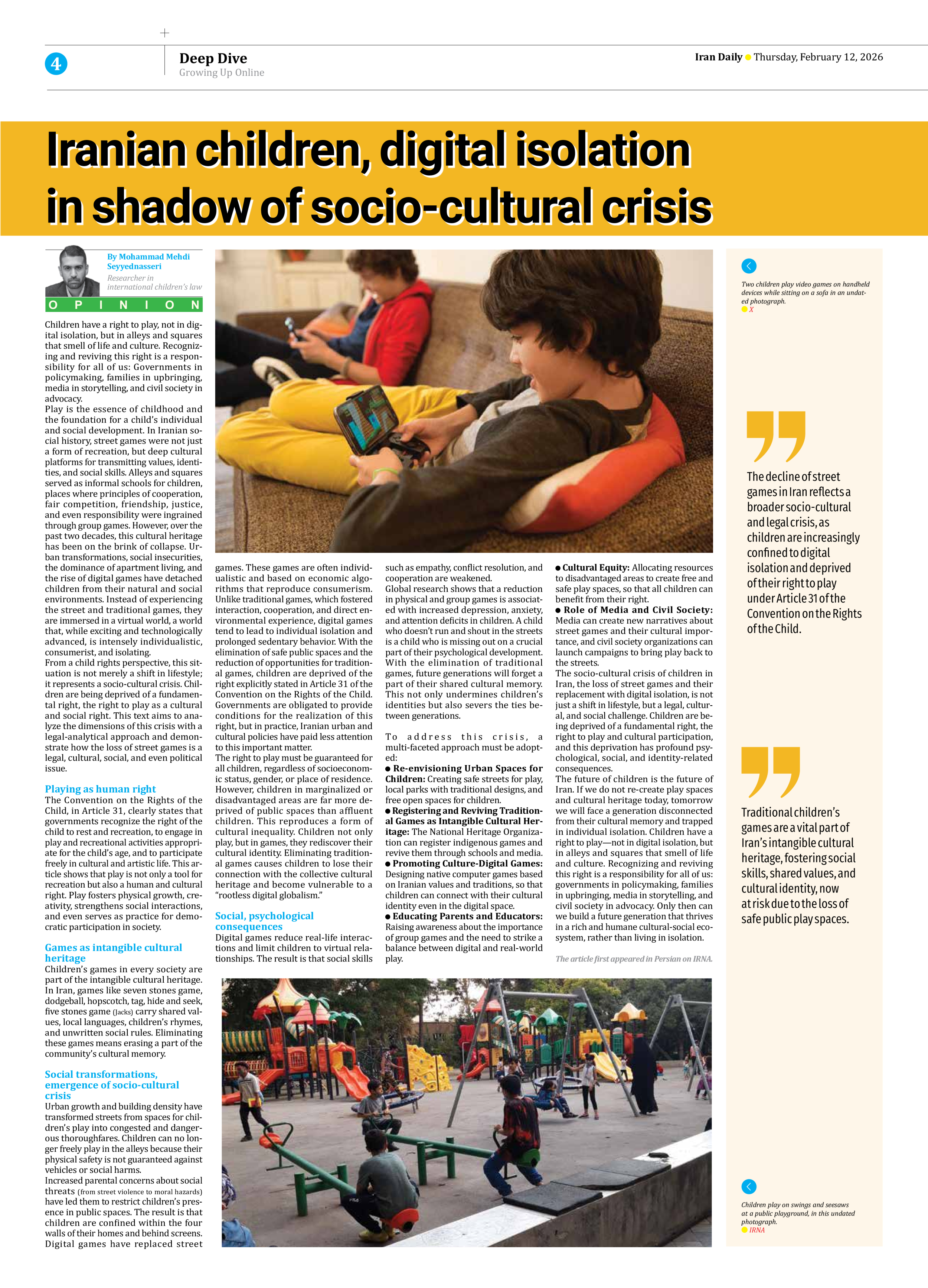


Iranian children, digital isolation in shadow of socio-cultural crisis
By Mohammad Mehdi Seyyednasseri
Researcher in
international children’s law
Children have a right to play, not in digital isolation, but in alleys and squares that smell of life and culture. Recognizing and reviving this right is a responsibility for all of us: Governments in policymaking, families in upbringing, media in storytelling, and civil society in advocacy.
Play is the essence of childhood and the foundation for a child’s individual and social development. In Iranian social history, street games were not just a form of recreation, but deep cultural platforms for transmitting values, identities, and social skills. Alleys and squares served as informal schools for children, places where principles of cooperation, fair competition, friendship, justice, and even responsibility were ingrained through group games. However, over the past two decades, this cultural heritage has been on the brink of collapse. Urban transformations, social insecurities, the dominance of apartment living, and the rise of digital games have detached children from their natural and social environments. Instead of experiencing the street and traditional games, they are immersed in a virtual world, a world that, while exciting and technologically advanced, is intensely individualistic, consumerist, and isolating.
From a child rights perspective, this situation is not merely a shift in lifestyle; it represents a socio-cultural crisis. Children are being deprived of a fundamental right, the right to play as a cultural and social right. This text aims to analyze the dimensions of this crisis with a legal-analytical approach and demonstrate how the loss of street games is a legal, cultural, social, and even political issue.
Playing as human right
The Convention on the Rights of the Child, in Article 31, clearly states that governments recognize the right of the child to rest and recreation, to engage in play and recreational activities appropriate for the child’s age, and to participate freely in cultural and artistic life. This article shows that play is not only a tool for recreation but also a human and cultural right. Play fosters physical growth, creativity, strengthens social interactions, and even serves as practice for democratic participation in society.
Games as intangible cultural heritage
Children’s games in every society are part of the intangible cultural heritage. In Iran, games like seven stones game, dodgeball, hopscotch, tag, hide and seek, five stones game (Jacks) carry shared values, local languages, children’s rhymes, and unwritten social rules. Eliminating these games means erasing a part of the community’s cultural memory.
Social transformations, emergence of socio-cultural crisis
Urban growth and building density have transformed streets from spaces for children’s play into congested and dangerous thoroughfares. Children can no longer freely play in the alleys because their physical safety is not guaranteed against vehicles or social harms.
Increased parental concerns about social threats (from street violence to moral hazards) have led them to restrict children’s presence in public spaces. The result is that children are confined within the four walls of their homes and behind screens.
Digital games have replaced street games. These games are often individualistic and based on economic algorithms that reproduce consumerism. Unlike traditional games, which fostered interaction, cooperation, and direct environmental experience, digital games tend to lead to individual isolation and prolonged sedentary behavior. With the elimination of safe public spaces and the reduction of opportunities for traditional games, children are deprived of the right explicitly stated in Article 31 of the Convention on the Rights of the Child. Governments are obligated to provide conditions for the realization of this right, but in practice, Iranian urban and cultural policies have paid less attention to this important matter.
The right to play must be guaranteed for all children, regardless of socioeconomic status, gender, or place of residence. However, children in marginalized or disadvantaged areas are far more deprived of public spaces than affluent children. This reproduces a form of cultural inequality. Children not only play, but in games, they rediscover their cultural identity. Eliminating traditional games causes children to lose their connection with the collective cultural heritage and become vulnerable to a “rootless digital globalism.”
Social, psychological consequences
Digital games reduce real-life interactions and limit children to virtual relationships. The result is that social skills such as empathy, conflict resolution, and cooperation are weakened.
Global research shows that a reduction in physical and group games is associated with increased depression, anxiety, and attention deficits in children. A child who doesn’t run and shout in the streets is a child who is missing out on a crucial part of their psychological development.
With the elimination of traditional games, future generations will forget a part of their shared cultural memory. This not only undermines children’s identities but also severs the ties between generations.
To address this crisis, a
multi-faceted approach must be adopted:
Re-envisioning Urban Spaces for Children: Creating safe streets for play, local parks with traditional designs, and free open spaces for children.
Registering and Reviving Traditional Games as Intangible Cultural Heritage: The National Heritage Organization can register indigenous games and revive them through schools and media.
Promoting Culture-Digital Games: Designing native computer games based on Iranian values and traditions, so that children can connect with their cultural identity even in the digital space.
Educating Parents and Educators: Raising awareness about the importance of group games and the need to strike a balance between digital and real-world play.
Cultural Equity: Allocating resources to disadvantaged areas to create free and safe play spaces, so that all children can benefit from their right.
Role of Media and Civil Society: Media can create new narratives about street games and their cultural importance, and civil society organizations can launch campaigns to bring play back to the streets.
The socio-cultural crisis of children in Iran, the loss of street games and their replacement with digital isolation, is not just a shift in lifestyle, but a legal, cultural, and social challenge. Children are being deprived of a fundamental right, the right to play and cultural participation, and this deprivation has profound psychological, social, and identity-related consequences.
The future of children is the future of Iran. If we do not re-create play spaces and cultural heritage today, tomorrow we will face a generation disconnected from their cultural memory and trapped in individual isolation. Children have a right to play—not in digital isolation, but in alleys and squares that smell of life and culture. Recognizing and reviving this right is a responsibility for all of us: governments in policymaking, families in upbringing, media in storytelling, and civil society in advocacy. Only then can we build a future generation that thrives in a rich and humane cultural-social ecosystem, rather than living in isolation.
The article first appeared in Persian on IRNA.