







Copy in clipboard...
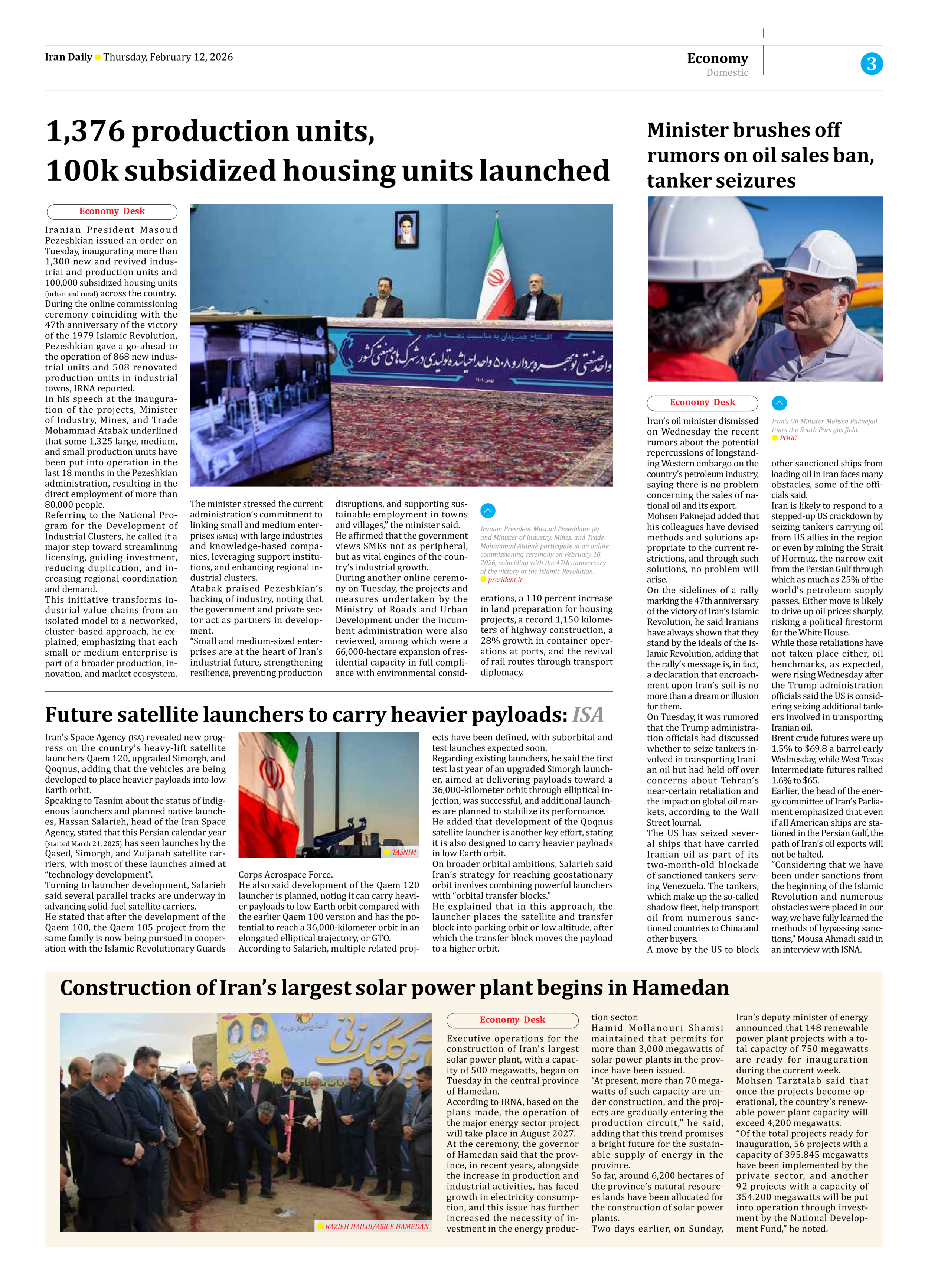
Future satellite launchers to carry heavier payloads: ISA
Speaking to Tasnim about the status of indigenous launchers and planned native launches, Hassan Salarieh, head of the Iran Space Agency, stated that this Persian calendar year (started March 21, 2025) has seen launches by the Qased, Simorgh, and Zuljanah satellite carriers, with most of these launches aimed at “technology development”.
Turning to launcher development, Salarieh said several parallel tracks are underway in advancing solid-fuel satellite carriers.
He stated that after the development of the Qaem 100, the Qaem 105 project from the same family is now being pursued in cooperation with the Islamic Revolutionary Guards Corps Aerospace Force.
He also said development of the Qaem 120 launcher is planned, noting it can carry heavier payloads to low Earth orbit compared with the earlier Qaem 100 version and has the potential to reach a 36,000-kilometer orbit in an elongated elliptical trajectory, or GTO.
According to Salarieh, multiple related projects have been defined, with suborbital and test launches expected soon.
Regarding existing launchers, he said the first test last year of an upgraded Simorgh launcher, aimed at delivering payloads toward a 36,000-kilometer orbit through elliptical injection, was successful, and additional launches are planned to stabilize its performance.
He added that development of the Qoqnus satellite launcher is another key effort, stating it is also designed to carry heavier payloads in low Earth orbit.
On broader orbital ambitions, Salarieh said Iran’s strategy for reaching geostationary orbit involves combining powerful launchers with “orbital transfer blocks.”
He explained that in this approach, the launcher places the satellite and transfer block into parking orbit or low altitude, after which the transfer block moves the payload to a higher orbit.