







Legacy of a revolution
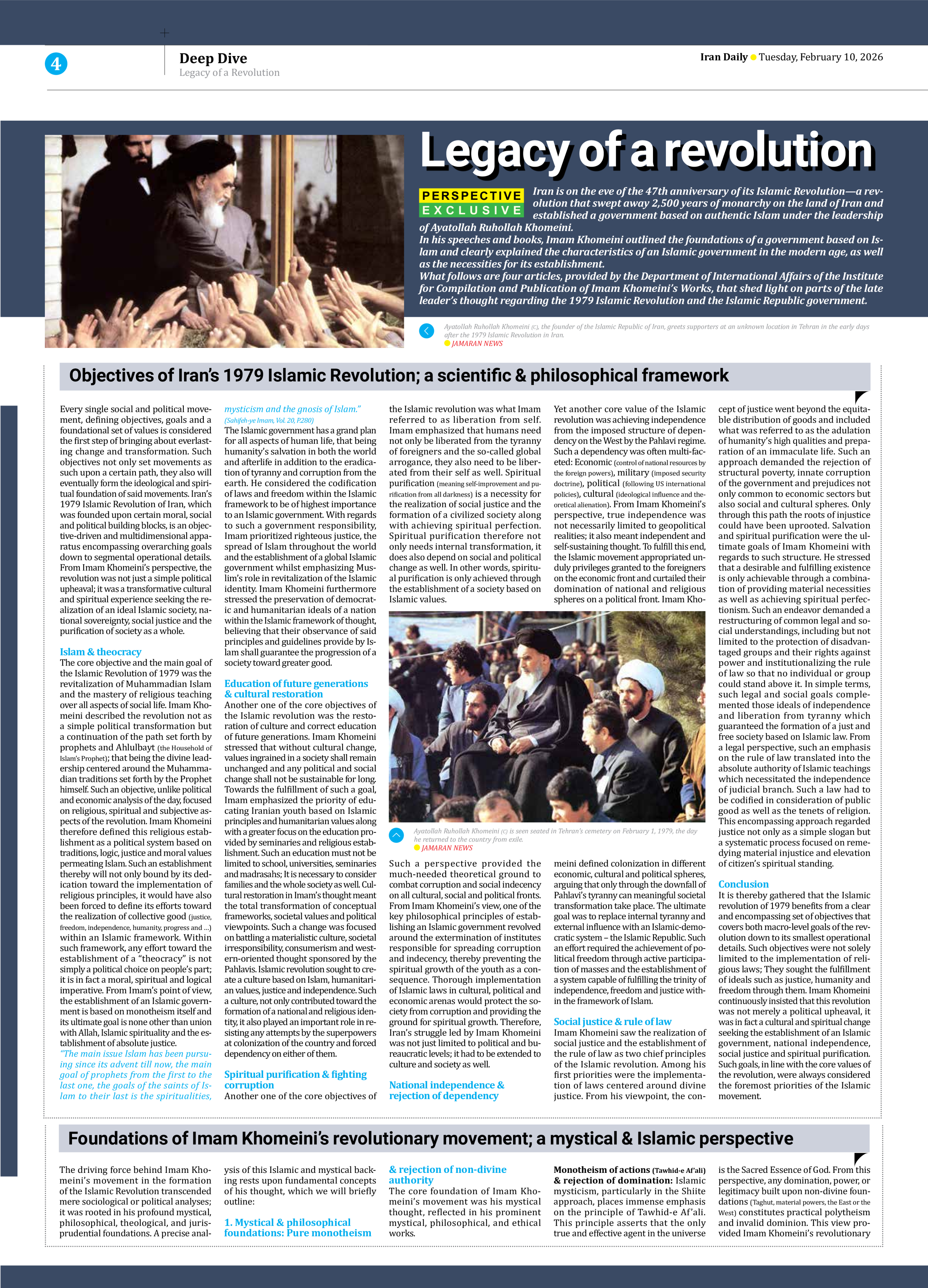
Iran is on the eve of the 47th anniversary of its Islamic Revolution—a revolution that swept away 2,500 years of monarchy on the land of Iran and established a government based on authentic Islam under the leadership of Ayatollah Ruhollah Khomeini. In his speeches and books, Imam Khomeini outlined the foundations of a government based on Islam and clearly explained the characteristics of an Islamic government in the modern age, as well as the necessities for its establishment. What follows are four articles, provided by the Department of International Affairs of the Institute for Compilation and Publication of Imam Khomeini’s Works, that shed light on parts of the late leader’s thought regarding the 1979 Islamic Revolution and the Islamic Republic government.
Objectives of Iran’s 1979 Islamic Revolution; a scientific & philosophical framework
Every single social and political movement, defining objectives, goals and a foundational set of values is considered the first step of bringing about everlasting change and transformation. Such objectives not only set movements as such upon a certain path, they also will eventually form the ideological and spiritual foundation of said movements. Iran’s 1979 Islamic Revolution of Iran, which was founded upon certain moral, social and political building blocks, is an objective-driven and multidimensional apparatus encompassing overarching goals down to segmental operational details. From Imam Khomeini’s perspective, the revolution was not just a simple political upheaval; it was a transformative cultural and spiritual experience seeking the realization of an ideal Islamic society, national sovereignty, social justice and the purification of society as a whole.
Islam & theocracy
The core objective and the main goal of the Islamic Revolution of 1979 was the revitalization of Muhammadian Islam and the mastery of religious teaching over all aspects of social life. Imam Khomeini described the revolution not as a simple political transformation but a continuation of the path set forth by prophets and Ahlulbayt (the Household of Islam’s Prophet); that being the divine leadership centered around the Muhammadian traditions set forth by the Prophet himself. Such an objective, unlike political and economic analysis of the day, focused on religious, spiritual and subjective aspects of the revolution. Imam Khomeini therefore defined this religious establishment as a political system based on traditions, logic, justice and moral values permeating Islam. Such an establishment thereby will not only bound by its dedication toward the implementation of religious principles, it would have also been forced to define its efforts toward the realization of collective good (justice, freedom, independence, humanity, progress and …) within an Islamic framework. Within such framework, any effort toward the establishment of a “theocracy” is not simply a political choice on people’s part; it is in fact a moral, spiritual and logical imperative. From Imam’s point of view, the establishment of an Islamic government is based on monotheism itself and its ultimate goal is none other than union with Allah, Islamic spirituality and the establishment of absolute justice.
“The main issue Islam has been pursuing since its advent till now, the main goal of prophets from the first to the last one, the goals of the saints of Islam to their last is the spiritualities,
mysticism and the gnosis of Islam.”
(Sahifeh-ye Imam, Vol. 20, P.280)
The Islamic government has a grand plan for all aspects of human life, that being humanity’s salvation in both the world and afterlife in addition to the eradication of tyranny and corruption from the earth. He considered the codification of laws and freedom within the Islamic framework to be of highest importance to an Islamic government. With regards to such a government responsibility, Imam prioritized righteous justice, the spread of Islam throughout the world and the establishment of a global Islamic government whilst emphasizing Muslim’s role in revitalization of the Islamic identity. Imam Khomeini furthermore stressed the preservation of democratic and humanitarian ideals of a nation within the Islamic framework of thought, believing that their observance of said principles and guidelines provide by Islam shall guarantee the progression of a society toward greater good.
Education of future generations & cultural restoration
Another one of the core objectives of the Islamic revolution was the restoration of culture and correct education of future generations. Imam Khomeini stressed that without cultural change, values ingrained in a society shall remain unchanged and any political and social change shall not be sustainable for long. Towards the fulfillment of such a goal, Imam emphasized the priority of educating Iranian youth based on Islamic principles and humanitarian values along with a greater focus on the education provided by seminaries and religious establishment. Such an education must not be limited to school, universities, seminaries and madrasahs; It is necessary to consider families and the whole society as well. Cultural restoration in Imam’s thought meant the total transformation of conceptual frameworks, societal values and political viewpoints. Such a change was focused on battling a materialistic culture, societal irresponsibility, consumerism and western-oriented thought sponsored by the Pahlavis. Islamic revolution sought to create a culture based on Islam, humanitarian values, justice and independence. Such a culture, not only contributed toward the formation of a national and religious identity, it also played an important role in resisting any attempts by the superpowers at colonization of the country and forced dependency on either of them.
Spiritual purification & fighting corruption
Another one of the core objectives of the Islamic revolution was what Imam referred to as liberation from self. Imam emphasized that humans need not only be liberated from the tyranny of foreigners and the so-called global arrogance, they also need to be liberated from their self as well. Spiritual purification (meaning self-improvement and purification from all darkness) is a necessity for the realization of social justice and the formation of a civilized society along with achieving spiritual perfection. Spiritual purification therefore not only needs internal transformation, it does also depend on social and political change as well. In other words, spiritual purification is only achieved through the establishment of a society based on Islamic values.
Such a perspective provided the much-needed theoretical ground to combat corruption and social indecency on all cultural, social and political fronts. From Imam Khomeini’s view, one of the key philosophical principles of establishing an Islamic government revolved around the extermination of institutes responsible for spreading corruption and indecency, thereby preventing the spiritual growth of the youth as a consequence. Thorough implementation of Islamic laws in cultural, political and economic arenas would protect the society from corruption and providing the ground for spiritual growth. Therefore, Iran’s struggle led by Imam Khomeini was not just limited to political and bureaucratic levels; it had to be extended to culture and society as well.
National independence & rejection of dependency
Yet another core value of the Islamic revolution was achieving independence from the imposed structure of dependency on the West by the Pahlavi regime. Such a dependency was often multi-faceted: Economic (control of national resources by the foreign powers), military (imposed security doctrine), political (following US international policies), cultural (ideological influence and theoretical alienation). From Imam Khomeini’s perspective, true independence was not necessarily limited to geopolitical realities; it also meant independent and self-sustaining thought. To fulfill this end, the Islamic movement appropriated unduly privileges granted to the foreigners on the economic front and curtailed their domination of national and religious spheres on a political front. Imam Khomeini defined colonization in different economic, cultural and political spheres, arguing that only through the downfall of Pahlavi’s tyranny can meaningful societal transformation take place. The ultimate goal was to replace internal tyranny and external influence with an Islamic-democratic system – the Islamic Republic. Such an effort required the achievement of political freedom through active participation of masses and the establishment of a system capable of fulfilling the trinity of independence, freedom and justice within the framework of Islam.
Social justice & rule of law
Imam Khomeini saw the realization of social justice and the establishment of the rule of law as two chief principles of the Islamic revolution. Among his first priorities were the implementation of laws centered around divine justice. From his viewpoint, the concept of justice went beyond the equitable distribution of goods and included what was referred to as the adulation of humanity’s high qualities and preparation of an immaculate life. Such an approach demanded the rejection of structural poverty, innate corruption of the government and prejudices not only common to economic sectors but also social and cultural spheres. Only through this path the roots of injustice could have been uprooted. Salvation and spiritual purification were the ultimate goals of Imam Khomeini with regards to such structure. He stressed that a desirable and fulfilling existence is only achievable through a combination of providing material necessities as well as achieving spiritual perfectionism. Such an endeavor demanded a restructuring of common legal and social understandings, including but not limited to the protection of disadvantaged groups and their rights against power and institutionalizing the rule of law so that no individual or group could stand above it. In simple terms, such legal and social goals complemented those ideals of independence and liberation from tyranny which guaranteed the formation of a just and free society based on Islamic law. From a legal perspective, such an emphasis on the rule of law translated into the absolute authority of Islamic teachings which necessitated the independence of judicial branch. Such a law had to be codified in consideration of public good as well as the tenets of religion. This encompassing approach regarded justice not only as a simple slogan but a systematic process focused on remedying material injustice and elevation of citizen’s spiritual standing.
Conclusion
It is thereby gathered that the Islamic revolution of 1979 benefits from a clear and encompassing set of objectives that covers both macro-level goals of the revolution down to its smallest operational details. Such objectives were not solely limited to the implementation of religious laws; They sought the fulfillment of ideals such as justice, humanity and freedom through them. Imam Khomeini continuously insisted that this revolution was not merely a political upheaval, it was in fact a cultural and spiritual change seeking the establishment of an Islamic government, national independence, social justice and spiritual purification. Such goals, in line with the core values of the revolution, were always considered the foremost priorities of the Islamic movement.
Foundations of Imam Khomeini’s revolutionary movement; a mystical & Islamic perspective
The driving force behind Imam Khomeini’s movement in the formation of the Islamic Revolution transcended mere sociological or political analyses; it was rooted in his profound mystical, philosophical, theological, and jurisprudential foundations. A precise analysis of this Islamic and mystical backing rests upon fundamental concepts of his thought, which we will briefly outline:
1. Mystical & philosophical foundations: Pure monotheism & rejection of non-divine authority
The core foundation of Imam Khomeini’s movement was his mystical thought, reflected in his prominent mystical, philosophical, and ethical works.
Monotheism of actions (Tawhid-e Af’ali) & rejection of domination: Islamic mysticism, particularly in the Shiite approach, places immense emphasis on the principle of Tawhid-e Af’ali. This principle asserts that the only true and effective agent in the universe is the Sacred Essence of God. From this perspective, any domination, power, or legitimacy built upon non-divine foundations (Taghut, material powers, the East or the West) constitutes practical polytheism and invalid dominion. This view provided Imam Khomeini’s revolutionary movement with a robust mystical and religious theoretical base. From this vantage point, the sovereignty of the Shah’s regime, which arose from foreign support (America), possessed no legitimacy against the infinite power of the Divine and the will of the people connected to the Truth.
“The most important and valuable of our beliefs is the principle of Monotheism (Tawhid). According to this principle, we believe that the Creator of the universe, of all realms of existence, and of humanity, is solely the Sacred Essence of God Almighty, who is aware of all truths, capable of all things, and the Owner of all things. This principle teaches us that man must submit only to the Holy Essence of the Truth and must not obey any human being unless that obedience is, in effect, obedience to God.”
(Sahifeh-ye Imam, Vol. 5, p. 387)
Movement building based on political mysticism: In the mystical and philosophical view of the Imam, the ultimate goal of all individual and collective actions is the return to the Divine Station. Within this framework, political movement was not an intrinsic goal but was considered the “Greater Jihad” (struggle against the tyranny of the self and self-purification), which served as the prerequisite and necessary condition for realizing the “Lesser Jihad” (struggle against external tyranny, the establishment of divine laws, and the restoration of justice in society). This perspective transformed political struggle from a limited political event into a mystical and sacred act, granting it a transcendent and spiritual dimension.
2. Jurisprudential foundations: Theory of Wilayat al-Faqih
Perhaps the most significant practical and institutional backing for Imam Khomeini’s revolutionary movement was his jurisprudential innovation and expansion based on the theory of Guardianship of the Islamic Jurist (Wilayat al-Faqih).
Necessity of forming Islamic government in era of occultation
Through a precise and innovative interpretation of Shiite jurisprudence, Imam Khomeini proved that the administration of Islamic society, based on rational and textual evidence, is entrusted to a qualified jurist (Faqih) in the absence of the Infallible Imam (PBUH). This is, in truth, not a political choice but a religious duty. This theory served two fundamental functions:
Delegitimizing Pahlavi regime: As stated, a government not based on Shari’ah and divine laws is tyranny (Taghut), and thus a usurping and illegitimate government.
Legitimizing alternative government: The revolutionary movement of the people led by Imam Khomeini transformed from a mere socio-political protest into a religious duty and divine obligation that required obedience.
Islamic jurisprudence as practical framework for social justice: The jurisprudential view of the Imam was a dynamic, socialized interpretation of Islamic law, removing it from the confinement of individual and ritualistic rulings. He viewed jurisprudence not merely as a collection of ritual “dos and don’ts,” but as a legal and ethical charter governing society, one of whose primary goals is the establishment of divine “equity and justice.” He believed that if divine laws (Fiqh) were implemented completely and comprehensively within the government structure, the natural result would be pervasive economic, social, and political justice. In this view, the execution of jurisprudential laws (such as those regarding transactions, usury, property, and penal codes) directly leads to the elimination of exploitative structures and the realization of justice in accessing resources. This firm link between “Divine Laws” and the “Realization of Justice” transformed the Iranian people’s revolutionary movement from a mere political dispute into a religious duty for all classes. For example, when the struggle against usury, hoarding, and economic corruption was raised, it was no longer just an economic demand but was perceived by the masses as the upholding of religious rites.
Islamic teachings in Sirah of Ahlulbayt
Imam Khomeini utilized Islamic history, particularly the lifestyle (Sirah) of the Ahlulbayt, as a source for role-modeling and inspiration to strengthen the spirit of resistance, articulate the legitimacy of the struggle, and convert the revolutionary movement into a religious and ethical issue. He situated the historic revolutionary movement of the Iranian nation within the framework of an ethical and faith-based struggle.
Revolution in path of Ashura uprising
Imam Khomeini regarded his movement not as an ordinary political change, but as a repetition of Imam Hussein’s uprising in Ashura. In the Imam’s view, this historical model was not an event of the past, but an eternal Islamic archetype for fighting oppression and tyranny. From this perspective, the world is characterized by a constant, objective duality of the confrontation between the front of Truth and Falsehood. The Shah and the despotic Pahlavi system were introduced as the representatives of the Taghut of the time, and fighting them was defined as a continuation of obedience to the Lord of Martyrs (Imam Husayn).
Disregard for apparent defeat & importance of steadfastness: In Islamic thought, failure has no place in the struggle against tyranny and the fulfillment of divine duty. Steadfastness to the point of death, self-sacrifice, and the spirit of martyrdom in the path of duty not only bestowed a transcendent value upon the revolutionary movement, but also drastically strengthened the fighting spirit and the threshold for enduring violence among the masses. This had profound ideological and psychological impacts on society.
Combating global arrogance: Imam Khomeini’s emphasis on the concept of “Global Arrogance” (not merely the US government) is rooted in Islamic teachings that view the boundary between Truth and Falsehood as global. In this view, the struggle against the West and Zionism was considered not only Iran’s issue, but a contemporary instance of the historical battle between Truth and Falsehood. This approach transformed the struggle from a domestic and regional conflict into a global and all-encompassing dimension, engaging not only the Iranian people, but also Muslims and all the oppressed of the world intellectually and spiritually in the fight against the West and Zionism. This distinction clearly demonstrates the global significance of the Iranian people’s revolutionary movement led by the Imam, especially regarding contemporary global events.
In summary, the backing of Imam Khomeini’s movement was based on a coherent intellectual foundation wherein Islamic Mysticism (Monotheistic Worldview) provided the theoretical basis, Jurisprudence (Wilayat al-Faqih) provided the structural and practical framework, and the Sirah of the Ahl al-Bayt (the Ashura Model) supplied the power for mobilization and the continuity of the struggle. This comprehensiveness created a powerful ideological force capable of overcoming the complex material and security structure of the Pahlavi regime and its foreign backers.
Formation of Islamic government according to Imam Khomeini’s school of thought
The concept of government can be examined on both a theoretical and operational ground. From a macro-level perspective, the ultimate goal in Imam’s mind was the creation of an encompassing global Islamic government; a world government where divine law reigns, not individual’s opinions and decisions. Imam was deeply opposed to all nationalistic, racial and tribal movement resulting in the formation of nation-states. He considered such conspiratorial ideas to be a ploy by the enemies in order to weaken the Islamic nation (Ummah). He believed that the dissolution of the Ottoman Empire following the World War I to be a colonial endeavor, aiming to break down the power of Islam. Therefore, Imam Khomeini constantly stressed notions such as “Islamic Nation”, “Islamic Heartland” and “Ummah”; considering the formation of a unified Islamic world government to be among highest priorities of the Islamic revolution of Iran (1979).
Nevertheless, on an operational level, Imam taking into consideration the political state of affairs, structured his ideal Islamic government within a traditional nation-state framework, organizing the system based on that. On foreign policy front, following Islamic Republic of Iran’s renewed membership in international organizations, Imam prioritized the improvement of relations with other Islamic nations based on the principle of mutual respect. He considered divisions between the Islamic nations to be the primary reason of Islamic world lack of progress with regards to the other nations, arguing that unity around the axis of Islam and fulfillment of Islam’s original promises would address all problems plaguing the Islamic world. The formation of an Islamic government was composed of three stages:
Overarching ideal
Imam Khomeini first introduced the concept of an Islamic nation as an overarching ideal, considering the rule of Fuqaha (P. Faqih/Scholar) during the time of occultation to be the best form of government which would seek to implement divine laws in the society. Whilst defining such a form of government as an ideal one, Imam, as a matter of expediency, cautioned his followers about any form of public opposition to the government until certain conditions for the realization of such a dream was met.
Alternative paradigm & criticism of monarchy
In the next step, which took place around 1960s, Imam proposed the Islamic form of government as an alternative to the monarchial system, which he fiercely opposed and criticized. He believed that elucidation of political and social aspects of Islam would inevitably lead to public awareness and mass support. Such an effort however could only be realized through the support of religious scholars who would see this divine charge through.
Establishment of Islamic Republic
On the eve of 1979 Islamic revolution’s victory, Imam Khomeini sought to defend and demonstrate different aspects of the Islamic republic in an effort to legitimize the establishment of such a form of government in Iran. He therefore only accepted the establishment of such a government on the condition of codifying the new constitution based on Islamic law and public vote.
Reconstruction of Iranian national identity in Imam Khomeini’s view
“You proved that you can create whatever you desire. You manifested a miracle in the world, a miracle that was the power of God in man. You stood against all the powers that wanted to devour Iran and the Iranian, who wanted to loot your reserves; you resisted, and you triumphed.”
(Sahifeh-ye Imam, Vol. 16, p. 76)
One of the most exalted achievements of the glorious Islamic Revolution is the revival and reconstruction of the authentic national Iranian identity. The late Imam, with profound insight and complete awareness of colonialist stratagems, knew well that the root of foreign domination over nations lies in stripping them of their identity and self-belief. He consistently emphasized the boundless richness of culture, literature, and the deep roots of Islamic-Iranian civilization.
In his Divine Will and Testament, referring to the engineered plans of colonialism to alienate regional nations from their own authenticity, Imam Khomeini stated:
“The Aryan and Arab races are no less than the European, American, and Soviet races. If they find their true selves, cast away despair, and do not look to others, they have the power—in the long run—to do anything and build everything.”
(Sahifeh-ye Imam, Vol. 21, p. 417)
This statement expresses the truth that authenticity is the source of power. The Iranian nation must realize that its inherent assets, including its faithful and intelligent human resources, are in no way inferior to those of nations claiming power; the only obstacle was the illusion of dependency and induced hopelessness, which has now departed with the call of the Revolution.
Therefore, he placed the collective duty of “building” upon the shoulders of all who care for Iran, emphasizing that anyone who truly desires Iran’s pride must, with firm resolve, belt up for the construction of the country to overcome the imposed ruin and, through the preservation and correct utilization of God-given resources, pave the path for prosperity.
In his belief, returning to national and Islamic authenticity is not a cultural choice but a vital condition for true independence. As long as identity is lost and the fundamental values of the nation are buried under layers of Western influence, achieving true independence and liberation from the comprehensive domination of enemies will be impossible. Thus, while pursuing the realization of an Islamic government and the revival of religious identity, the Imam paid special attention to development and progress. However, this development had to be defined within the framework of Islamic and national identity—a development that is self-sufficient and reliant on internal assets.