





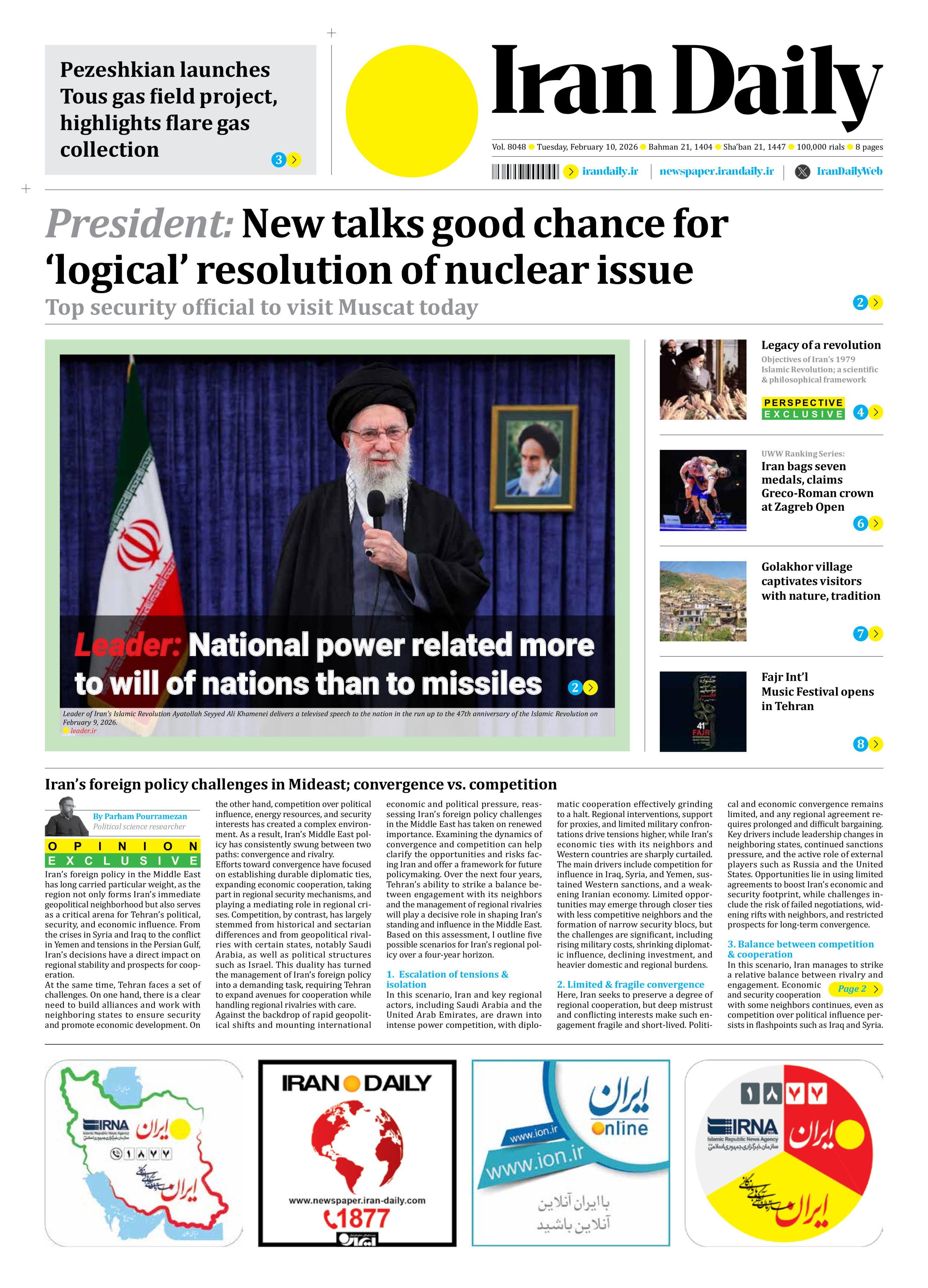


Iran’s foreign policy challenges in Mideast; convergence vs. competition
By Parham Pourramezan
Political science researcher
Iran’s foreign policy in the Middle East has long carried particular weight, as the region not only forms Iran’s immediate geopolitical neighborhood but also serves as a critical arena for Tehran’s political, security, and economic influence. From the crises in Syria and Iraq to the conflict in Yemen and tensions in the Persian Gulf, Iran’s decisions have a direct impact on regional stability and prospects for cooperation.
At the same time, Tehran faces a set of challenges. On one hand, there is a clear need to build alliances and work with neighboring states to ensure security and promote economic development. On the other hand, competition over political influence, energy resources, and security interests has created a complex environment. As a result, Iran’s Middle East policy has consistently swung between two paths: convergence and rivalry.
Efforts toward convergence have focused on establishing durable diplomatic ties, expanding economic cooperation, taking part in regional security mechanisms, and playing a mediating role in regional crises. Competition, by contrast, has largely stemmed from historical and sectarian differences and from geopolitical rivalries with certain states, notably Saudi Arabia, as well as political structures such as Israel. This duality has turned the management of Iran’s foreign policy into a demanding task, requiring Tehran to expand avenues for cooperation while handling regional rivalries with care.
Against the backdrop of rapid geopolitical shifts and mounting international economic and political pressure, reassessing Iran’s foreign policy challenges in the Middle East has taken on renewed importance. Examining the dynamics of convergence and competition can help clarify the opportunities and risks facing Iran and offer a framework for future policymaking. Over the next four years, Tehran’s ability to strike a balance between engagement with its neighbors and the management of regional rivalries will play a decisive role in shaping Iran’s standing and influence in the Middle East.
Based on this assessment, I outline five possible scenarios for Iran’s regional policy over a four-year horizon.
1. Escalation of tensions & isolation
In this scenario, Iran and key regional actors, including Saudi Arabia and the United Arab Emirates, are drawn into intense power competition, with diplomatic cooperation effectively grinding to a halt. Regional interventions, support for proxies, and limited military confrontations drive tensions higher, while Iran’s economic ties with its neighbors and Western countries are sharply curtailed. The main drivers include competition for influence in Iraq, Syria, and Yemen, sustained Western sanctions, and a weakening Iranian economy. Limited opportunities may emerge through closer ties with less competitive neighbors and the formation of narrow security blocs, but the challenges are significant, including rising military costs, shrinking diplomatic influence, declining investment, and heavier domestic and regional burdens.
2. Limited & fragile convergence
Here, Iran seeks to preserve a degree of regional cooperation, but deep mistrust and conflicting interests make such engagement fragile and short-lived. Political and economic convergence remains limited, and any regional agreement requires prolonged and difficult bargaining. Key drivers include leadership changes in neighboring states, continued sanctions pressure, and the active role of external players such as Russia and the United States. Opportunities lie in using limited agreements to boost Iran’s economic and security footprint, while challenges include the risk of failed negotiations, widening rifts with neighbors, and restricted prospects for long-term convergence.
3. Balance between competition & cooperation
In this scenario, Iran manages to strike a relative balance between rivalry and engagement. Economic and security cooperation with some neighbors continues, even as competition over political influence persists in flashpoints such as Iraq and Syria.
Page 2