







At closing ceremony of 43rd Book of the Year Award
Pezeshkian stresses support for book industry to promote reading
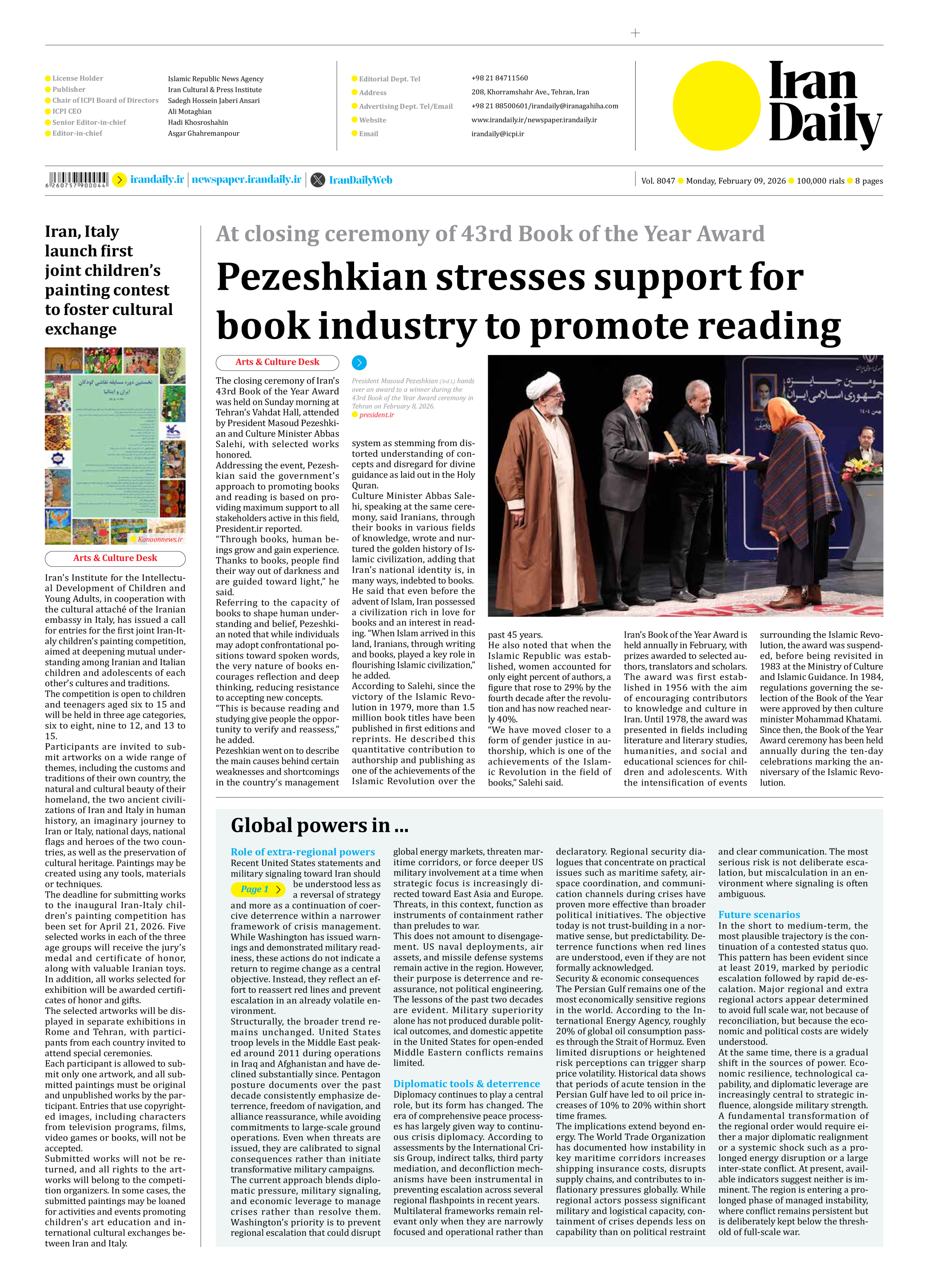
The closing ceremony of Iran’s 43rd Book of the Year Award was held on Sunday morning at Tehran’s Vahdat Hall, attended by President Masoud Pezeshkian and Culture Minister Abbas Salehi, with selected works honored.
Addressing the event, Pezeshkian said the government’s approach to promoting books and reading is based on providing maximum support to all stakeholders active in this field, President.ir reported.
“Through books, human beings grow and gain experience. Thanks to books, people find their way out of darkness and are guided toward light,” he said.
Referring to the capacity of books to shape human understanding and belief, Pezeshkian noted that while individuals may adopt confrontational positions toward spoken words, the very nature of books encourages reflection and deep thinking, reducing resistance to accepting new concepts.
“This is because reading and studying give people the opportunity to verify and reassess,” he added.
Pezeshkian went on to describe the main causes behind certain weaknesses and shortcomings in the country’s management system as stemming from distorted understanding of concepts and disregard for divine guidance as laid out in the Holy Quran.
Culture Minister Abbas Salehi, speaking at the same ceremony, said Iranians, through their books in various fields of knowledge, wrote and nurtured the golden history of Islamic civilization, adding that Iran’s national identity is, in many ways, indebted to books.
He said that even before the advent of Islam, Iran possessed a civilization rich in love for books and an interest in reading. “When Islam arrived in this land, Iranians, through writing and books, played a key role in flourishing Islamic civilization,” he added.
According to Salehi, since the victory of the Islamic Revolution in 1979, more than 1.5 million book titles have been published in first editions and reprints. He described this quantitative contribution to authorship and publishing as one of the achievements of the Islamic Revolution over the past 45 years.
He also noted that when the Islamic Republic was established, women accounted for only eight percent of authors, a figure that rose to 29% by the fourth decade after the revolution and has now reached nearly 40%.
“We have moved closer to a form of gender justice in authorship, which is one of the achievements of the Islamic Revolution in the field of books,” Salehi said.
Iran’s Book of the Year Award is held annually in February, with prizes awarded to selected authors, translators and scholars.
The award was first established in 1956 with the aim of encouraging contributors to knowledge and culture in Iran. Until 1978, the award was presented in fields including literature and literary studies, humanities, and social and educational sciences for children and adolescents. With the intensification of events surrounding the Islamic Revolution, the award was suspended, before being revisited in 1983 at the Ministry of Culture and Islamic Guidance. In 1984, regulations governing the selection of the Book of the Year were approved by then culture minister Mohammad Khatami.
Since then, the Book of the Year Award ceremony has been held annually during the ten-day celebrations marking the anniversary of the Islamic Revolution.