





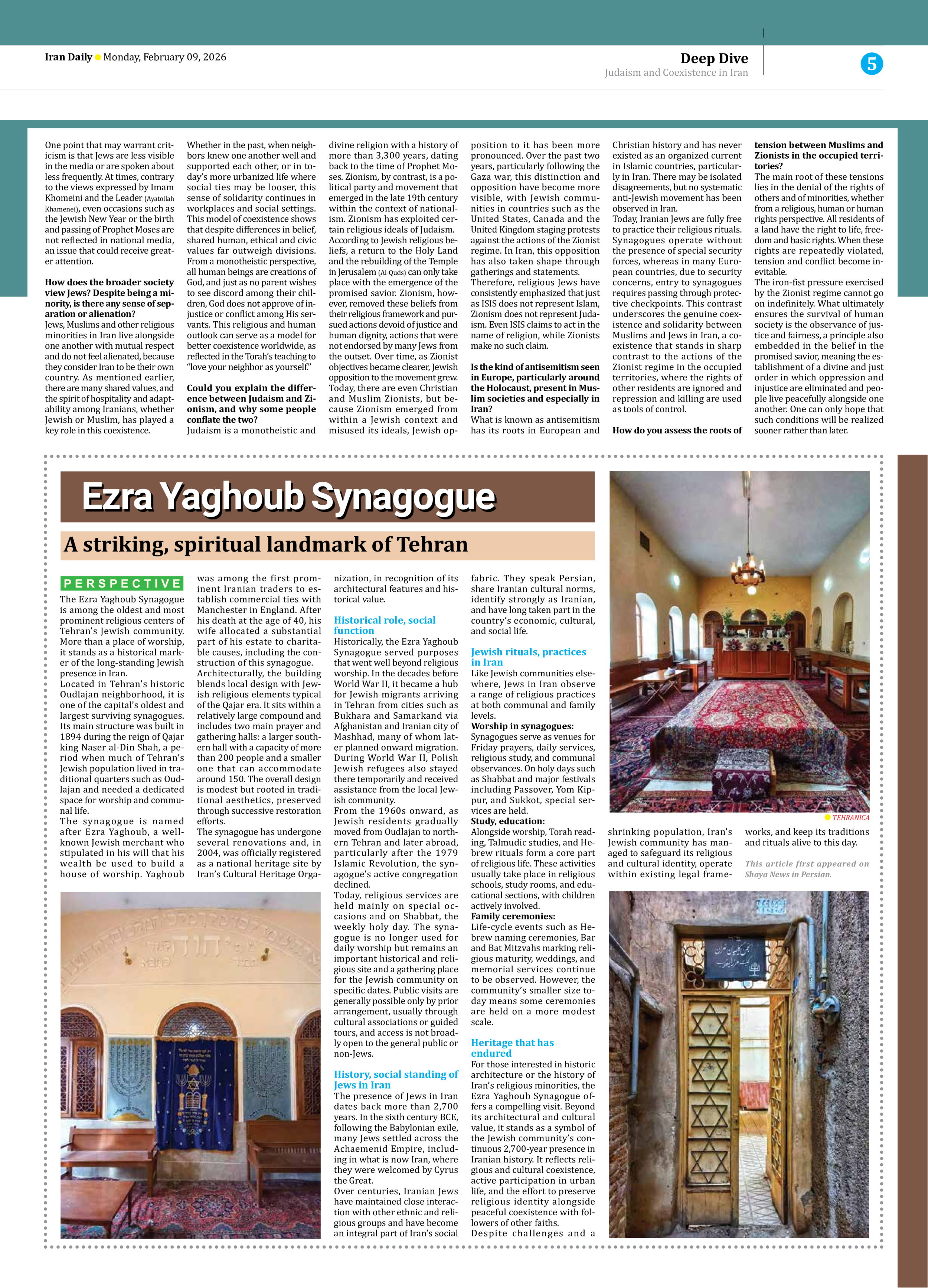


Ezra Yaghoub Synagogue
A striking, spiritual landmark of Tehran
The Ezra Yaghoub Synagogue is among the oldest and most prominent religious centers of Tehran’s Jewish community. More than a place of worship, it stands as a historical marker of the long-standing Jewish presence in Iran.
Located in Tehran’s historic Oudlajan neighborhood, it is one of the capital’s oldest and largest surviving synagogues. Its main structure was built in 1894 during the reign of Qajar king Naser al-Din Shah, a period when much of Tehran’s Jewish population lived in traditional quarters such as Oudlajan and needed a dedicated space for worship and communal life.
The synagogue is named after Ezra Yaghoub, a well-known Jewish merchant who stipulated in his will that his wealth be used to build a house of worship. Yaghoub was among the first prominent Iranian traders to establish commercial ties with Manchester in England. After his death at the age of 40, his wife allocated a substantial part of his estate to charitable causes, including the construction of this synagogue.
Architecturally, the building blends local design with Jewish religious elements typical of the Qajar era. It sits within a relatively large compound and includes two main prayer and gathering halls: a larger southern hall with a capacity of more than 200 people and a smaller one that can accommodate around 150. The overall design is modest but rooted in traditional aesthetics, preserved through successive restoration efforts.
The synagogue has undergone several renovations and, in 2004, was officially registered as a national heritage site by Iran’s Cultural Heritage Organization, in recognition of its architectural features and historical value.
Historical role, social function
Historically, the Ezra Yaghoub Synagogue served purposes that went well beyond religious worship. In the decades before World War II, it became a hub for Jewish migrants arriving in Tehran from cities such as Bukhara and Samarkand via Afghanistan and Iranian city of Mashhad, many of whom later planned onward migration. During World War II, Polish Jewish refugees also stayed there temporarily and received assistance from the local Jewish community.
From the 1960s onward, as Jewish residents gradually moved from Oudlajan to northern Tehran and later abroad, particularly after the 1979 Islamic Revolution, the synagogue’s active congregation declined.
Today, religious services are held mainly on special occasions and on Shabbat, the weekly holy day. The synagogue is no longer used for daily worship but remains an important historical and religious site and a gathering place for the Jewish community on specific dates. Public visits are generally possible only by prior arrangement, usually through cultural associations or guided tours, and access is not broadly open to the general public or non-Jews.
History, social standing of Jews in Iran
The presence of Jews in Iran dates back more than 2,700 years. In the sixth century BCE, following the Babylonian exile, many Jews settled across the Achaemenid Empire, including in what is now Iran, where they were welcomed by Cyrus the Great.
Over centuries, Iranian Jews have maintained close interaction with other ethnic and religious groups and have become an integral part of Iran’s social fabric. They speak Persian, share Iranian cultural norms, identify strongly as Iranian, and have long taken part in the country’s economic, cultural, and social life.
Jewish rituals, practices in Iran
Like Jewish communities elsewhere, Jews in Iran observe a range of religious practices at both communal and family levels.
Worship in synagogues:
Synagogues serve as venues for Friday prayers, daily services, religious study, and communal observances. On holy days such as Shabbat and major festivals including Passover, Yom Kippur, and Sukkot, special services are held.
Study, education:
Alongside worship, Torah reading, Talmudic studies, and Hebrew rituals form a core part of religious life. These activities usually take place in religious schools, study rooms, and educational sections, with children actively involved.
Family ceremonies:
Life-cycle events such as Hebrew naming ceremonies, Bar and Bat Mitzvahs marking religious maturity, weddings, and memorial services continue to be observed. However, the community’s smaller size today means some ceremonies are held on a more modest scale.
Heritage that has endured
For those interested in historic architecture or the history of Iran’s religious minorities, the Ezra Yaghoub Synagogue offers a compelling visit. Beyond its architectural and cultural value, it stands as a symbol of the Jewish community’s continuous 2,700-year presence in Iranian history. It reflects religious and cultural coexistence, active participation in urban life, and the effort to preserve religious identity alongside peaceful coexistence with followers of other faiths.
Despite challenges and a shrinking population, Iran’s Jewish community has managed to safeguard its religious and cultural identity, operate within existing legal frameworks, and keep its traditions and rituals alive to this day.
This article first appeared on Shaya News in Persian.