





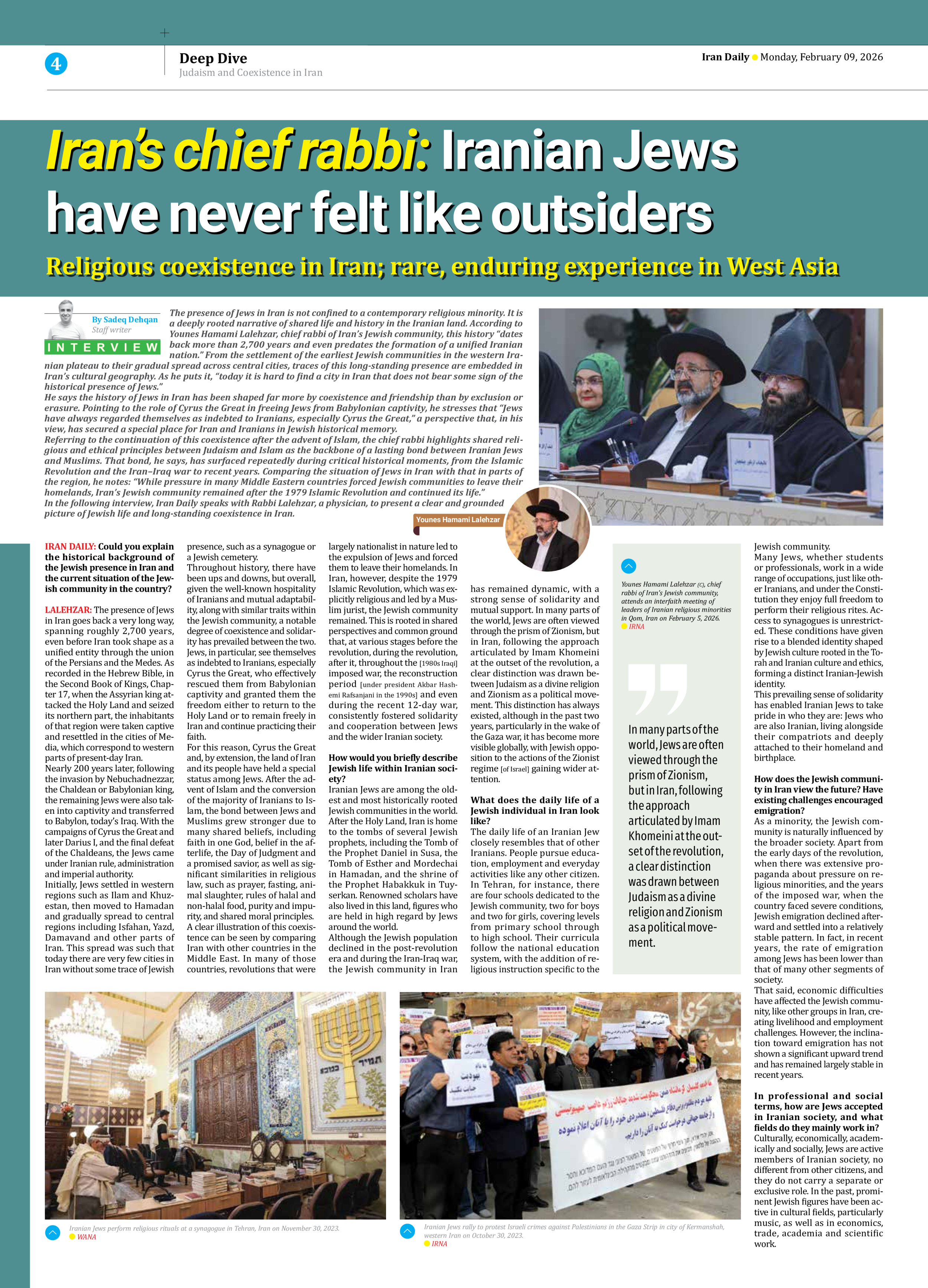


Iran’s chief rabbi:
Iranian Jews have never felt like outsiders
Religious coexistence in Iran; rare, enduring experience in West Asia
The presence of Jews in Iran is not confined to a contemporary religious minority. It is a deeply rooted narrative of shared life and history in the Iranian land. According to Younes Hamami Lalehzar, chief rabbi of Iran’s Jewish community, this history “dates back more than 2,700 years and even predates the formation of a unified Iranian nation.” From the settlement of the earliest Jewish communities in the western Iranian plateau to their gradual spread across central cities, traces of this long-standing presence are embedded in Iran’s cultural geography. As he puts it, “today it is hard to find a city in Iran that does not bear some sign of the historical presence of Jews.” He says the history of Jews in Iran has been shaped far more by coexistence and friendship than by exclusion or erasure. Pointing to the role of Cyrus the Great in freeing Jews from Babylonian captivity, he stresses that “Jews have always regarded themselves as indebted to Iranians, especially Cyrus the Great,” a perspective that, in his view, has secured a special place for Iran and Iranians in Jewish historical memory. Referring to the continuation of this coexistence after the advent of Islam, the chief rabbi highlights shared religious and ethical principles between Judaism and Islam as the backbone of a lasting bond between Iranian Jews and Muslims. That bond, he says, has surfaced repeatedly during critical historical moments, from the Islamic Revolution and the Iran–Iraq war to recent years. Comparing the situation of Jews in Iran with that in parts of the region, he notes: “While pressure in many Middle Eastern countries forced Jewish communities to leave their homelands, Iran’s Jewish community remained after the 1979 Islamic Revolution and continued its life.” In the following interview, Iran Daily speaks with Rabbi Lalehzar, a physician, to present a clear and grounded picture of Jewish life and long-standing coexistence in Iran.
By Sadeq Dehqan
Staff writer
IRAN DAILY: Could you explain the historical background of the Jewish presence in Iran and the current situation of the Jewish community in the country?
LALEHZAR: The presence of Jews in Iran goes back a very long way, spanning roughly 2,700 years, even before Iran took shape as a unified entity through the union of the Persians and the Medes. As recorded in the Hebrew Bible, in the Second Book of Kings, Chapter 17, when the Assyrian king attacked the Holy Land and seized its northern part, the inhabitants of that region were taken captive and resettled in the cities of Media, which correspond to western parts of present-day Iran.
Nearly 200 years later, following the invasion by Nebuchadnezzar, the Chaldean or Babylonian king, the remaining Jews were also taken into captivity and transferred to Babylon, today’s Iraq. With the campaigns of Cyrus the Great and later Darius I, and the final defeat of the Chaldeans, the Jews came under Iranian rule, administration and imperial authority.
Initially, Jews settled in western regions such as Ilam and Khuzestan, then moved to Hamadan and gradually spread to central regions including Isfahan, Yazd, Damavand and other parts of Iran. This spread was such that today there are very few cities in Iran without some trace of Jewish presence, such as a synagogue or a Jewish cemetery.
Throughout history, there have been ups and downs, but overall, given the well-known hospitality of Iranians and mutual adaptability, along with similar traits within the Jewish community, a notable degree of coexistence and solidarity has prevailed between the two. Jews, in particular, see themselves as indebted to Iranians, especially Cyrus the Great, who effectively rescued them from Babylonian captivity and granted them the freedom either to return to the Holy Land or to remain freely in Iran and continue practicing their faith.
For this reason, Cyrus the Great and, by extension, the land of Iran and its people have held a special status among Jews. After the advent of Islam and the conversion of the majority of Iranians to Islam, the bond between Jews and Muslims grew stronger due to many shared beliefs, including faith in one God, belief in the afterlife, the Day of Judgment and a promised savior, as well as significant similarities in religious law, such as prayer, fasting, animal slaughter, rules of halal and non-halal food, purity and impurity, and shared moral principles.
A clear illustration of this coexistence can be seen by comparing Iran with other countries in the Middle East. In many of those countries, revolutions that were largely nationalist in nature led to the expulsion of Jews and forced them to leave their homelands. In Iran, however, despite the 1979 Islamic Revolution, which was explicitly religious and led by a Muslim jurist, the Jewish community remained. This is rooted in shared perspectives and common ground that, at various stages before the revolution, during the revolution, after it, throughout the [1980s Iraqi] imposed war, the reconstruction period [under president Akbar Hashemi Rafsanjani in the 1990s] and even during the recent 12-day war, consistently fostered solidarity and cooperation between Jews and the wider Iranian society.
How would you briefly describe Jewish life within Iranian society?
Iranian Jews are among the oldest and most historically rooted Jewish communities in the world. After the Holy Land, Iran is home to the tombs of several Jewish prophets, including the Tomb of the Prophet Daniel in Susa, the Tomb of Esther and Mordechai in Hamadan, and the shrine of the Prophet Habakkuk in Tuyserkan. Renowned scholars have also lived in this land, figures who are held in high regard by Jews around the world.
Although the Jewish population declined in the post-revolution era and during the Iran-Iraq war, the Jewish community in Iran has remained dynamic, with a strong sense of solidarity and mutual support. In many parts of the world, Jews are often viewed through the prism of Zionism, but in Iran, following the approach articulated by Imam Khomeini at the outset of the revolution, a clear distinction was drawn between Judaism as a divine religion and Zionism as a political movement. This distinction has always existed, although in the past two years, particularly in the wake of the Gaza war, it has become more visible globally, with Jewish opposition to the actions of the Zionist regime [of Israel] gaining wider attention.
What does the daily life of a Jewish individual in Iran look like?
The daily life of an Iranian Jew closely resembles that of other Iranians. People pursue education, employment and everyday activities like any other citizen. In Tehran, for instance, there are four schools dedicated to the Jewish community, two for boys and two for girls, covering levels from primary school through to high school. Their curricula follow the national education system, with the addition of religious instruction specific to the Jewish community.
Many Jews, whether students or professionals, work in a wide range of occupations, just like other Iranians, and under the Constitution they enjoy full freedom to perform their religious rites. Access to synagogues is unrestricted. These conditions have given rise to a blended identity shaped by Jewish culture rooted in the Torah and Iranian culture and ethics, forming a distinct Iranian-Jewish identity.
This prevailing sense of solidarity has enabled Iranian Jews to take pride in who they are: Jews who are also Iranian, living alongside their compatriots and deeply attached to their homeland and birthplace.
How does the Jewish community in Iran view the future? Have existing challenges encouraged emigration?
As a minority, the Jewish community is naturally influenced by the broader society. Apart from the early days of the revolution, when there was extensive propaganda about pressure on religious minorities, and the years of the imposed war, when the country faced severe conditions, Jewish emigration declined afterward and settled into a relatively stable pattern. In fact, in recent years, the rate of emigration among Jews has been lower than that of many other segments of society.
That said, economic difficulties have affected the Jewish community, like other groups in Iran, creating livelihood and employment challenges. However, the inclination toward emigration has not shown a significant upward trend and has remained largely stable in recent years.
In professional and social terms, how are Jews accepted in Iranian society, and what fields do they mainly work in?
Culturally, economically, academically and socially, Jews are active members of Iranian society, no different from other citizens, and they do not carry a separate or exclusive role. In the past, prominent Jewish figures have been active in cultural fields, particularly music, as well as in economics, trade, academia and scientific work.
One point that may warrant criticism is that Jews are less visible in the media or are spoken about less frequently. At times, contrary to the views expressed by Imam Khomeini and the Leader (Ayatollah Khamenei), even occasions such as the Jewish New Year or the birth and passing of Prophet Moses are not reflected in national media, an issue that could receive greater attention.
How does the broader society view Jews? Despite being a minority, is there any sense of separation or alienation?
Jews, Muslims and other religious minorities in Iran live alongside one another with mutual respect and do not feel alienated, because they consider Iran to be their own country. As mentioned earlier, there are many shared values, and the spirit of hospitality and adaptability among Iranians, whether Jewish or Muslim, has played a key role in this coexistence.
Whether in the past, when neighbors knew one another well and supported each other, or in today’s more urbanized life where social ties may be looser, this sense of solidarity continues in workplaces and social settings. This model of coexistence shows that despite differences in belief, shared human, ethical and civic values far outweigh divisions. From a monotheistic perspective, all human beings are creations of God, and just as no parent wishes to see discord among their children, God does not approve of injustice or conflict among His servants. This religious and human outlook can serve as a model for better coexistence worldwide, as reflected in the Torah’s teaching to “love your neighbor as yourself.”
Could you explain the difference between Judaism and Zionism, and why some people conflate the two?
Judaism is a monotheistic and divine religion with a history of more than 3,300 years, dating back to the time of Prophet Moses. Zionism, by contrast, is a political party and movement that emerged in the late 19th century within the context of nationalism. Zionism has exploited certain religious ideals of Judaism.
According to Jewish religious beliefs, a return to the Holy Land and the rebuilding of the Temple in Jerusalem (Al-Quds) can only take place with the emergence of the promised savior. Zionism, however, removed these beliefs from their religious framework and pursued actions devoid of justice and human dignity, actions that were not endorsed by many Jews from the outset. Over time, as Zionist objectives became clearer, Jewish opposition to the movement grew.
Today, there are even Christian and Muslim Zionists, but because Zionism emerged from within a Jewish context and misused its ideals, Jewish opposition to it has been more pronounced. Over the past two years, particularly following the Gaza war, this distinction and opposition have become more visible, with Jewish communities in countries such as the United States, Canada and the United Kingdom staging protests against the actions of the Zionist regime. In Iran, this opposition has also taken shape through gatherings and statements.
Therefore, religious Jews have consistently emphasized that just as ISIS does not represent Islam, Zionism does not represent Judaism. Even ISIS claims to act in the name of religion, while Zionists make no such claim.
Is the kind of antisemitism seen in Europe, particularly around the Holocaust, present in Muslim societies and especially in Iran?
What is known as antisemitism has its roots in European and Christian history and has never existed as an organized current in Islamic countries, particularly in Iran. There may be isolated disagreements, but no systematic anti-Jewish movement has been observed in Iran.
Today, Iranian Jews are fully free to practice their religious rituals. Synagogues operate without the presence of special security forces, whereas in many European countries, due to security concerns, entry to synagogues requires passing through protective checkpoints. This contrast underscores the genuine coexistence and solidarity between Muslims and Jews in Iran, a coexistence that stands in sharp contrast to the actions of the Zionist regime in the occupied territories, where the rights of other residents are ignored and repression and killing are used as tools of control.
How do you assess the roots of tension between Muslims and Zionists in the occupied territories?
The main root of these tensions lies in the denial of the rights of others and of minorities, whether from a religious, human or human rights perspective. All residents of a land have the right to life, freedom and basic rights. When these rights are repeatedly violated, tension and conflict become inevitable.
The iron-fist pressure exercised by the Zionist regime cannot go on indefinitely. What ultimately ensures the survival of human society is the observance of justice and fairness, a principle also embedded in the belief in the promised savior, meaning the establishment of a divine and just order in which oppression and injustice are eliminated and people live peacefully alongside one another. One can only hope that such conditions will be realized sooner rather than later.