







Copy in clipboard...
Petropars:
Farzad B joint gas field enters operational phase after long hiatus
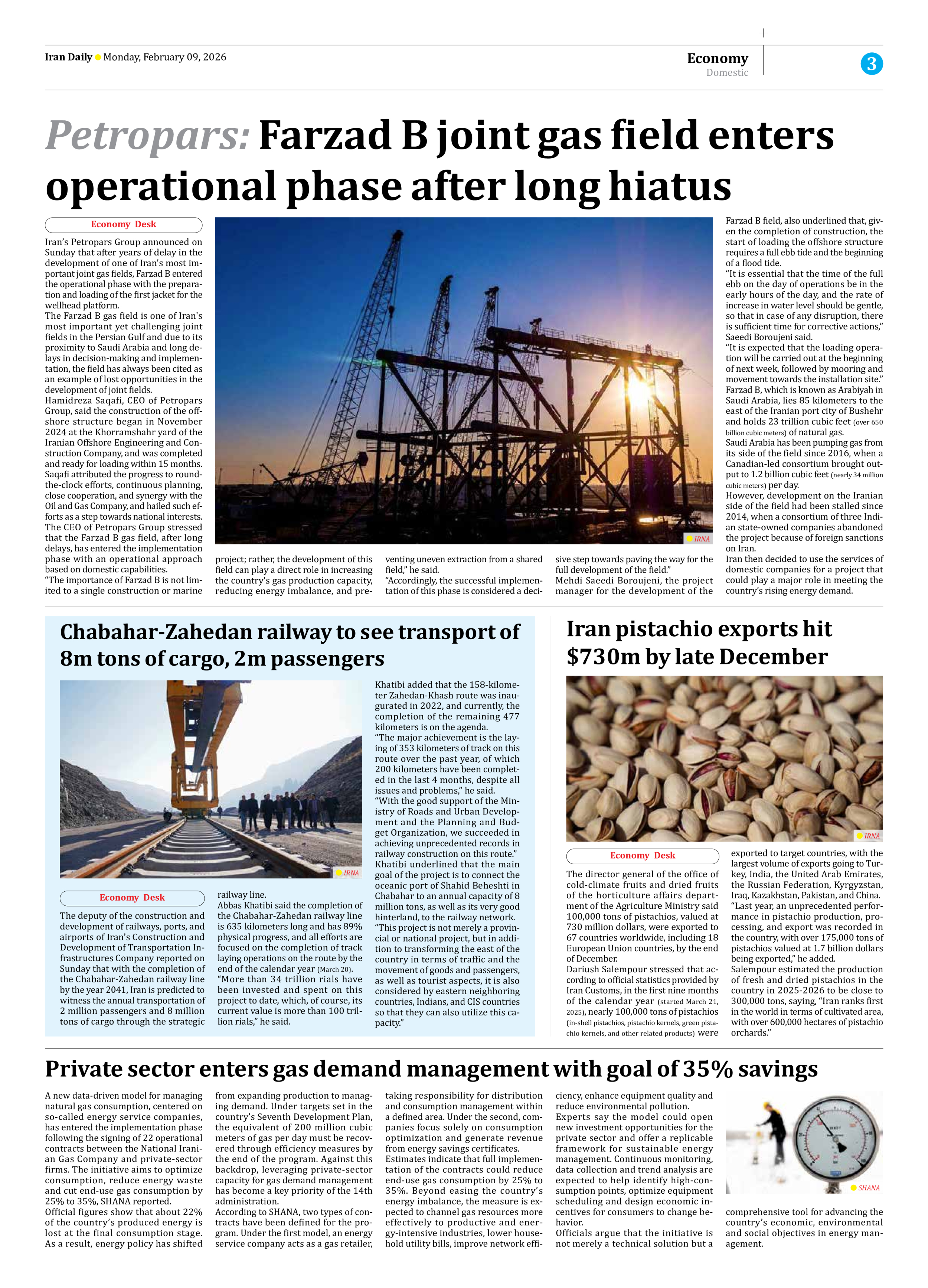
Iran’s Petropars Group announced on Sunday that after years of delay in the development of one of Iran's most important joint gas fields, Farzad B entered the operational phase with the preparation and loading of the first jacket for the wellhead platform.
The Farzad B gas field is one of Iran's most important yet challenging joint fields in the Persian Gulf and due to its proximity to Saudi Arabia and long delays in decision-making and implementation, the field has always been cited as an example of lost opportunities in the development of joint fields.
Hamidreza Saqafi, CEO of Petropars Group, said the construction of the offshore structure began in November 2024 at the Khorramshahr yard of the Iranian Offshore Engineering and Construction Company, and was completed and ready for loading within 15 months.
Saqafi attributed the progress to round-the-clock efforts, continuous planning, close cooperation, and synergy with the Oil and Gas Company, and hailed such efforts as a step towards national interests.
The CEO of Petropars Group stressed that the Farzad B gas field, after long delays, has entered the implementation phase with an operational approach based on domestic capabilities.
“The importance of Farzad B is not limited to a single construction or marine project; rather, the development of this field can play a direct role in increasing the country's gas production capacity, reducing energy imbalance, and preventing uneven extraction from a shared field,” he said.
“Accordingly, the successful implementation of this phase is considered a decisive step towards paving the way for the full development of the field.”
Mehdi Saeedi Boroujeni, the project manager for the development of the Farzad B field, also underlined that, given the completion of construction, the start of loading the offshore structure requires a full ebb tide and the beginning of a flood tide.
“It is essential that the time of the full ebb on the day of operations be in the early hours of the day, and the rate of increase in water level should be gentle, so that in case of any disruption, there is sufficient time for corrective actions,” Saeedi Boroujeni said.
“It is expected that the loading operation will be carried out at the beginning of next week, followed by mooring and movement towards the installation site.”
Farzad B, which is known as Arabiyah in Saudi Arabia, lies 85 kilometers to the east of the Iranian port city of Bushehr and holds 23 trillion cubic feet (over 650 billion cubic meters) of natural gas.
Saudi Arabia has been pumping gas from its side of the field since 2016, when a Canadian-led consortium brought output to 1.2 billion cubic feet (nearly 34 million cubic meters) per day.
However, development on the Iranian side of the field had been stalled since 2014, when a consortium of three Indian state-owned companies abandoned the project because of foreign sanctions on Iran.
Iran then decided to use the services of domestic companies for a project that could play a major role in meeting the country’s rising energy demand.