





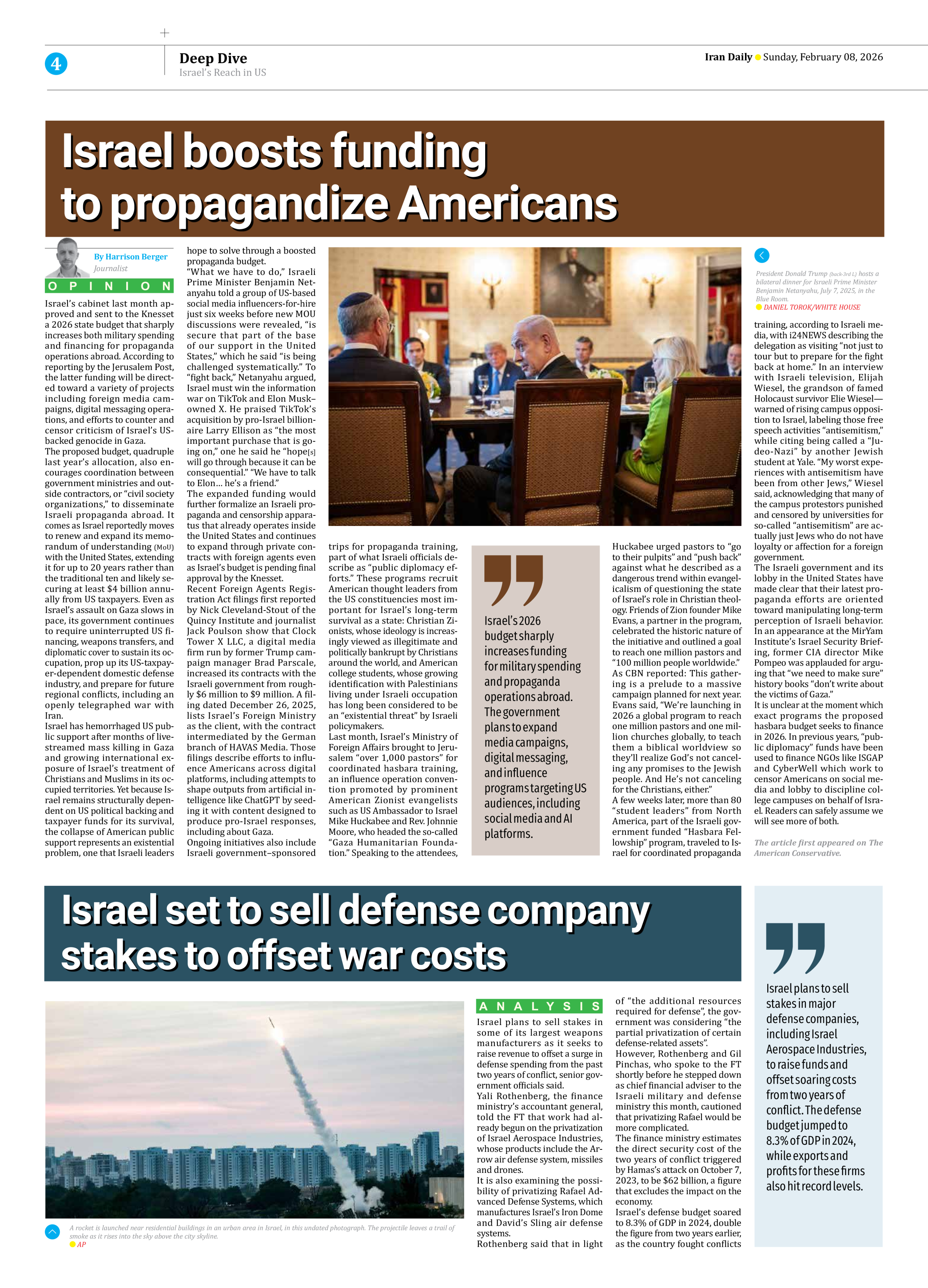


Israel set to sell defense company stakes to offset war costs
Israel plans to sell stakes in some of its largest weapons manufacturers as it seeks to raise revenue to offset a surge in defense spending from the past two years of conflict, senior government officials said.
Yali Rothenberg, the finance ministry’s accountant general, told the FT that work had already begun on the privatization of Israel Aerospace Industries, whose products include the Arrow air defense system, missiles and drones.
It is also examining the possibility of privatizing Rafael Advanced Defense Systems, which manufactures Israel’s Iron Dome and David’s Sling air defense systems.
Rothenberg said that in light of “the additional resources required for defense”, the government was considering “the partial privatization of certain defense-related assets”.
However, Rothenberg and Gil Pinchas, who spoke to the FT shortly before he stepped down as chief financial adviser to the Israeli military and defense ministry this month, cautioned that privatizing Rafael would be more complicated.
The finance ministry estimates the direct security cost of the two years of conflict triggered by Hamas’s attack on October 7, 2023, to be $62 billion, a figure that excludes the impact on the economy.
Israel’s defense budget soared to 8.3% of GDP in 2024, double the figure from two years earlier, as the country fought conflicts on at least seven fronts, including in Gaza, Lebanon, Syria and Iran.
In addition, the US has provided at least $21.7 billion to Israel since Hamas’s attack, according to the Quincy Institute for Responsible Tradecraft.
Following US-backed ceasefires in Gaza and elsewhere, Israel’s defense budget is forecast to fall to about 5 percent of GDP this year, or $35 billion, and remain at that level for the medium term, Rothenberg said.
The huge spend on defense and the broader economic impact of the war meant growth declined and the budget deficit widened to 6.8 percent of GDP in 2024.
Rothenberg said the government’s “working assumption” was that it would sell a 25 per cent stake in IAI, “with an upper range of up to 49 percent, subject to government decisions”.
In a separate interview Pinchas, an Israeli brigadier general, put the initial sale at between 20 percent and 25 percent of the state-owned company, predicting it would happen “within a year or two”.
It was too early to determine IAI’s valuation, Rothenberg said, but cited the company’s order book of almost $30 billion in arms sales as an indicator of its size.
IAI reported sales of $6.1billion in 2024, and net income of about $493 million, a 55 percent increase on the previous year.
Rafael has enjoyed a similar boost, with its sales in 2024 increasing by more than a quarter to $4.8 billion and its net profit rising 64 percent to $257milion compared with the previous year.
It developed Israel’s vaunted Iron Dome system, which was designed to intercept short-range rockets fired from Gaza and elsewhere, with US funding and support, but Israel has never sold the system to a third country despite numerous requests.
Israel’s defense industry had record exports of $14.8 billion in 2024, even as the country faced increasing international condemnation over the conduct of its war against Hamas in Gaza.
Pinchas said income generated from the sale of a stake in IAI would help both Israel’s state finances and reinvestment into the firm itself.
The finance ministry often finds itself in a struggle with the defense ministry over spending and budgets.
But the latter could also be expected to make changes to help replenish the government’s coffers, including moving some of its operations, such as major bases like the Kirya military headquarters, located in a prime area of central Tel Aviv, to areas where property prices are cheaper.
Rothenberg said “discussions are taking place regarding the relocation of certain Ministry of Defiance activities to lower-cost areas, which could allow for the monetization of existing land assets”.
“Any such measures are intended to help offset the long-term fiscal and financial implications of increased defense expenditure,” he said.
This article was originally
published in Financial Times.