







‘Doctrine of impunity’ for Israel menacing regional stability: Araghchi
Iran’s missile program ‘never negotiable’
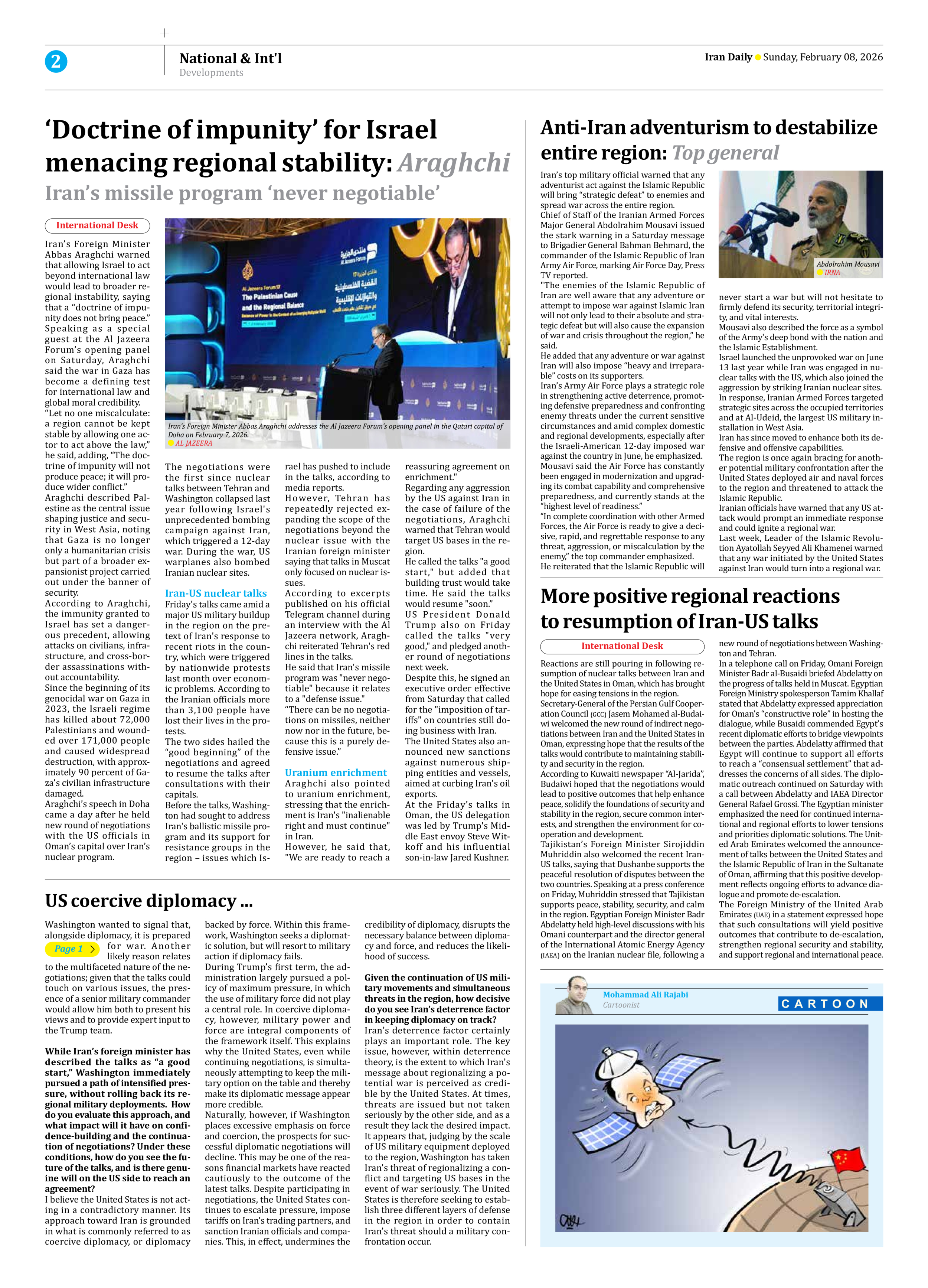
Iran’s Foreign Minister Abbas Araghchi warned that allowing Israel to act beyond international law would lead to broader regional instability, saying that a “doctrine of impunity does not bring peace.”
Speaking as a special guest at the Al Jazeera Forum’s opening panel on Saturday, Araghchi said the war in Gaza has become a defining test for international law and global moral credibility.
“Let no one miscalculate: a region cannot be kept stable by allowing one actor to act above the law,” he said, adding, “The doctrine of impunity will not produce peace; it will produce wider conflict.”
Araghchi described Palestine as the central issue shaping justice and security in West Asia, noting that Gaza is no longer only a humanitarian crisis but part of a broader expansionist project carried out under the banner of security.
According to Araghchi, the immunity granted to Israel has set a dangerous precedent, allowing attacks on civilians, infrastructure, and cross-border assassinations without accountability.
Since the beginning of its genocidal war on Gaza in 2023, the Israeli regime has killed about 72,000 Palestinians and wounded over 171,000 people and caused widespread destruction, with approximately 90 percent of Gaza’s civilian infrastructure damaged.
Araghchi’s speech in Doha came a day after he held new round of negotiations with the US officials in Oman’s capital over Iran’s nuclear program.
The negotiations were the first since nuclear talks between Tehran and Washington collapsed last year following Israel's unprecedented bombing campaign against Iran, which triggered a 12-day war. During the war, US warplanes also bombed Iranian nuclear sites.
Iran-US nuclear talks
Friday's talks came amid a major US military buildup in the region on the pretext of Iran's response to recent riots in the country, which were triggered by nationwide protests last month over economic problems. According to the Iranian officials more than 3,100 people have lost their lives in the protests.
The two sides hailed the “good beginning” of the negotiations and agreed to resume the talks after consultations with their capitals.
Before the talks, Washington had sought to address Iran's ballistic missile program and its support for resistance groups in the region – issues which Israel has pushed to include in the talks, according to media reports.
However, Tehran has repeatedly rejected expanding the scope of the negotiations beyond the nuclear issue with the Iranian foreign minister saying that talks in Muscat only focused on nuclear issues.
According to excerpts published on his official Telegram channel during an interview with the Al Jazeera network, Araghchi reiterated Tehran's red lines in the talks.
He said that Iran's missile program was "never negotiable" because it relates to a "defense issue."
“There can be no negotiations on missiles, neither now nor in the future, because this is a purely defensive issue.”
Uranium enrichment
Araghchi also pointed to uranium enrichment, stressing that the enrichment is Iran's "inalienable right and must continue" in Iran.
However, he said that, "We are ready to reach a reassuring agreement on enrichment."
Regarding any aggression by the US against Iran in the case of failure of the negotiations, Araghchi warned that Tehran would target US bases in the region.
He called the talks "a good start," but added that building trust would take time. He said the talks would resume "soon.”
US President Donald Trump also on Friday called the talks "very good," and pledged another round of negotiations next week.
Despite this, he signed an executive order effective from Saturday that called for the "imposition of tariffs" on countries still doing business with Iran.
The United States also announced new sanctions against numerous shipping entities and vessels, aimed at curbing Iran's oil exports.
At the Friday's talks in Oman, the US delegation was led by Trump's Middle East envoy Steve Witkoff and his influential son-in-law Jared Kushner.