





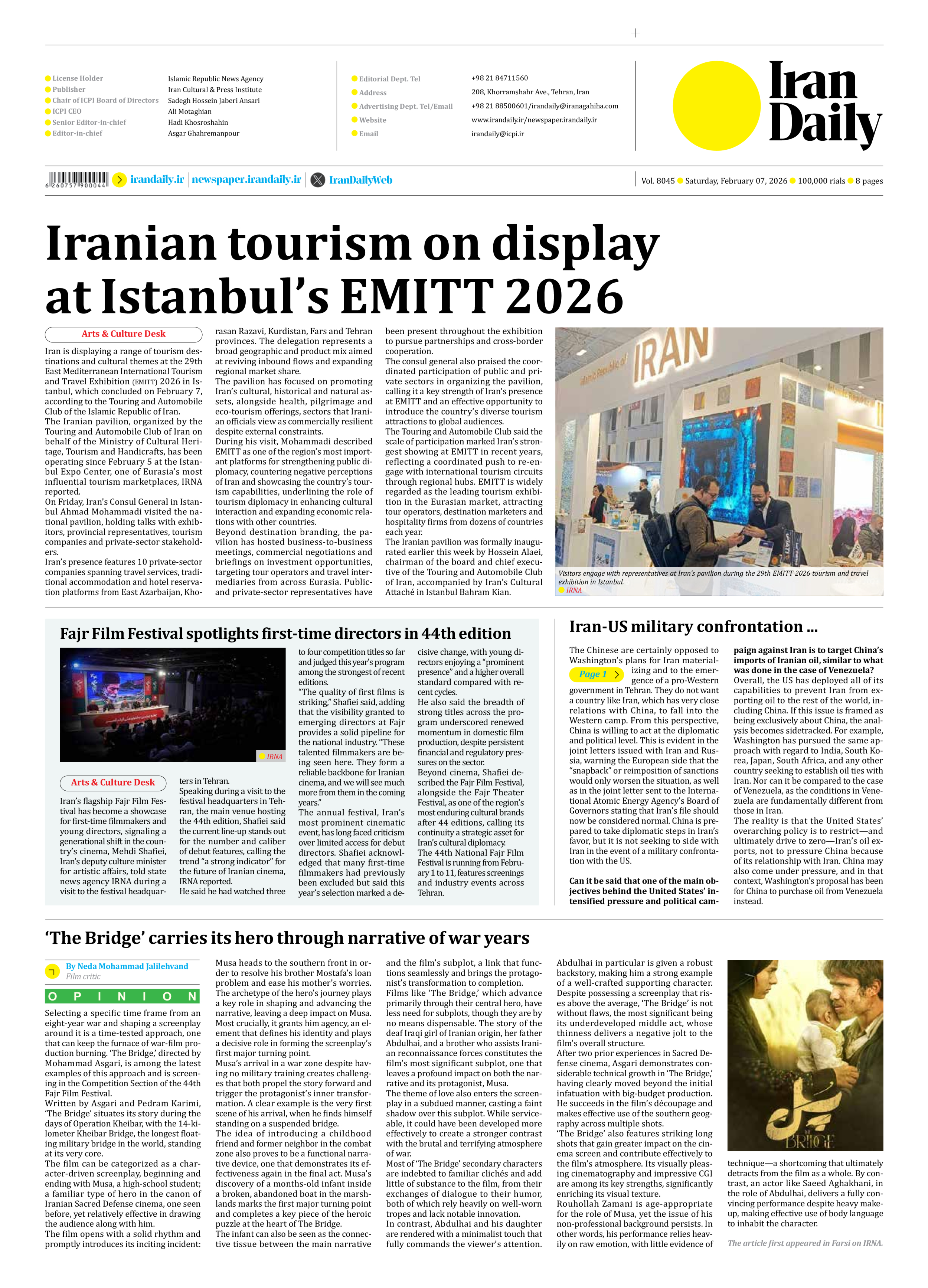


‘The Bridge’ carries its hero through narrative of war years
By Neda Mohammad Jalilehvand
Film critic
Selecting a specific time frame from an eight-year war and shaping a screenplay around it is a time-tested approach, one that can keep the furnace of war-film production burning. ‘The Bridge,’ directed by Mohammad Asgari, is among the latest examples of this approach and is screening in the Competition Section of the 44th Fajr Film Festival.
Written by Asgari and Pedram Karimi, ‘The Bridge’ situates its story during the days of Operation Kheibar, with the 14-kilometer Kheibar Bridge, the longest floating military bridge in the world, standing at its very core.
The film can be categorized as a character-driven screenplay, beginning and ending with Musa, a high-school student; a familiar type of hero in the canon of Iranian Sacred Defense cinema, one seen before, yet relatively effective in drawing the audience along with him.
The film opens with a solid rhythm and promptly introduces its inciting incident: Musa heads to the southern front in order to resolve his brother Mostafa’s loan problem and ease his mother’s worries. The archetype of the hero’s journey plays a key role in shaping and advancing the narrative, leaving a deep impact on Musa. Most crucially, it grants him agency, an element that defines his identity and plays a decisive role in forming the screenplay’s first major turning point.
Musa’s arrival in a war zone despite having no military training creates challenges that both propel the story forward and trigger the protagonist’s inner transformation. A clear example is the very first scene of his arrival, when he finds himself standing on a suspended bridge.
The idea of introducing a childhood friend and former neighbor in the combat zone also proves to be a functional narrative device, one that demonstrates its effectiveness again in the final act. Musa’s discovery of a months-old infant inside a broken, abandoned boat in the marshlands marks the first major turning point and completes a key piece of the heroic puzzle at the heart of The Bridge.
The infant can also be seen as the connective tissue between the main narrative and the film’s subplot, a link that functions seamlessly and brings the protagonist’s transformation to completion.
Films like ‘The Bridge,’ which advance primarily through their central hero, have less need for subplots, though they are by no means dispensable. The story of the deaf Iraqi girl of Iranian origin, her father Abdulhai, and a brother who assists Iranian reconnaissance forces constitutes the film’s most significant subplot, one that leaves a profound impact on both the narrative and its protagonist, Musa.
The theme of love also enters the screenplay in a subdued manner, casting a faint shadow over this subplot. While serviceable, it could have been developed more effectively to create a stronger contrast with the brutal and terrifying atmosphere of war.
Most of ‘The Bridge’ secondary characters are indebted to familiar clichés and add little of substance to the film, from their exchanges of dialogue to their humor, both of which rely heavily on well-worn tropes and lack notable innovation.
In contrast, Abdulhai and his daughter are rendered with a minimalist touch that fully commands the viewer’s attention. Abdulhai in particular is given a robust backstory, making him a strong example of a well-crafted supporting character. Despite possessing a screenplay that rises above the average, ‘The Bridge’ is not without flaws, the most significant being its underdeveloped middle act, whose thinness delivers a negative jolt to the film’s overall structure.
After two prior experiences in Sacred Defense cinema, Asgari demonstrates considerable technical growth in ‘The Bridge,’ having clearly moved beyond the initial infatuation with big-budget production. He succeeds in the film’s découpage and makes effective use of the southern geography across multiple shots.
‘The Bridge’ also features striking long shots that gain greater impact on the cinema screen and contribute effectively to the film’s atmosphere. Its visually pleasing cinematography and impressive CGI are among its key strengths, significantly enriching its visual texture.
Rouhollah Zamani is age-appropriate for the role of Musa, yet the issue of his non-professional background persists. In other words, his performance relies heavily on raw emotion, with little evidence of technique—a shortcoming that ultimately detracts from the film as a whole. By contrast, an actor like Saeed Aghakhani, in the role of Abdulhai, delivers a fully convincing performance despite heavy makeup, making effective use of body language to inhabit the character.
The article first appeared in Farsi on IRNA.