





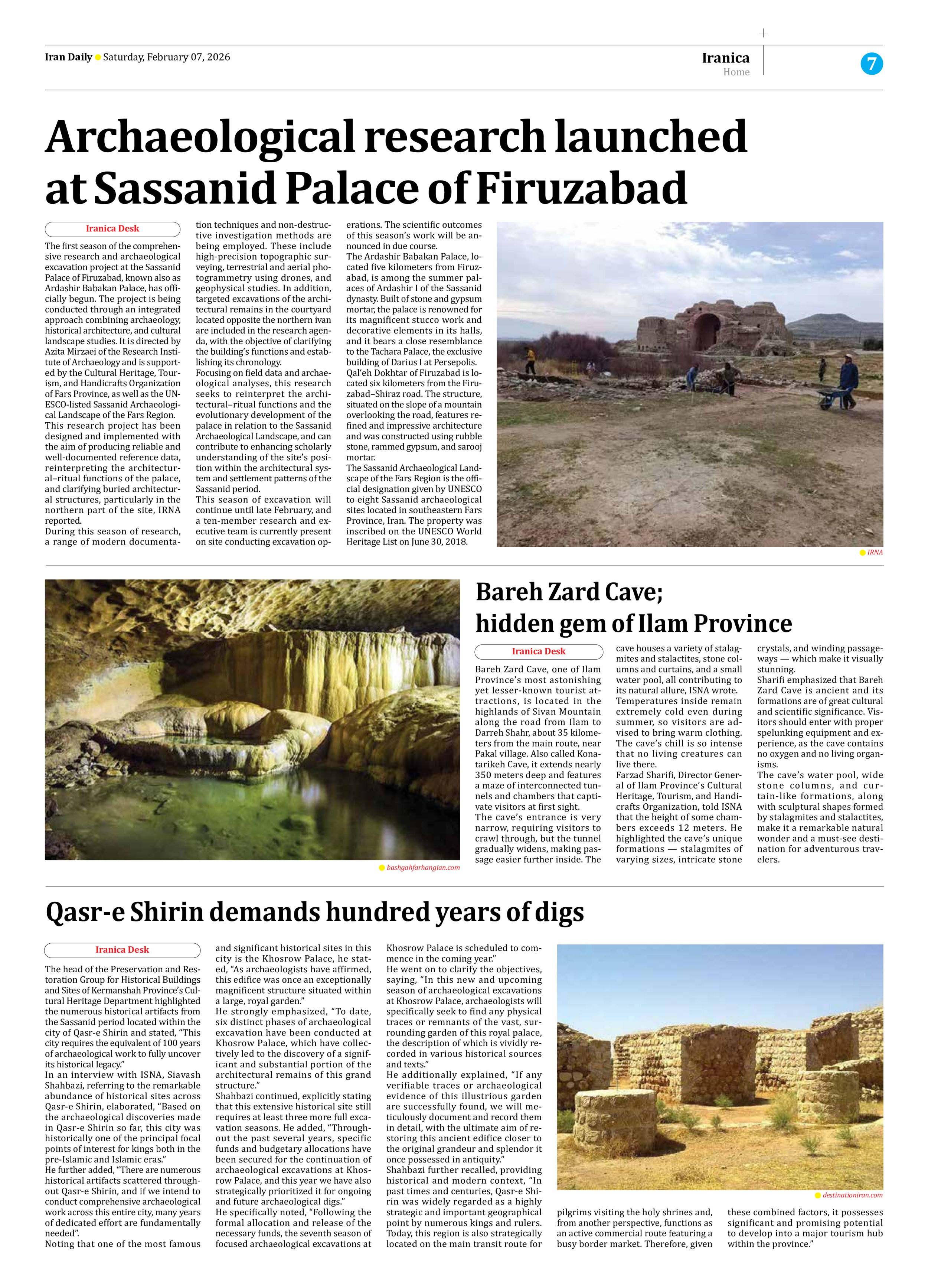


Qasr-e Shirin demands hundred years of digs
The head of the Preservation and Restoration Group for Historical Buildings and Sites of Kermanshah Province’s Cultural Heritage Department highlighted the numerous historical artifacts from the Sassanid period located within the city of Qasr-e Shirin and stated, “This city requires the equivalent of 100 years of archaeological work to fully uncover its historical legacy.”
In an interview with ISNA, Siavash Shahbazi, referring to the remarkable abundance of historical sites across Qasr-e Shirin, elaborated, “Based on the archaeological discoveries made in Qasr-e Shirin so far, this city was historically one of the principal focal points of interest for kings both in the pre-Islamic and Islamic eras.”
He further added, “There are numerous historical artifacts scattered throughout Qasr-e Shirin, and if we intend to conduct comprehensive archaeological work across this entire city, many years of dedicated effort are fundamentally needed”.
Noting that one of the most famous and significant historical sites in this city is the Khosrow Palace, he stated, “As archaeologists have affirmed, this edifice was once an exceptionally magnificent structure situated within a large, royal garden.”
He strongly emphasized, “To date, six distinct phases of archaeological excavation have been conducted at Khosrow Palace, which have collectively led to the discovery of a significant and substantial portion of the architectural remains of this grand structure.”
Shahbazi continued, explicitly stating that this extensive historical site still requires at least three more full excavation seasons. He added, “Throughout the past several years, specific funds and budgetary allocations have been secured for the continuation of archaeological excavations at Khosrow Palace, and this year we have also strategically prioritized it for ongoing and future archaeological digs.”
He specifically noted, “Following the formal allocation and release of the necessary funds, the seventh season of focused archaeological excavations at Khosrow Palace is scheduled to commence in the coming year.”
He went on to clarify the objectives, saying, “In this new and upcoming season of archaeological excavations at Khosrow Palace, archaeologists will specifically seek to find any physical traces or remnants of the vast, surrounding garden of this royal palace, the description of which is vividly recorded in various historical sources and texts.”
He additionally explained, “If any verifiable traces or archaeological evidence of this illustrious garden are successfully found, we will meticulously document and record them in detail, with the ultimate aim of restoring this ancient edifice closer to the original grandeur and splendor it once possessed in antiquity.”
Shahbazi further recalled, providing historical and modern context, “In past times and centuries, Qasr-e Shirin was widely regarded as a highly strategic and important geographical point by numerous kings and rulers. Today, this region is also strategically located on the main transit route for pilgrims visiting the holy shrines and, from another perspective, functions as an active commercial route featuring a busy border market. Therefore, given these combined factors, it possesses significant and promising potential to develop into a major tourism hub within the province.”