







Copper projects, graphite plant opened in Kerman to boost domestic output
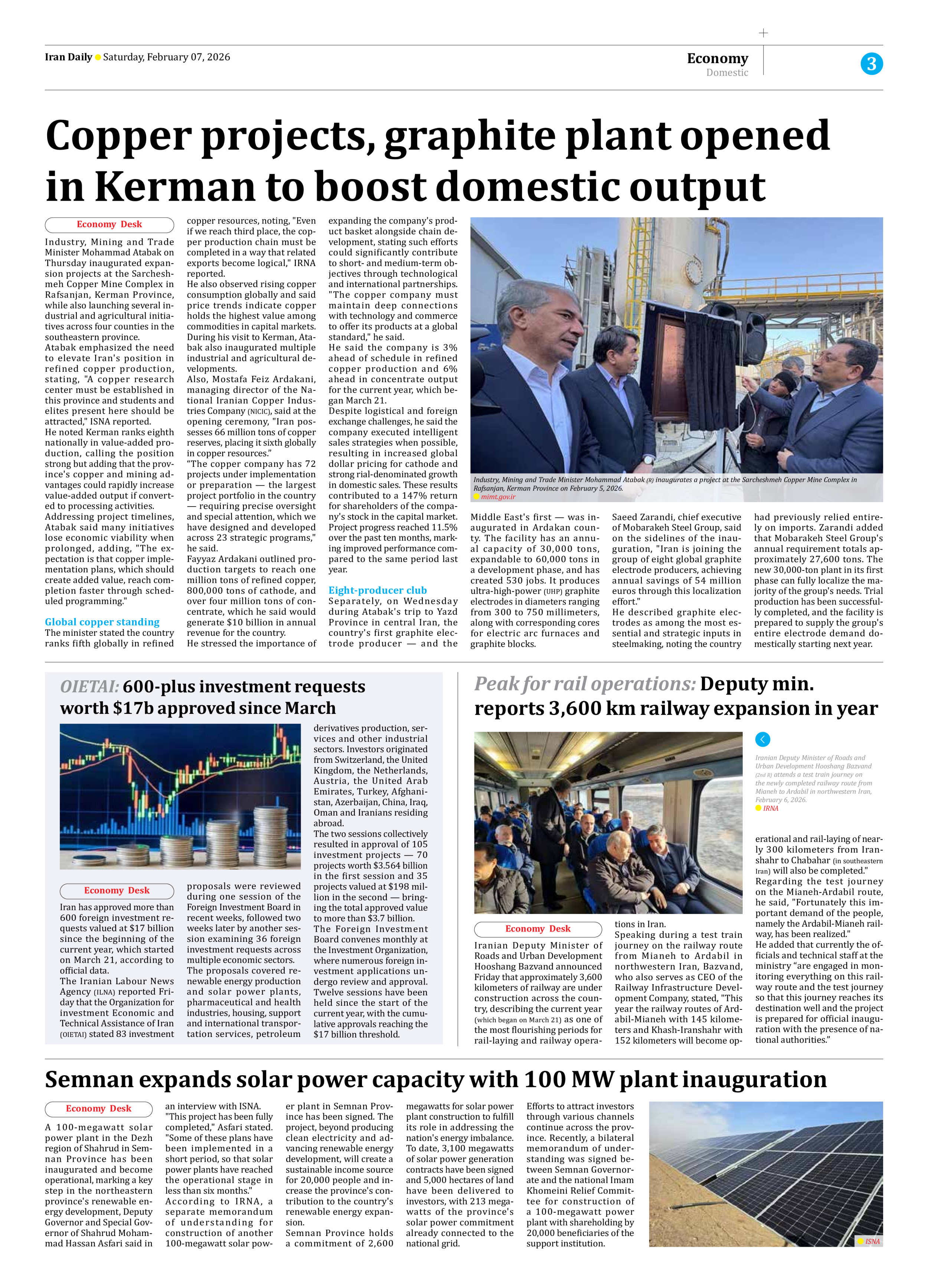
Industry, Mining and Trade Minister Mohammad Atabak on Thursday inaugurated expansion projects at the Sarcheshmeh Copper Mine Complex in Rafsanjan, Kerman Province, while also launching several industrial and agricultural initiatives across four counties in the southeastern province.
Atabak emphasized the need to elevate Iran's position in refined copper production, stating, "A copper research center must be established in this province and students and elites present here should be attracted," ISNA reported.
He noted Kerman ranks eighth nationally in value-added production, calling the position strong but adding that the province's copper and mining advantages could rapidly increase value-added output if converted to processing activities.
Addressing project timelines, Atabak said many initiatives lose economic viability when prolonged, adding, "The expectation is that copper implementation plans, which should create added value, reach completion faster through scheduled programming."
Global copper standing
The minister stated the country ranks fifth globally in refined copper resources, noting, "Even if we reach third place, the copper production chain must be completed in a way that related exports become logical," IRNA reported.
He also observed rising copper consumption globally and said price trends indicate copper holds the highest value among commodities in capital markets.
During his visit to Kerman, Atabak also inaugurated multiple industrial and agricultural developments.
Also, Mostafa Feiz Ardakani, managing director of the National Iranian Copper Industries Company (NICIC), said at the opening ceremony, "Iran possesses 66 million tons of copper reserves, placing it sixth globally in copper resources.”
“The copper company has 72 projects under implementation or preparation — the largest project portfolio in the country — requiring precise oversight and special attention, which we have designed and developed across 23 strategic programs," he said.
Fayyaz Ardakani outlined production targets to reach one million tons of refined copper, 800,000 tons of cathode, and over four million tons of concentrate, which he said would generate $10 billion in annual revenue for the country.
He stressed the importance of expanding the company's product basket alongside chain development, stating such efforts could significantly contribute to short- and medium-term objectives through technological and international partnerships. "The copper company must maintain deep connections with technology and commerce to offer its products at a global standard," he said.
He said the company is 3% ahead of schedule in refined copper production and 6% ahead in concentrate output for the current year, which began March 21.
Despite logistical and foreign exchange challenges, he said the company executed intelligent sales strategies when possible, resulting in increased global dollar pricing for cathode and strong rial-denominated growth in domestic sales. These results contributed to a 147% return for shareholders of the company's stock in the capital market. Project progress reached 11.5% over the past ten months, marking improved performance compared to the same period last year.
Eight-producer club
Separately, on Wednesday during Atabak's trip to Yazd Province in central Iran, the country's first graphite electrode producer — and the Middle East's first — was inaugurated in Ardakan county. The facility has an annual capacity of 30,000 tons, expandable to 60,000 tons in a development phase, and has created 530 jobs. It produces ultra-high-power (UHP) graphite electrodes in diameters ranging from 300 to 750 millimeters, along with corresponding cores for electric arc furnaces and graphite blocks.
Saeed Zarandi, chief executive of Mobarakeh Steel Group, said on the sidelines of the inauguration, "Iran is joining the group of eight global graphite electrode producers, achieving annual savings of 54 million euros through this localization effort."
He described graphite electrodes as among the most essential and strategic inputs in steelmaking, noting the country had previously relied entirely on imports. Zarandi added that Mobarakeh Steel Group's annual requirement totals approximately 27,600 tons. The new 30,000-ton plant in its first phase can fully localize the majority of the group's needs. Trial production has been successfully completed, and the facility is prepared to supply the group's entire electrode demand domestically starting next year.