







Copy in clipboard...
Iran, US agree to resume talks despite ‘prevailing mistrust’
Araghchi hails Muscat negotiations as ‘very good start’
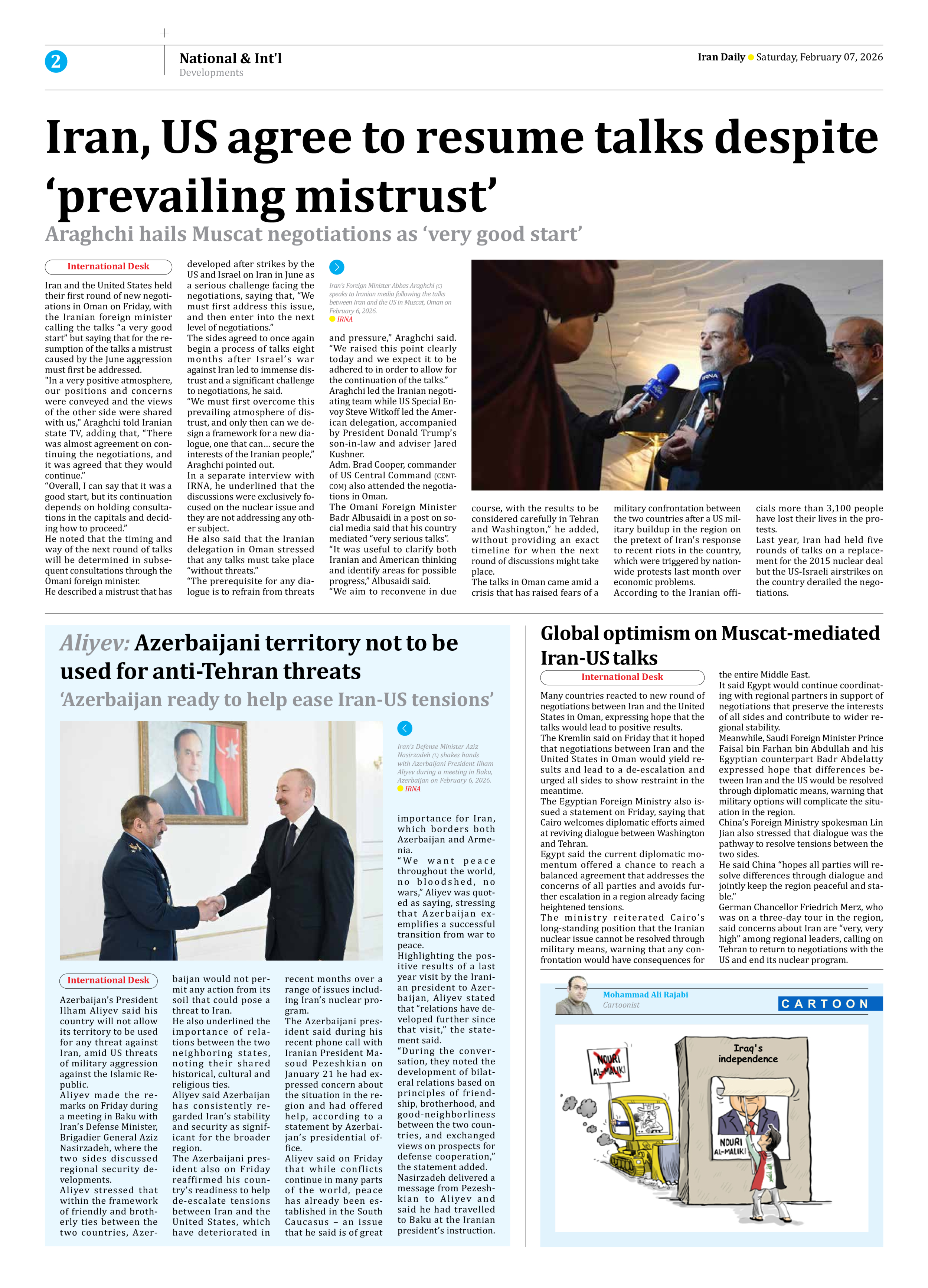
"In a very positive atmosphere, our positions and concerns were conveyed and the views of the other side were shared with us," Araghchi told Iranian state TV, adding that, “There was almost agreement on continuing the negotiations, and it was agreed that they would continue.”
“Overall, I can say that it was a good start, but its continuation depends on holding consultations in the capitals and deciding how to proceed.”
He noted that the timing and way of the next round of talks will be determined in subsequent consultations through the Omani foreign minister.
He described a mistrust that has developed after strikes by the US and Israel on Iran in June as a serious challenge facing the negotiations, saying that, “We must first address this issue, and then enter into the next level of negotiations.”
The sides agreed to once again begin a process of talks eight months after Israel’s war against Iran led to immense distrust and a significant challenge to negotiations, he said.
“We must first overcome this prevailing atmosphere of distrust, and only then can we design a framework for a new dialogue, one that can… secure the interests of the Iranian people,” Araghchi pointed out.
In a separate interview with IRNA, he underlined that the discussions were exclusively focused on the nuclear issue and they are not addressing any other subject.
He also said that the Iranian delegation in Oman stressed that any talks must take place “without threats.”
“The prerequisite for any dialogue is to refrain from threats and pressure,” Araghchi said. “We raised this point clearly today and we expect it to be adhered to in order to allow for the continuation of the talks.”
Araghchi led the Iranian negotiating team while US Special Envoy Steve Witkoff led the American delegation, accompanied by President Donald Trump’s son-in-law and adviser Jared Kushner.
Adm. Brad Cooper, commander of US Central Command (CENTCOM) also attended the negotiations in Oman.
The Omani Foreign Minister Badr Albusaidi in a post on social media said that his country mediated “very serious talks”.
“It was useful to clarify both Iranian and American thinking and identify areas for possible progress,” Albusaidi said.
“We aim to reconvene in due course, with the results to be considered carefully in Tehran and Washington,” he added, without providing an exact timeline for when the next round of discussions might take place.
The talks in Oman came amid a crisis that has raised fears of a military confrontation between the two countries after a US military buildup in the region on the pretext of Iran's response to recent riots in the country, which were triggered by nationwide protests last month over economic problems.
According to the Iranian officials more than 3,100 people have lost their lives in the protests.
Last year, Iran had held five rounds of talks on a replacement for the 2015 nuclear deal but the US-Israeli airstrikes on the country derailed the negotiations.