





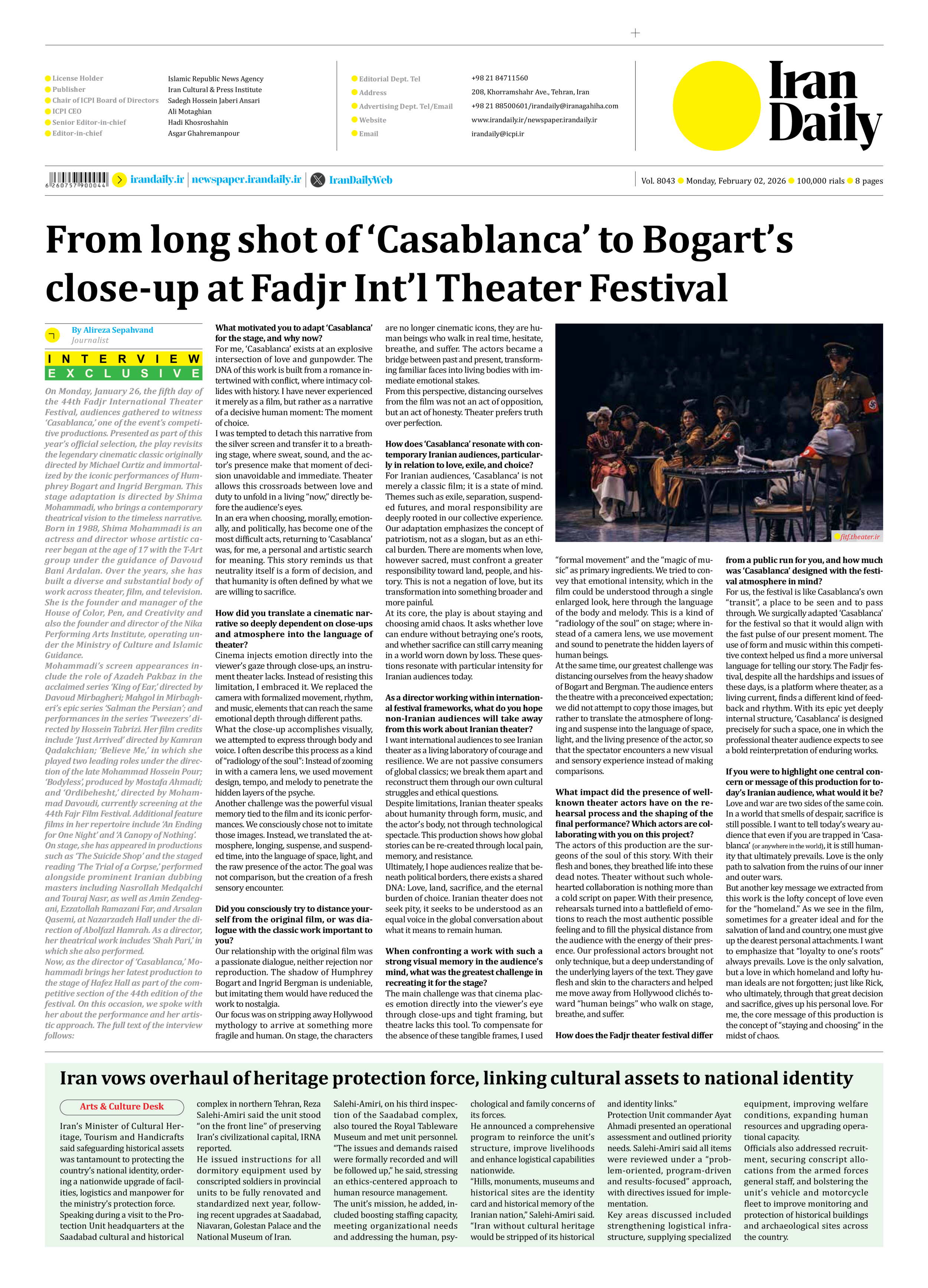


From long shot of ‘Casablanca’ to Bogart’s close-up at Fadjr Int’l Theater Festival
By Alireza Sepahvand
Journalist
On Monday, January 26, the fifth day of the 44th Fadjr International Theater Festival, audiences gathered to witness ‘Casablanca,’ one of the event’s competitive productions. Presented as part of this year’s official selection, the play revisits the legendary cinematic classic originally directed by Michael Curtiz and immortalized by the iconic performances of Humphrey Bogart and Ingrid Bergman. This stage adaptation is directed by Shima Mohammadi, who brings a contemporary theatrical vision to the timeless narrative.
Born in 1988, Shima Mohammadi is an actress and director whose artistic career began at the age of 17 with the T-Art group under the guidance of Davoud Bani Ardalan. Over the years, she has built a diverse and substantial body of work across theater, film, and television. She is the founder and manager of the House of Color, Pen, and Creativity and also the founder and director of the Nika Performing Arts Institute, operating under the Ministry of Culture and Islamic Guidance.
Mohammadi’s screen appearances include the role of Azadeh Pakbaz in the acclaimed series ‘King of Ear,’ directed by Davoud Mirbagheri; Mahgol in Mirbagheri’s epic series ‘Salman the Persian’; and performances in the series ‘Tweezers’ directed by Hossein Tabrizi. Her film credits include ‘Just Arrived’ directed by Kamran Qadakchian; ‘Believe Me,’ in which she played two leading roles under the direction of the late Mohammad Hossein Pour; ‘Bodyless’, produced by Mostafa Ahmadi; and ‘Ordibehesht,’ directed by Mohammad Davoudi, currently screening at the 44th Fajr Film Festival. Additional feature films in her repertoire include ‘An Ending for One Night’ and ‘A Canopy of Nothing’.
On stage, she has appeared in productions such as ‘The Suicide Shop’ and the staged reading ‘The Trial of a Corpse,’ performed alongside prominent Iranian dubbing masters including Nasrollah Medqalchi and Touraj Nasr, as well as Amin Zendegani, Ezzatollah Ramazani Far, and Arsalan Qasemi, at Nazarzadeh Hall under the direction of Abolfazl Hamrah. As a director, her theatrical work includes ‘Shah Pari,’ in which she also performed.
Now, as the director of ‘Casablanca,’ Mohammadi brings her latest production to the stage of Hafez Hall as part of the competitive section of the 44th edition of the festival. On this occasion, we spoke with her about the performance and her artistic approach. The full text of the interview follows:
What motivated you to adapt ‘Casablanca’ for the stage, and why now?
For me, ‘Casablanca’ exists at an explosive intersection of love and gunpowder. The DNA of this work is built from a romance intertwined with conflict, where intimacy collides with history. I have never experienced it merely as a film, but rather as a narrative of a decisive human moment: The moment of choice.
I was tempted to detach this narrative from the silver screen and transfer it to a breathing stage, where sweat, sound, and the actor’s presence make that moment of decision unavoidable and immediate. Theater allows this crossroads between love and duty to unfold in a living “now,” directly before the audience’s eyes.
In an era when choosing, morally, emotionally, and politically, has become one of the most difficult acts, returning to ‘Casablanca’ was, for me, a personal and artistic search for meaning. This story reminds us that neutrality itself is a form of decision, and that humanity is often defined by what we are willing to sacrifice.
How did you translate a cinematic narrative so deeply dependent on close-ups and atmosphere into the language of theater?
Cinema injects emotion directly into the viewer’s gaze through close-ups, an instrument theater lacks. Instead of resisting this limitation, I embraced it. We replaced the camera with formalized movement, rhythm, and music, elements that can reach the same emotional depth through different paths.
What the close-up accomplishes visually, we attempted to express through body and voice. I often describe this process as a kind of “radiology of the soul”: Instead of zooming in with a camera lens, we used movement design, tempo, and melody to penetrate the hidden layers of the psyche.
Another challenge was the powerful visual memory tied to the film and its iconic performances. We consciously chose not to imitate those images. Instead, we translated the atmosphere, longing, suspense, and suspended time, into the language of space, light, and the raw presence of the actor. The goal was not comparison, but the creation of a fresh sensory encounter.
Did you consciously try to distance yourself from the original film, or was dialogue with the classic work important to you?
Our relationship with the original film was a passionate dialogue, neither rejection nor reproduction. The shadow of Humphrey Bogart and Ingrid Bergman is undeniable, but imitating them would have reduced the work to nostalgia.
Our focus was on stripping away Hollywood mythology to arrive at something more fragile and human. On stage, the characters are no longer cinematic icons, they are human beings who walk in real time, hesitate, breathe, and suffer. The actors became a bridge between past and present, transforming familiar faces into living bodies with immediate emotional stakes.
From this perspective, distancing ourselves from the film was not an act of opposition, but an act of honesty. Theater prefers truth over perfection.
How does ‘Casablanca’ resonate with contemporary Iranian audiences, particularly in relation to love, exile, and choice?
For Iranian audiences, ‘Casablanca’ is not merely a classic film; it is a state of mind. Themes such as exile, separation, suspended futures, and moral responsibility are deeply rooted in our collective experience. Our adaptation emphasizes the concept of patriotism, not as a slogan, but as an ethical burden. There are moments when love, however sacred, must confront a greater responsibility toward land, people, and history. This is not a negation of love, but its transformation into something broader and more painful.
At its core, the play is about staying and choosing amid chaos. It asks whether love can endure without betraying one’s roots, and whether sacrifice can still carry meaning in a world worn down by loss. These questions resonate with particular intensity for Iranian audiences today.
As a director working within international festival frameworks, what do you hope non-Iranian audiences will take away from this work about Iranian theater?
I want international audiences to see Iranian theater as a living laboratory of courage and resilience. We are not passive consumers of global classics; we break them apart and reconstruct them through our own cultural struggles and ethical questions.
Despite limitations, Iranian theater speaks about humanity through form, music, and the actor’s body, not through technological spectacle. This production shows how global stories can be re-created through local pain, memory, and resistance.
Ultimately, I hope audiences realize that beneath political borders, there exists a shared DNA: Love, land, sacrifice, and the eternal burden of choice. Iranian theater does not seek pity, it seeks to be understood as an equal voice in the global conversation about what it means to remain human.
When confronting a work with such a strong visual memory in the audience’s mind, what was the greatest challenge in recreating it for the stage?
The main challenge was that cinema places emotion directly into the viewer’s eye through close-ups and tight framing, but theatre lacks this tool. To compensate for the absence of these tangible frames, I used “formal movement” and the “magic of music” as primary ingredients. We tried to convey that emotional intensity, which in the film could be understood through a single enlarged look, here through the language of the body and melody. This is a kind of “radiology of the soul” on stage; where instead of a camera lens, we use movement and sound to penetrate the hidden layers of human beings.
At the same time, our greatest challenge was distancing ourselves from the heavy shadow of Bogart and Bergman. The audience enters the theatre with a preconceived expectation; we did not attempt to copy those images, but rather to translate the atmosphere of longing and suspense into the language of space, light, and the living presence of the actor, so that the spectator encounters a new visual and sensory experience instead of making comparisons.
What impact did the presence of well-known theater actors have on the rehearsal process and the shaping of the final performance? Which actors are collaborating with you on this project?
The actors of this production are the surgeons of the soul of this story. With their flesh and bones, they breathed life into these dead notes. Theater without such wholehearted collaboration is nothing more than a cold script on paper. With their presence, rehearsals turned into a battlefield of emotions to reach the most authentic possible feeling and to fill the physical distance from the audience with the energy of their presence. Our professional actors brought not only technique, but a deep understanding of the underlying layers of the text. They gave flesh and skin to the characters and helped me move away from Hollywood clichés toward “human beings” who walk on stage, breathe, and suffer.
How does the Fadjr theater festival differ from a public run for you, and how much was ‘Casablanca’ designed with the festival atmosphere in mind?
For us, the festival is like Casablanca’s own “transit”, a place to be seen and to pass through. We surgically adapted ‘Casablanca’ for the festival so that it would align with the fast pulse of our present moment. The use of form and music within this competitive context helped us find a more universal language for telling our story. The Fadjr festival, despite all the hardships and issues of these days, is a platform where theater, as a living current, finds a different kind of feedback and rhythm. With its epic yet deeply internal structure, ‘Casablanca’ is designed precisely for such a space, one in which the professional theater audience expects to see a bold reinterpretation of enduring works.
If you were to highlight one central concern or message of this production for today’s Iranian audience, what would it be?
Love and war are two sides of the same coin. In a world that smells of despair, sacrifice is still possible. I want to tell today’s weary audience that even if you are trapped in ‘Casablanca’ (or anywhere in the world), it is still humanity that ultimately prevails. Love is the only path to salvation from the ruins of our inner and outer wars.
But another key message we extracted from this work is the lofty concept of love even for the “homeland.” As we see in the film, sometimes for a greater ideal and for the salvation of land and country, one must give up the dearest personal attachments. I want to emphasize that “loyalty to one’s roots” always prevails. Love is the only salvation, but a love in which homeland and lofty human ideals are not forgotten; just like Rick, who ultimately, through that great decision and sacrifice, gives up his personal love. For me, the core message of this production is the concept of “staying and choosing” in the midst of chaos.