







Egypt’s foreign policy in the modern Middle East
Joshua Stacher
University professor at Kent State University
Egypt is by far the largest Arab country and sits near the center of the Middle East, so regional and international powers want a friendly relationship with it. Moreover, the Suez Canal provides the shortest distance for shipping goods and commodities between Asia and Europe. The canal was important during the colonial era, and it is no less strategic today. US national security concerns and commitments to Arab states in the Persian Gulf region, as well as the wars in Iraq and Afghanistan, mean the canal also serves as a crucial transportation link for the US military.
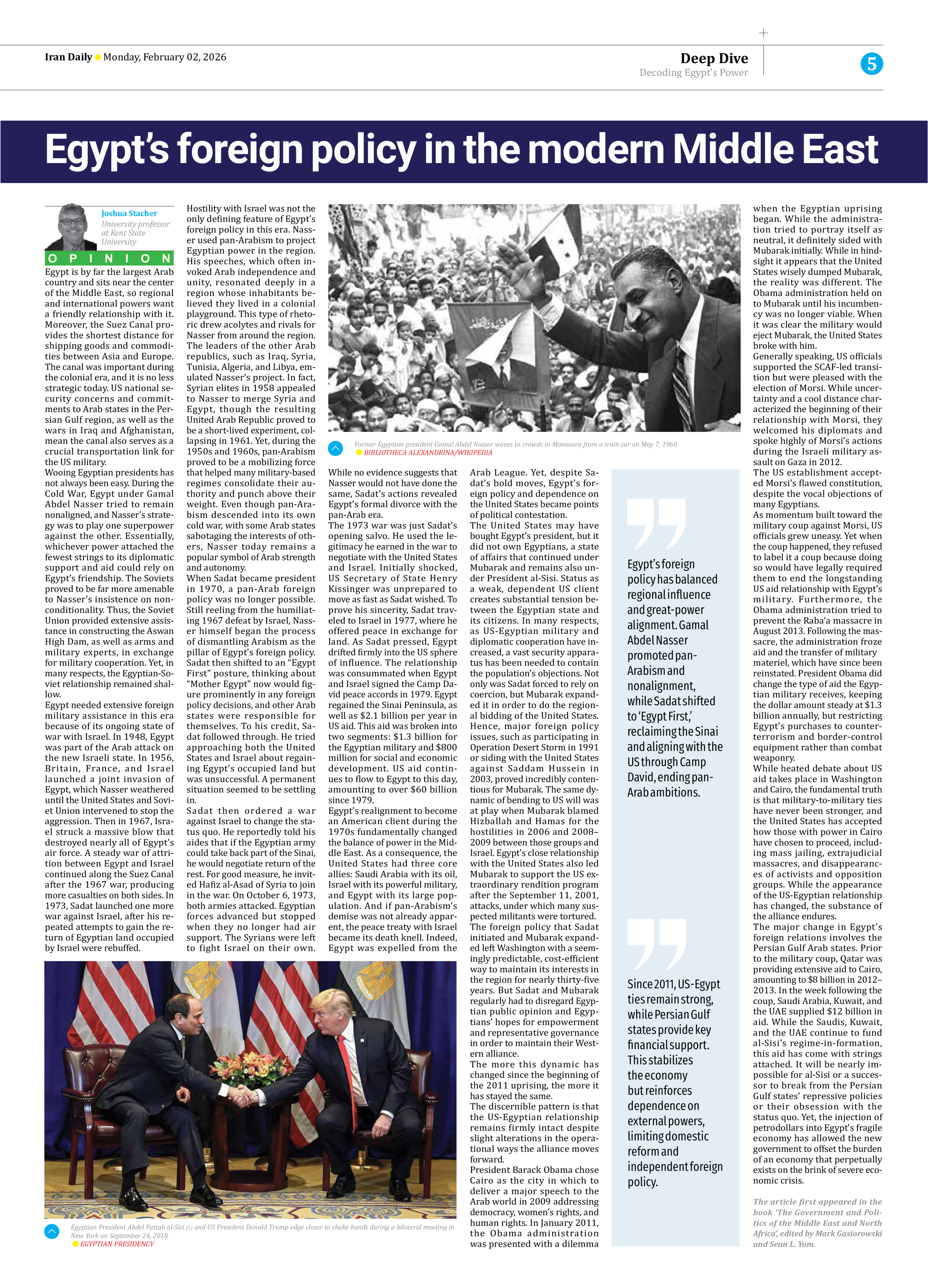
Wooing Egyptian presidents has not always been easy. During the Cold War, Egypt under Gamal Abdel Nasser tried to remain nonaligned, and Nasser’s strategy was to play one superpower against the other. Essentially, whichever power attached the fewest strings to its diplomatic support and aid could rely on Egypt’s friendship. The Soviets proved to be far more amenable to Nasser’s insistence on nonconditionality. Thus, the Soviet Union provided extensive assistance in constructing the Aswan High Dam, as well as arms and military experts, in exchange for military cooperation. Yet, in many respects, the Egyptian-Soviet relationship remained shallow.
Egypt needed extensive foreign military assistance in this era because of its ongoing state of war with Israel. In 1948, Egypt was part of the Arab attack on the new Israeli state. In 1956, Britain, France, and Israel launched a joint invasion of Egypt, which Nasser weathered until the United States and Soviet Union intervened to stop the aggression. Then in 1967, Israel struck a massive blow that destroyed nearly all of Egypt’s air force. A steady war of attrition between Egypt and Israel continued along the Suez Canal after the 1967 war, producing more casualties on both sides. In 1973, Sadat launched one more war against Israel, after his repeated attempts to gain the return of Egyptian land occupied by Israel were rebuffed.
Hostility with Israel was not the only defining feature of Egypt’s foreign policy in this era. Nasser used pan-Arabism to project Egyptian power in the region. His speeches, which often invoked Arab independence and unity, resonated deeply in a region whose inhabitants believed they lived in a colonial playground. This type of rhetoric drew acolytes and rivals for Nasser from around the region. The leaders of the other Arab republics, such as Iraq, Syria, Tunisia, Algeria, and Libya, emulated Nasser’s project. In fact, Syrian elites in 1958 appealed to Nasser to merge Syria and Egypt, though the resulting United Arab Republic proved to be a short-lived experiment, collapsing in 1961. Yet, during the 1950s and 1960s, pan-Arabism proved to be a mobilizing force that helped many military-based regimes consolidate their authority and punch above their weight. Even though pan-Arabism descended into its own cold war, with some Arab states sabotaging the interests of others, Nasser today remains a popular symbol of Arab strength and autonomy.
When Sadat became president in 1970, a pan-Arab foreign policy was no longer possible. Still reeling from the humiliating 1967 defeat by Israel, Nasser himself began the process of dismantling Arabism as the pillar of Egypt’s foreign policy. Sadat then shifted to an “Egypt First” posture, thinking about “Mother Egypt” now would figure prominently in any foreign policy decisions, and other Arab states were responsible for themselves. To his credit, Sadat followed through. He tried approaching both the United States and Israel about regaining Egypt’s occupied land but was unsuccessful. A permanent situation seemed to be settling in.
Sadat then ordered a war against Israel to change the status quo. He reportedly told his aides that if the Egyptian army could take back part of the Sinai, he would negotiate return of the rest. For good measure, he invited Hafiz al-Asad of Syria to join in the war. On October 6, 1973, both armies attacked. Egyptian forces advanced but stopped when they no longer had air support. The Syrians were left to fight Israel on their own. While no evidence suggests that Nasser would not have done the same, Sadat’s actions revealed Egypt’s formal divorce with the pan-Arab era.
The 1973 war was just Sadat’s opening salvo. He used the legitimacy he earned in the war to negotiate with the United States and Israel. Initially shocked, US Secretary of State Henry Kissinger was unprepared to move as fast as Sadat wished. To prove his sincerity, Sadat traveled to Israel in 1977, where he offered peace in exchange for land. As Sadat pressed, Egypt drifted firmly into the US sphere of influence. The relationship was consummated when Egypt and Israel signed the Camp David peace accords in 1979. Egypt regained the Sinai Peninsula, as well as $2.1 billion per year in US aid. This aid was broken into two segments: $1.3 billion for the Egyptian military and $800 million for social and economic development. US aid continues to flow to Egypt to this day, amounting to over $60 billion since 1979.
Egypt’s realignment to become an American client during the 1970s fundamentally changed the balance of power in the Middle East. As a consequence, the United States had three core allies: Saudi Arabia with its oil, Israel with its powerful military, and Egypt with its large population. And if pan-Arabism’s demise was not already apparent, the peace treaty with Israel became its death knell. Indeed, Egypt was expelled from the Arab League. Yet, despite Sadat’s bold moves, Egypt’s foreign policy and dependence on the United States became points of political contestation.
The United States may have bought Egypt’s president, but it did not own Egyptians, a state of affairs that continued under Mubarak and remains also under President al-Sisi. Status as a weak, dependent US client creates substantial tension between the Egyptian state and its citizens. In many respects, as US-Egyptian military and diplomatic cooperation have increased, a vast security apparatus has been needed to contain the population’s objections. Not only was Sadat forced to rely on coercion, but Mubarak expanded it in order to do the regional bidding of the United States. Hence, major foreign policy issues, such as participating in Operation Desert Storm in 1991 or siding with the United States against Saddam Hussein in 2003, proved incredibly contentious for Mubarak. The same dynamic of bending to US will was at play when Mubarak blamed Hizballah and Hamas for the hostilities in 2006 and 2008–2009 between those groups and Israel. Egypt’s close relationship with the United States also led Mubarak to support the US extraordinary rendition program after the September 11, 2001, attacks, under which many suspected militants were tortured.
The foreign policy that Sadat initiated and Mubarak expanded left Washington with a seemingly predictable, cost-efficient way to maintain its interests in the region for nearly thirty-five years. But Sadat and Mubarak regularly had to disregard Egyptian public opinion and Egyptians’ hopes for empowerment and representative governance in order to maintain their Western alliance.
The more this dynamic has changed since the beginning of the 2011 uprising, the more it has stayed the same.
The discernible pattern is that the US-Egyptian relationship remains firmly intact despite slight alterations in the operational ways the alliance moves forward.
President Barack Obama chose Cairo as the city in which to deliver a major speech to the Arab world in 2009 addressing democracy, women’s rights, and human rights. In January 2011, the Obama administration was presented with a dilemma when the Egyptian uprising began. While the administration tried to portray itself as neutral, it definitely sided with Mubarak initially. While in hindsight it appears that the United States wisely dumped Mubarak, the reality was different. The Obama administration held on to Mubarak until his incumbency was no longer viable. When it was clear the military would eject Mubarak, the United States broke with him.
Generally speaking, US officials supported the SCAF-led transition but were pleased with the election of Morsi. While uncertainty and a cool distance characterized the beginning of their relationship with Morsi, they welcomed his diplomats and spoke highly of Morsi’s actions during the Israeli military assault on Gaza in 2012.
The US establishment accepted Morsi’s flawed constitution, despite the vocal objections of many Egyptians.
As momentum built toward the military coup against Morsi, US officials grew uneasy. Yet when the coup happened, they refused to label it a coup because doing so would have legally required them to end the longstanding US aid relationship with Egypt’s military. Furthermore, the Obama administration tried to prevent the Raba‘a massacre in August 2013. Following the massacre, the administration froze aid and the transfer of military
materiel, which have since been reinstated. President Obama did change the type of aid the Egyptian military receives, keeping the dollar amount steady at $1.3 billion annually, but restricting Egypt’s purchases to counterterrorism and border-control equipment rather than combat weaponry.
While heated debate about US aid takes place in Washington and Cairo, the fundamental truth is that military-to-military ties have never been stronger, and the United States has accepted how those with power in Cairo have chosen to proceed, including mass jailing, extrajudicial massacres, and disappearances of activists and opposition groups. While the appearance of the US-Egyptian relationship has changed, the substance of the alliance endures.
The major change in Egypt’s foreign relations involves the Persian Gulf Arab states. Prior to the military coup, Qatar was providing extensive aid to Cairo, amounting to $8 billion in 2012–2013. In the week following the coup, Saudi Arabia, Kuwait, and the UAE supplied $12 billion in aid. While the Saudis, Kuwait, and the UAE continue to fund al-Sisi’s regime-in-formation, this aid has come with strings attached. It will be nearly impossible for al-Sisi or a successor to break from the Persian Gulf states’ repressive policies or their obsession with the status quo. Yet, the injection of petrodollars into Egypt’s fragile economy has allowed the new government to offset the burden of an economy that perpetually exists on the brink of severe economic crisis.
The article first appeared in the book ‘The Government and Politics of the Middle East and North Africa’, edited by Mark Gasiorowski and Sean L. Yom.