







Political order in contemporary Egypt
Joshua Stacher
University professor at Kent State University
After the 1952 military takeover, Egypt’s new elites reshaped the state’s political structure. Although constitutions and laws dictated how state institutions should operate, the reality often was quite different in practice. Nevertheless, these institutions did operate in distinctive, predictable ways.
Nasser, Sadat, and Mubarak were careful to maintain and expand presidential authority vis-à-vis the other institutions of state. Maintaining such a hierarchy ensured that the president had autonomy to act while others were constrained. The Egyptian political system was not without institutionalized competition or debate.
However, state institutions were only allowed to contest each other in limited ways. Generally, the new organizations created after 1952 were unable to act without the president’s blessing, while institutions created before that time struggled but kept a limited semblance of independence.
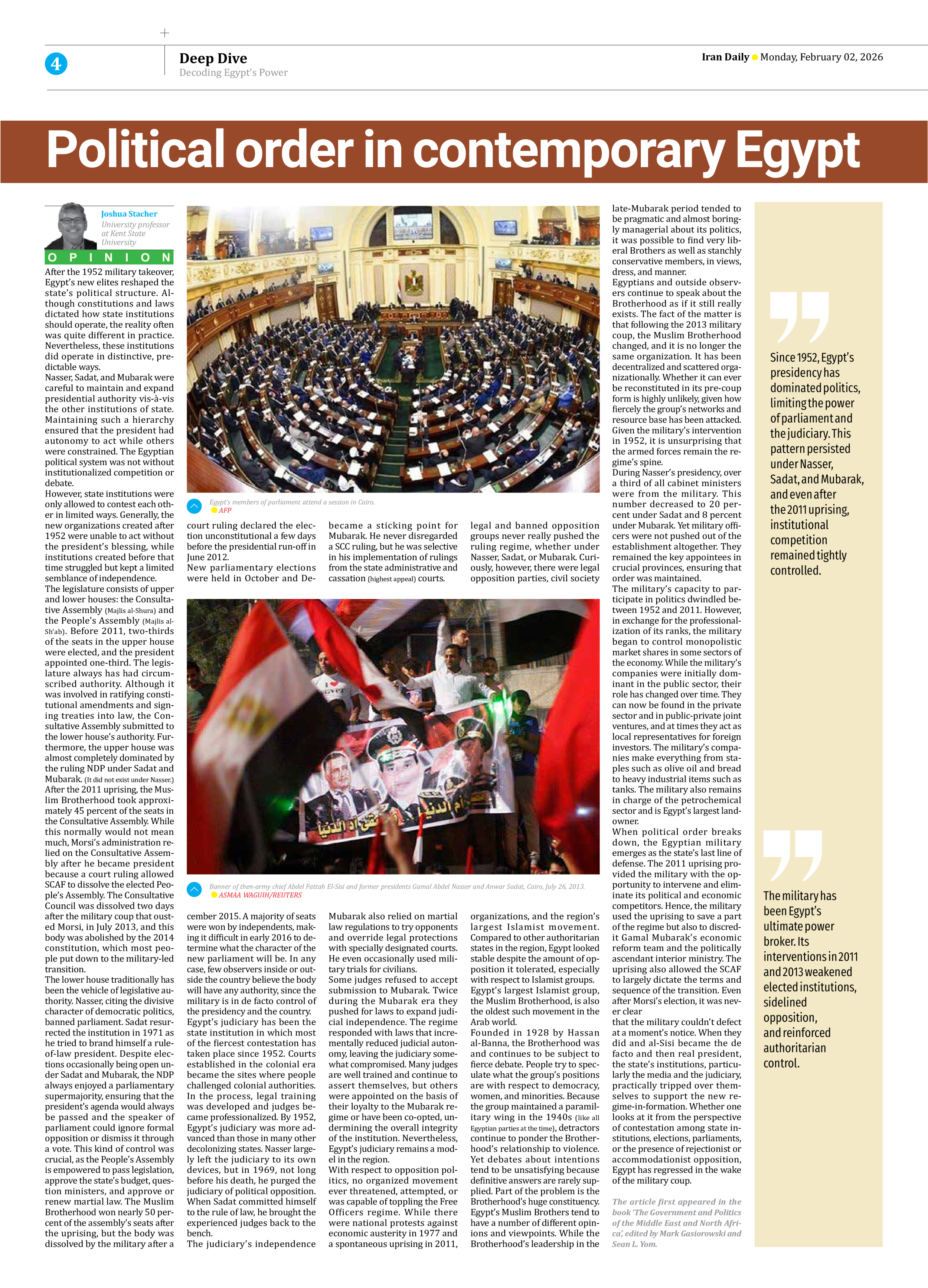
The legislature consists of upper and lower houses: the Consultative Assembly (Majlis al-Shura) and the People’s Assembly (Majlis al-Sh‘ab). Before 2011, two-thirds of the seats in the upper house were elected, and the president appointed one-third. The legislature always has had circumscribed authority. Although it was involved in ratifying constitutional amendments and signing treaties into law, the Consultative Assembly submitted to the lower house’s authority. Furthermore, the upper house was almost completely dominated by the ruling NDP under Sadat and Mubarak. (It did not exist under Nasser.)
After the 2011 uprising, the Muslim Brotherhood took approximately 45 percent of the seats in the Consultative Assembly. While this normally would not mean much, Morsi’s administration relied on the Consultative Assembly after he became president because a court ruling allowed SCAF to dissolve the elected People’s Assembly. The Consultative Council was dissolved two days after the military coup that ousted Morsi, in July 2013, and this body was abolished by the 2014 constitution, which most people put down to the military-led transition.
The lower house traditionally has been the vehicle of legislative authority. Nasser, citing the divisive character of democratic politics, banned parliament. Sadat resurrected the institution in 1971 as he tried to brand himself a rule-of-law president. Despite elections occasionally being open under Sadat and Mubarak, the NDP always enjoyed a parliamentary supermajority, ensuring that the president’s agenda would always be passed and the speaker of parliament could ignore formal opposition or dismiss it through a vote. This kind of control was crucial, as the People’s Assembly is empowered to pass legislation, approve the state’s budget, question ministers, and approve or renew martial law. The Muslim Brotherhood won nearly 50 percent of the assembly’s seats after the uprising, but the body was dissolved by the military after a court ruling declared the election unconstitutional a few days before the presidential run-off in June 2012.
New parliamentary elections were held in October and December 2015. A majority of seats were won by independents, making it difficult in early 2016 to determine what the character of the new parliament will be. In any case, few observers inside or outside the country believe the body will have any authority, since the military is in de facto control of the presidency and the country.
Egypt’s judiciary has been the state institution in which most of the fiercest contestation has taken place since 1952. Courts established in the colonial era became the sites where people challenged colonial authorities. In the process, legal training was developed and judges became professionalized. By 1952, Egypt’s judiciary was more advanced than those in many other decolonizing states. Nasser largely left the judiciary to its own devices, but in 1969, not long before his death, he purged the judiciary of political opposition. When Sadat committed himself to the rule of law, he brought the experienced judges back to the bench.
The judiciary’s independence became a sticking point for Mubarak. He never disregarded a SCC ruling, but he was selective in his implementation of rulings from the state administrative and cassation (highest appeal) courts.
Mubarak also relied on martial law regulations to try opponents and override legal protections with specially designated courts. He even occasionally used military trials for civilians.
Some judges refused to accept submission to Mubarak. Twice during the Mubarak era they pushed for laws to expand judicial independence. The regime responded with laws that incrementally reduced judicial autonomy, leaving the judiciary somewhat compromised. Many judges are well trained and continue to assert themselves, but others were appointed on the basis of their loyalty to the Mubarak regime or have been co-opted, undermining the overall integrity of the institution. Nevertheless, Egypt’s judiciary remains a model in the region.
With respect to opposition politics, no organized movement ever threatened, attempted, or was capable of toppling the Free Officers regime. While there were national protests against economic austerity in 1977 and a spontaneous uprising in 2011, legal and banned opposition groups never really pushed the ruling regime, whether under Nasser, Sadat, or Mubarak. Curiously, however, there were legal opposition parties, civil society organizations, and the region’s largest Islamist movement. Compared to other authoritarian states in the region, Egypt looked stable despite the amount of opposition it tolerated, especially with respect to Islamist groups.
Egypt’s largest Islamist group, the Muslim Brotherhood, is also the oldest such movement in the Arab world.
Founded in 1928 by Hassan al-Banna, the Brotherhood was and continues to be subject to fierce debate. People try to speculate what the group’s positions are with respect to democracy, women, and minorities. Because the group maintained a paramilitary wing in the 1940s (like all Egyptian parties at the time), detractors continue to ponder the Brotherhood’s relationship to violence. Yet debates about intentions tend to be unsatisfying because definitive answers are rarely supplied. Part of the problem is the Brotherhood’s huge constituency. Egypt’s Muslim Brothers tend to have a number of different opinions and viewpoints. While the Brotherhood’s leadership in the late-Mubarak period tended to be pragmatic and almost boringly managerial about its politics, it was possible to find very liberal Brothers as well as stanchly conservative members, in views, dress, and manner.
Egyptians and outside observers continue to speak about the Brotherhood as if it still really exists. The fact of the matter is that following the 2013 military coup, the Muslim Brotherhood changed, and it is no longer the same organization. It has been decentralized and scattered organizationally. Whether it can ever be reconstituted in its pre-coup form is highly unlikely, given how fiercely the group’s networks and resource base has been attacked.
Given the military’s intervention in 1952, it is unsurprising that the armed forces remain the regime’s spine.
During Nasser’s presidency, over a third of all cabinet ministers were from the military. This number decreased to 20 percent under Sadat and 8 percent under Mubarak. Yet military officers were not pushed out of the establishment altogether. They remained the key appointees in crucial provinces, ensuring that order was maintained.
The military’s capacity to participate in politics dwindled between 1952 and 2011. However, in exchange for the professionalization of its ranks, the military began to control monopolistic market shares in some sectors of the economy. While the military’s companies were initially dominant in the public sector, their role has changed over time. They can now be found in the private sector and in public-private joint ventures, and at times they act as local representatives for foreign investors. The military’s companies make everything from staples such as olive oil and bread to heavy industrial items such as tanks. The military also remains in charge of the petrochemical sector and is Egypt’s largest landowner.
When political order breaks down, the Egyptian military emerges as the state’s last line of defense. The 2011 uprising provided the military with the opportunity to intervene and eliminate its political and economic competitors. Hence, the military used the uprising to save a part of the regime but also to discredit Gamal Mubarak’s economic reform team and the politically ascendant interior ministry. The uprising also allowed the SCAF to largely dictate the terms and sequence of the transition. Even after Morsi’s election, it was never clear
that the military couldn’t defect at a moment’s notice. When they did and al-Sisi became the de facto and then real president, the state’s institutions, particularly the media and the judiciary, practically tripped over themselves to support the new regime-in-formation. Whether one looks at it from the perspective of contestation among state institutions, elections, parliaments, or the presence of rejectionist or accommodationist opposition, Egypt has regressed in the wake of the military coup.
The article first appeared in the book ‘The Government and Politics of the Middle East and North Africa’, edited by Mark Gasiorowski and Sean L. Yom.