





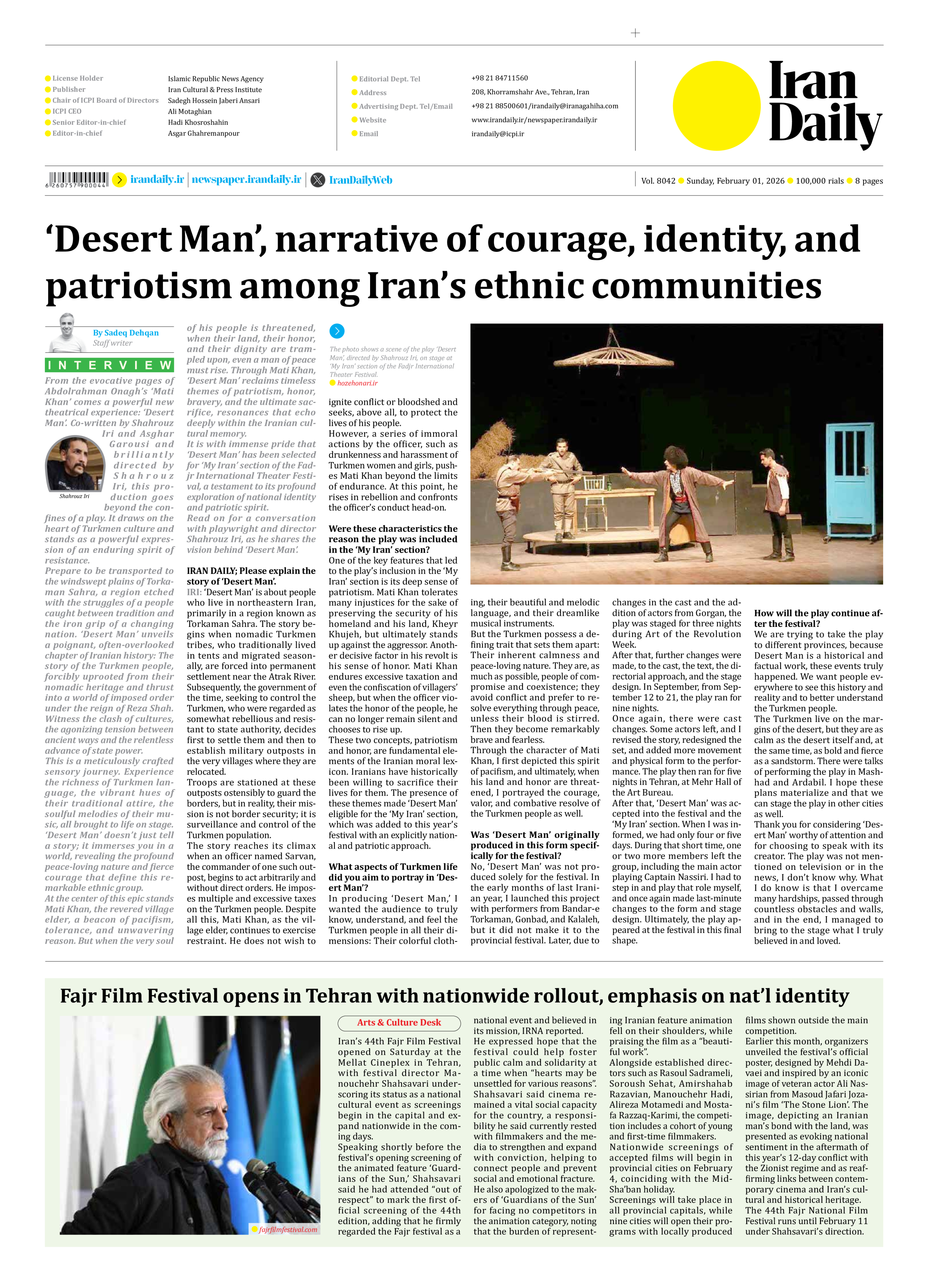


‘Desert Man’, narrative of courage, identity, and patriotism among Iran’s ethnic communities
By Sadeq Dehqan
Staff writer
From the evocative pages of Abdolrahman Onagh’s ‘Mati Khan’ comes a powerful new theatrical experience: ‘Desert Man’. Co-written by Shahrouz Iri and Asghar Garousi and brilliantly directed by Shahrouz Iri, this production goes beyond the confines of a play. It draws on the heart of Turkmen culture and stands as a powerful expression of an enduring spirit of resistance.
Prepare to be transported to the windswept plains of Torkaman Sahra, a region etched with the struggles of a people caught between tradition and the iron grip of a changing nation. ‘Desert Man’ unveils a poignant, often-overlooked chapter of Iranian history: The story of the Turkmen people, forcibly uprooted from their nomadic heritage and thrust into a world of imposed order under the reign of Reza Shah. Witness the clash of cultures, the agonizing tension between ancient ways and the relentless advance of state power.
This is a meticulously crafted sensory journey. Experience the richness of Turkmen language, the vibrant hues of their traditional attire, the soulful melodies of their music, all brought to life on stage. ‘Desert Man’ doesn’t just tell a story; it immerses you in a world, revealing the profound peace-loving nature and fierce courage that define this remarkable ethnic group.
At the center of this epic stands Mati Khan, the revered village elder, a beacon of pacifism, tolerance, and unwavering reason. But when the very soul of his people is threatened, when their land, their honor, and their dignity are trampled upon, even a man of peace must rise. Through Mati Khan, ‘Desert Man’ reclaims timeless themes of patriotism, honor, bravery, and the ultimate sacrifice, resonances that echo deeply within the Iranian cultural memory.
It is with immense pride that ‘Desert Man’ has been selected for ‘My Iran’ section of the Fadjr International Theater Festival, a testament to its profound exploration of national identity and patriotic spirit.
Read on for a conversation with playwright and director Shahrouz Iri, as he shares the vision behind ‘Desert Man’.
IRAN DAILY; Please explain the story of ‘Desert Man’.
IRI: ‘Desert Man’ is about people who live in northeastern Iran, primarily in a region known as Torkaman Sahra. The story begins when nomadic Turkmen tribes, who traditionally lived in tents and migrated seasonally, are forced into permanent settlement near the Atrak River. Subsequently, the government of the time, seeking to control the Turkmen, who were regarded as somewhat rebellious and resistant to state authority, decides first to settle them and then to establish military outposts in the very villages where they are relocated.
Troops are stationed at these outposts ostensibly to guard the borders, but in reality, their mission is not border security; it is surveillance and control of the Turkmen population.
The story reaches its climax when an officer named Sarvan, the commander of one such outpost, begins to act arbitrarily and without direct orders. He imposes multiple and excessive taxes on the Turkmen people. Despite all this, Mati Khan, as the village elder, continues to exercise restraint. He does not wish to ignite conflict or bloodshed and seeks, above all, to protect the lives of his people.
However, a series of immoral actions by the officer, such as drunkenness and harassment of Turkmen women and girls, pushes Mati Khan beyond the limits of endurance. At this point, he rises in rebellion and confronts the officer’s conduct head-on.
Were these characteristics the reason the play was included in the ‘My Iran’ section?
One of the key features that led to the play’s inclusion in the ‘My Iran’ section is its deep sense of patriotism. Mati Khan tolerates many injustices for the sake of preserving the security of his homeland and his land, Kheyr Khujeh, but ultimately stands up against the aggressor. Another decisive factor in his revolt is his sense of honor. Mati Khan endures excessive taxation and even the confiscation of villagers’ sheep, but when the officer violates the honor of the people, he can no longer remain silent and chooses to rise up.
These two concepts, patriotism and honor, are fundamental elements of the Iranian moral lexicon. Iranians have historically been willing to sacrifice their lives for them. The presence of these themes made ‘Desert Man’ eligible for the ‘My Iran’ section, which was added to this year’s festival with an explicitly national and patriotic approach.
What aspects of Turkmen life did you aim to portray in ‘Desert Man’?
In producing ‘Desert Man,’ I wanted the audience to truly know, understand, and feel the Turkmen people in all their dimensions: Their colorful clothing, their beautiful and melodic language, and their dreamlike musical instruments.
But the Turkmen possess a defining trait that sets them apart: Their inherent calmness and peace-loving nature. They are, as much as possible, people of compromise and coexistence; they avoid conflict and prefer to resolve everything through peace, unless their blood is stirred. Then they become remarkably brave and fearless.
Through the character of Mati Khan, I first depicted this spirit of pacifism, and ultimately, when his land and honor are threatened, I portrayed the courage, valor, and combative resolve of the Turkmen people as well.
Was ‘Desert Man’ originally produced in this form specifically for the festival?
No, ‘Desert Man’ was not produced solely for the festival. In the early months of last Iranian year, I launched this project with performers from Bandar-e Torkaman, Gonbad, and Kalaleh, but it did not make it to the provincial festival. Later, due to changes in the cast and the addition of actors from Gorgan, the play was staged for three nights during Art of the Revolution Week.
After that, further changes were made, to the cast, the text, the directorial approach, and the stage design. In September, from September 12 to 21, the play ran for nine nights.
Once again, there were cast changes. Some actors left, and I revised the story, redesigned the set, and added more movement and physical form to the performance. The play then ran for five nights in Tehran, at Mehr Hall of the Art Bureau.
After that, ‘Desert Man’ was accepted into the festival and the ‘My Iran’ section. When I was informed, we had only four or five days. During that short time, one or two more members left the group, including the main actor playing Captain Nassiri. I had to step in and play that role myself, and once again made last-minute changes to the form and stage design. Ultimately, the play appeared at the festival in this final shape.
How will the play continue after the festival?
We are trying to take the play to different provinces, because Desert Man is a historical and factual work, these events truly happened. We want people everywhere to see this history and reality and to better understand the Turkmen people.
The Turkmen live on the margins of the desert, but they are as calm as the desert itself and, at the same time, as bold and fierce as a sandstorm. There were talks of performing the play in Mashhad and Ardabil. I hope these plans materialize and that we can stage the play in other cities as well.
Thank you for considering ‘Desert Man’ worthy of attention and for choosing to speak with its creator. The play was not mentioned on television or in the news, I don’t know why. What I do know is that I overcame many hardships, passed through countless obstacles and walls, and in the end, I managed to bring to the stage what I truly believed in and loved.