







Minister urges expansion of cultural infrastructure as participation rates lag
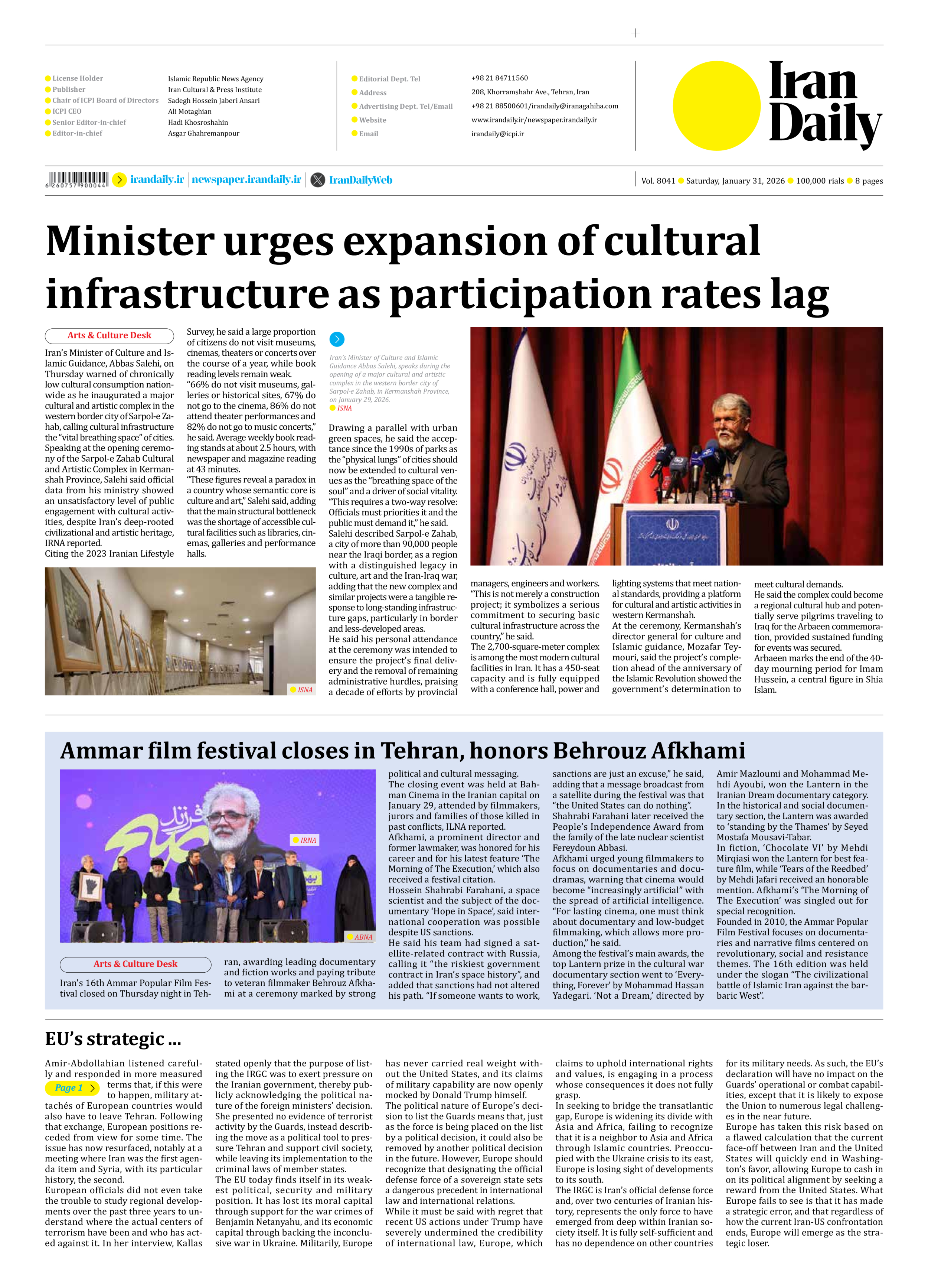
Iran’s Minister of Culture and Islamic Guidance, Abbas Salehi, on Thursday warned of chronically low cultural consumption nationwide as he inaugurated a major cultural and artistic complex in the western border city of Sarpol-e Zahab, calling cultural infrastructure the “vital breathing space” of cities.
Speaking at the opening ceremony of the Sarpol-e Zahab Cultural and Artistic Complex in Kermanshah Province, Salehi said official data from his ministry showed an unsatisfactory level of public engagement with cultural activities, despite Iran’s deep-rooted civilizational and artistic heritage, IRNA reported.
Citing the 2023 Iranian Lifestyle Survey, he said a large proportion of citizens do not visit museums, cinemas, theaters or concerts over the course of a year, while book reading levels remain weak.
“66% do not visit museums, galleries or historical sites, 67% do not go to the cinema, 86% do not attend theater performances and 82% do not go to music concerts,” he said. Average weekly book reading stands at about 2.5 hours, with newspaper and magazine reading at 43 minutes.
“These figures reveal a paradox in a country whose semantic core is culture and art,” Salehi said, adding that the main structural bottleneck was the shortage of accessible cultural facilities such as libraries, cinemas, galleries and performance halls.
Drawing a parallel with urban green spaces, he said the acceptance since the 1990s of parks as the “physical lungs” of cities should now be extended to cultural venues as the “breathing space of the soul” and a driver of social vitality. “This requires a two-way resolve: Officials must priorities it and the public must demand it,” he said.
Salehi described Sarpol-e Zahab, a city of more than 90,000 people near the Iraqi border, as a region with a distinguished legacy in culture, art and the Iran-Iraq war, adding that the new complex and similar projects were a tangible response to long-standing infrastructure gaps, particularly in border and less-developed areas.
He said his personal attendance at the ceremony was intended to ensure the project’s final delivery and the removal of remaining administrative hurdles, praising a decade of efforts by provincial managers, engineers and workers. “This is not merely a construction project; it symbolizes a serious commitment to securing basic cultural infrastructure across the country,” he said.
The 2,700-square-meter complex is among the most modern cultural facilities in Iran. It has a 450-seat capacity and is fully equipped with a conference hall, power and lighting systems that meet national standards, providing a platform for cultural and artistic activities in western Kermanshah.
At the ceremony, Kermanshah’s director general for culture and Islamic guidance, Mozafar Teymouri, said the project’s completion ahead of the anniversary of the Islamic Revolution showed the government’s determination to meet cultural demands.
He said the complex could become a regional cultural hub and potentially serve pilgrims traveling to Iraq for the Arbaeen commemoration, provided sustained funding for events was secured.
Arbaeen marks the end of the 40-day mourning period for Imam Hussein, a central figure in Shia Islam.