







Call for dialogue to ease social polarization
By Hadi Khaniqi
University professor
Hadi Khaniqi, a distinguished professor of communications and media, believes that “dialogue” holds the key to resolving today’s challenges in Iran and building a brighter future for the country. He believes that opportunities for dialogue emerged during wartime conditions, but unfortunately, this potential was not fully utilized, and with the escalation of various factors, we witnessed unfortunate events. The most dangerous aspect of these events is the tendency towards violence, the erosion of trust and grounds for dialogue, and the polarization of public opinion.
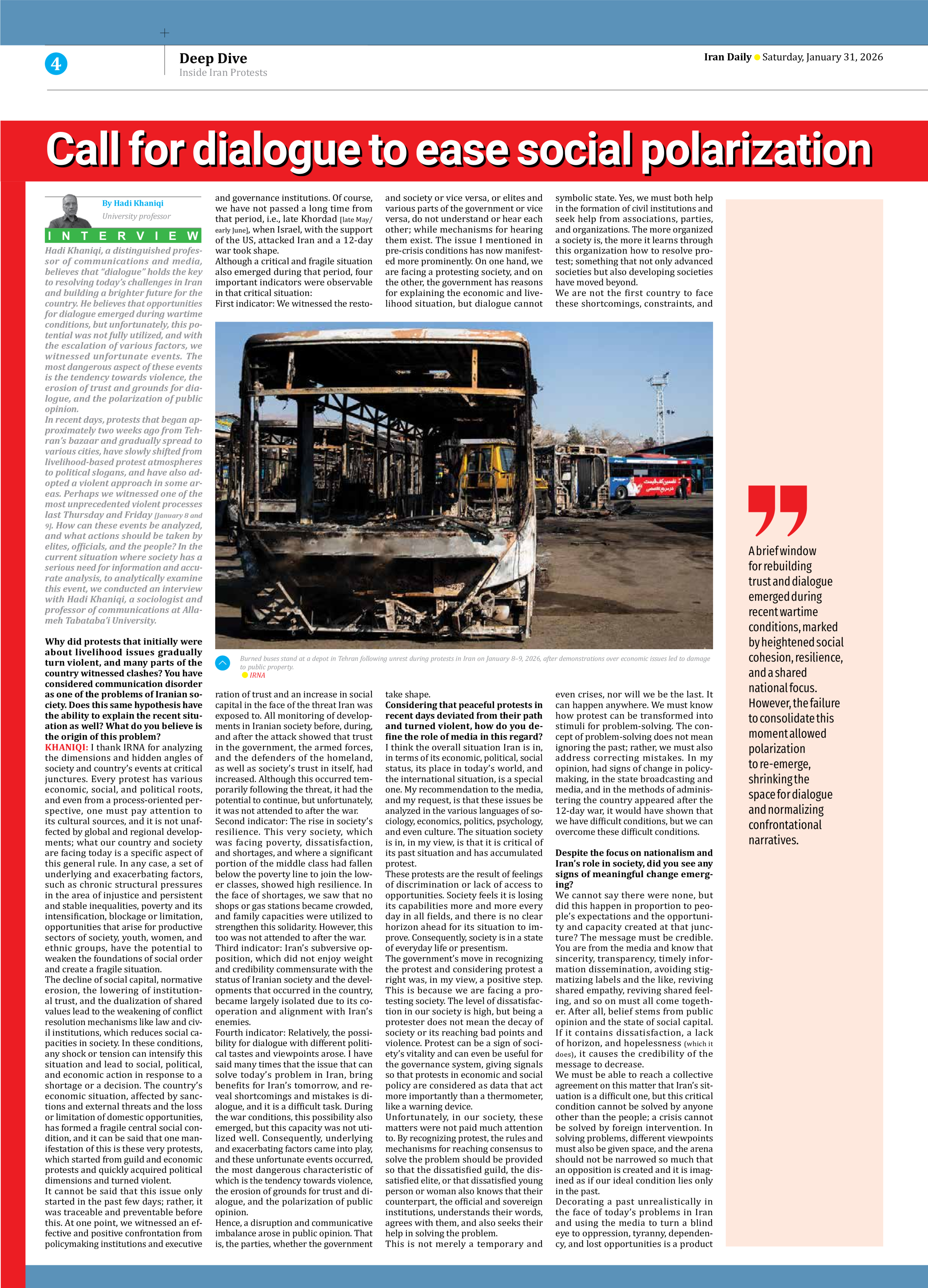
In recent days, protests that began approximately two weeks ago from Tehran’s bazaar and gradually spread to various cities, have slowly shifted from livelihood-based protest atmospheres to political slogans, and have also adopted a violent approach in some areas. Perhaps we witnessed one of the most unprecedented violent processes last Thursday and Friday [January 8 and 9]. How can these events be analyzed, and what actions should be taken by elites, officials, and the people? In the current situation where society has a serious need for information and accurate analysis, to analytically examine this event, we conducted an interview with Hadi Khaniqi, a sociologist and professor of communications at Allameh Tabataba’i University.
Why did protests that initially were about livelihood issues gradually turn violent, and many parts of the country witnessed clashes? You have considered communication disorder as one of the problems of Iranian society. Does this same hypothesis have the ability to explain the recent situation as well? What do you believe is the origin of this problem?
KHANIQI: I thank IRNA for analyzing the dimensions and hidden angles of society and country’s events at critical junctures. Every protest has various economic, social, and political roots, and even from a process-oriented perspective, one must pay attention to its cultural sources, and it is not unaffected by global and regional developments; what our country and society are facing today is a specific aspect of this general rule. In any case, a set of underlying and exacerbating factors, such as chronic structural pressures in the area of injustice and persistent and stable inequalities, poverty and its intensification, blockage or limitation, opportunities that arise for productive sectors of society, youth, women, and ethnic groups, have the potential to weaken the foundations of social order and create a fragile situation.
The decline of social capital, normative erosion, the lowering of institutional trust, and the dualization of shared values lead to the weakening of conflict resolution mechanisms like law and civil institutions, which reduces social capacities in society. In these conditions, any shock or tension can intensify this situation and lead to social, political, and economic action in response to a shortage or a decision. The country’s economic situation, affected by sanctions and external threats and the loss or limitation of domestic opportunities, has formed a fragile central social condition, and it can be said that one manifestation of this is these very protests, which started from guild and economic protests and quickly acquired political dimensions and turned violent.
It cannot be said that this issue only started in the past few days; rather, it was traceable and preventable before this. At one point, we witnessed an effective and positive confrontation from policymaking institutions and executive and governance institutions. Of course, we have not passed a long time from that period, i.e., late Khordad [late May/early June], when Israel, with the support of the US, attacked Iran and a 12-day war took shape.
Although a critical and fragile situation also emerged during that period, four important indicators were observable in that critical situation:
First indicator: We witnessed the restoration of trust and an increase in social capital in the face of the threat Iran was exposed to. All monitoring of developments in Iranian society before, during, and after the attack showed that trust in the government, the armed forces, and the defenders of the homeland, as well as society’s trust in itself, had increased. Although this occurred temporarily following the threat, it had the potential to continue, but unfortunately, it was not attended to after the war.
Second indicator: The rise in society’s resilience. This very society, which was facing poverty, dissatisfaction, and shortages, and where a significant portion of the middle class had fallen below the poverty line to join the lower classes, showed high resilience. In the face of shortages, we saw that no shops or gas stations became crowded, and family capacities were utilized to strengthen this solidarity. However, this too was not attended to after the war.
Third indicator: Iran’s subversive opposition, which did not enjoy weight and credibility commensurate with the status of Iranian society and the developments that occurred in the country, became largely isolated due to its cooperation and alignment with Iran’s enemies.
Fourth indicator: Relatively, the possibility for dialogue with different political tastes and viewpoints arose. I have said many times that the issue that can solve today’s problem in Iran, bring benefits for Iran’s tomorrow, and reveal shortcomings and mistakes is dialogue, and it is a difficult task. During the war conditions, this possibility also emerged, but this capacity was not utilized well. Consequently, underlying and exacerbating factors came into play, and these unfortunate events occurred, the most dangerous characteristic of which is the tendency towards violence, the erosion of grounds for trust and dialogue, and the polarization of public opinion.
Hence, a disruption and communicative imbalance arose in public opinion. That is, the parties, whether the government and society or vice versa, or elites and various parts of the government or vice versa, do not understand or hear each other; while mechanisms for hearing them exist. The issue I mentioned in pre-crisis conditions has now manifested more prominently. On one hand, we are facing a protesting society, and on the other, the government has reasons for explaining the economic and livelihood situation, but dialogue cannot take shape.
Considering that peaceful protests in recent days deviated from their path and turned violent, how do you define the role of media in this regard?
I think the overall situation Iran is in, in terms of its economic, political, social status, its place in today’s world, and the international situation, is a special one. My recommendation to the media, and my request, is that these issues be analyzed in the various languages of sociology, economics, politics, psychology, and even culture. The situation society is in, in my view, is that it is critical of its past situation and has accumulated protest.
These protests are the result of feelings of discrimination or lack of access to opportunities. Society feels it is losing its capabilities more and more every day in all fields, and there is no clear horizon ahead for its situation to improve. Consequently, society is in a state of everyday life or presentism.
The government’s move in recognizing the protest and considering protest a right was, in my view, a positive step. This is because we are facing a protesting society. The level of dissatisfaction in our society is high, but being a protester does not mean the decay of society or its reaching bad points and violence. Protest can be a sign of society’s vitality and can even be useful for the governance system, giving signals so that protests in economic and social policy are considered as data that act more importantly than a thermometer, like a warning device.
Unfortunately, in our society, these matters were not paid much attention to. By recognizing protest, the rules and mechanisms for reaching consensus to solve the problem should be provided so that the dissatisfied guild, the dissatisfied elite, or that dissatisfied young person or woman also knows that their counterpart, the official and sovereign institutions, understands their words, agrees with them, and also seeks their help in solving the problem.
This is not merely a temporary and symbolic state. Yes, we must both help in the formation of civil institutions and seek help from associations, parties, and organizations. The more organized a society is, the more it learns through this organization how to resolve protest; something that not only advanced societies but also developing societies have moved beyond.
We are not the first country to face these shortcomings, constraints, and even crises, nor will we be the last. It can happen anywhere. We must know how protest can be transformed into stimuli for problem-solving. The concept of problem-solving does not mean ignoring the past; rather, we must also address correcting mistakes. In my opinion, had signs of change in policymaking, in the state broadcasting and media, and in the methods of administering the country appeared after the 12-day war, it would have shown that we have difficult conditions, but we can overcome these difficult conditions.
Despite the focus on nationalism and Iran’s role in society, did you see any signs of meaningful change emerging?
We cannot say there were none, but did this happen in proportion to people’s expectations and the opportunity and capacity created at that juncture? The message must be credible. You are from the media and know that sincerity, transparency, timely information dissemination, avoiding stigmatizing labels and the like, reviving shared empathy, reviving shared feeling, and so on must all come together. After all, belief stems from public opinion and the state of social capital. If it contains dissatisfaction, a lack of horizon, and hopelessness (which it does), it causes the credibility of the message to decrease.
We must be able to reach a collective agreement on this matter that Iran’s situation is a difficult one, but this critical condition cannot be solved by anyone other than the people; a crisis cannot be solved by foreign intervention. In solving problems, different viewpoints must also be given space, and the arena should not be narrowed so much that an opposition is created and it is imagined as if our ideal condition lies only in the past.
Decorating a past unrealistically in the face of today’s problems in Iran and using the media to turn a blind eye to oppression, tyranny, dependency, and lost opportunities is a product of narrow-mindedness. Meanwhile, a
desirable future horizon can be built by recognizing diversity and protest, but national construction happens with social cohesion, acceptance of the other, and strengthening non-violent legal capacities. If we restore protest to its proper place, give it a worthy response, facilitate dialogue, and accept our own mistakes, problems will lessen. The central signifier of Iranian society is justice, and justice includes accepting and correcting mistakes. One of the necessities of our society, which has also lost many opportunities, is recognizing change and reform. If change and reform are not recognized in time, they turn into accumulated anger.
So you believe the origin of the violence is this very weakness?
Yes, but this ground is not empty, and foreigners also ride on this violence. Therefore, in such conditions, I do not rule out foreign factors.
What results does the increase in violence have for society?
Security is what every developing society is missing, and development itself is the tool for charting the future; especially for Iranian society, where every citizen sees that it has all the capabilities for development, but their own situation is not good. A society that is hungry, has livelihood problems and feels humiliation, and whose future is not bright, sees that this situation is not worthy of it, and that there have been better situations both in its own past and in comparison with other countries.
I think we must contemplate this issue nationally, and in this national contemplation, there is no difference between reformist, principalist, nationalist, religious, and those who desire change. I see all of them. In the reform period, which entered the arena with the slogan of civil society and recognizing the other, inviting dialogue, and a sense of citizens’ effectiveness, it leads to economic success. Because it can control many threats internally, regionally, and globally. So, by recognizing change, things can be done.
So you can build economic achievements from social and political phenomena?
Yes, in any situation, by prioritizing solving people’s problems, things can be done. If we hear each other’s voices and facilitate dialogue, even in this damaged society where many young people are anguished, worried, and harmed, when we accept all this, instead of saying ‘let come what may,’ these damages, weaknesses, shortages, destructions, and the loss of human, material, and spiritual capital must be seen, and we must strive to get out of this situation. What I understand is that by recognizing protest and difficult conditions, a clear horizon can be drawn for society, and we can move towards it.
Considering the current situation, what is the solution and what should be done?
When the answer to ‘what should be done’ becomes very difficult, we must think about ‘what should not be done.’ From a communication perspective, in a dialogic space among elites, experts, civil institutions, and citizens, issues become clearer. The worst situation is the polarization of the public sphere and society. In a polarized space, everyone only seeks to gather evidence and documentation for their own interpretation and decision, rather than engaging in analysis.
As social psychologists say, a ‘crowd mentality’ forms where emotion, imitation, and suggestion are prominent, and a reduction in rationality and degradation of analytical faculties occur. In these conditions, no words are heard. Sometimes this phenomenon can be seen in cyberspace; there are two sides that lead to one side, like an echo chamber where only the reflection of one’s own words is heard and the other’s words are eliminated. Our society needs to speak and be heard. The more we move away from a bipolar atmosphere by creating dialogic arenas and intermediary institutions for two-sided and comprehensive reasoning, the better the media can also do their job.
What role do elites have in shaping a space for dialogue in this regard?
The ground for elites to speak must be prepared in society. In a bipolar space, ‘words’ are hard to hear. Some elites are disillusioned, and some see the future as so ambiguous that their words are not heard correctly and become costly for them. Providing arenas for dialogue and analytical, rational examination where they can articulate the share of every mistake and wrong approach is essential. In my opinion, it is better for elites to enter the arena and speak.
The interview first appeared in Persian on IRNA.