







44th Fadjr International Theater Festival
‘Homay’, a theatrical narrative of Iranian woman through history
By Sadeq Dehqan
Staff writer
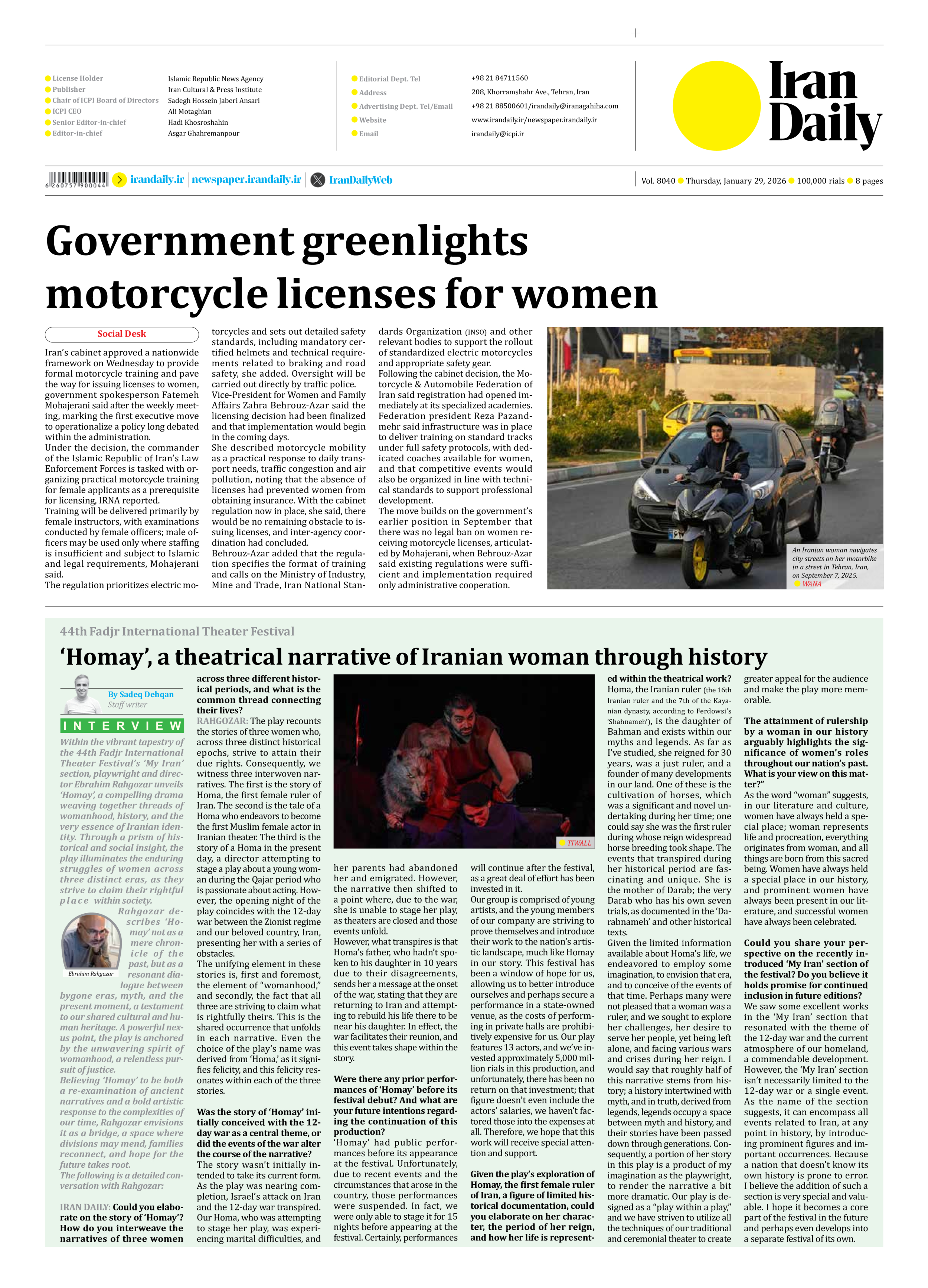
Within the vibrant tapestry of the 44th Fadjr International Theater Festival’s ‘My Iran’ section, playwright and director Ebrahim Rahgozar unveils ‘Homay’, a compelling drama weaving together threads of womanhood, history, and the very essence of Iranian identity. Through a prism of historical and social insight, the play illuminates the enduring struggles of women across three distinct eras, as they strive to claim their rightful place within society.
Rahgozar describes ‘Homay’ not as a mere chronicle of the past, but as a resonant dialogue between bygone eras, myth, and the present moment, a testament to our shared cultural and human heritage. A powerful nexus point, the play is anchored by the unwavering spirit of womanhood, a relentless pursuit of justice.
Believing ‘Homay’ to be both a re-examination of ancient narratives and a bold artistic response to the complexities of our time, Rahgozar envisions it as a bridge, a space where divisions may mend, families reconnect, and hope for the future takes root.
The following is a detailed conversation with Rahgozar:
IRAN DAILY: Could you elaborate on the story of ‘Homay’? How do you interweave the narratives of three women across three different historical periods, and what is the common thread connecting their lives?
Rahgozar: The play recounts the stories of three women who, across three distinct historical epochs, strive to attain their due rights. Consequently, we witness three interwoven narratives. The first is the story of Homa, the first female ruler of Iran. The second is the tale of a Homa who endeavors to become the first Muslim female actor in Iranian theater. The third is the story of a Homa in the present day, a director attempting to stage a play about a young woman during the Qajar period who is passionate about acting. However, the opening night of the play coincides with the 12-day war between the Zionist regime and our beloved country, Iran, presenting her with a series of obstacles.
The unifying element in these stories is, first and foremost, the element of “womanhood,” and secondly, the fact that all three are striving to claim what is rightfully theirs. This is the shared occurrence that unfolds in each narrative. Even the choice of the play’s name was derived from ‘Homa,’ as it signifies felicity, and this felicity resonates within each of the three stories.
Was the story of ‘Homay’ initially conceived with the 12-day war as a central theme, or did the events of the war alter the course of the narrative?
The story wasn’t initially intended to take its current form. As the play was nearing completion, Israel’s attack on Iran and the 12-day war transpired. Our Homa, who was attempting to stage her play, was experiencing marital difficulties, and her parents had abandoned her and emigrated. However, the narrative then shifted to a point where, due to the war, she is unable to stage her play, as theaters are closed and those events unfold.
However, what transpires is that Homa’s father, who hadn’t spoken to his daughter in 10 years due to their disagreements, sends her a message at the onset of the war, stating that they are returning to Iran and attempting to rebuild his life there to be near his daughter. In effect, the war facilitates their reunion, and this event takes shape within the story.
Were there any prior performances of ‘Homay’ before its festival debut? And what are your future intentions regarding the continuation of this production?
‘Homay’ had public performances before its appearance at the festival. Unfortunately, due to recent events and the circumstances that arose in the country, those performances were suspended. In fact, we were only able to stage it for 15 nights before appearing at the festival. Certainly, performances will continue after the festival, as a great deal of effort has been invested in it.
Our group is comprised of young artists, and the young members of our company are striving to prove themselves and introduce their work to the nation’s artistic landscape, much like Homay in our story. This festival has been a window of hope for us, allowing us to better introduce ourselves and perhaps secure a performance in a state-owned venue, as the costs of performing in private halls are prohibitively expensive for us. Our play features 13 actors, and we’ve invested approximately 5,000 million rials in this production, and unfortunately, there has been no return on that investment; that figure doesn’t even include the actors’ salaries, we haven’t factored those into the expenses at all. Therefore, we hope that this work will receive special attention and support.
Given the play’s exploration of Homay, the first female ruler of Iran, a figure of limited historical documentation, could you elaborate on her character, the period of her reign, and how her life is represented within the theatrical work?
Homa, the Iranian ruler (the 16th Iranian ruler and the 7th of the Kayanian dynasty, according to Ferdowsi’s ‘Shahnameh’), is the daughter of Bahman and exists within our myths and legends. As far as I’ve studied, she reigned for 30 years, was a just ruler, and a founder of many developments in our land. One of these is the cultivation of horses, which was a significant and novel undertaking during her time; one could say she was the first ruler during whose reign widespread horse breeding took shape. The events that transpired during her historical period are fascinating and unique. She is the mother of Darab; the very Darab who has his own seven trials, as documented in the ‘Darabnameh’ and other historical texts.
Given the limited information available about Homa’s life, we endeavored to employ some imagination, to envision that era, and to conceive of the events of that time. Perhaps many were not pleased that a woman was a ruler, and we sought to explore her challenges, her desire to serve her people, yet being left alone, and facing various wars and crises during her reign. I would say that roughly half of this narrative stems from history; a history intertwined with myth, and in truth, derived from legends, legends occupy a space between myth and history, and their stories have been passed down through generations. Consequently, a portion of her story in this play is a product of my imagination as the playwright, to render the narrative a bit more dramatic. Our play is designed as a “play within a play,” and we have striven to utilize all the techniques of our traditional and ceremonial theater to create greater appeal for the audience and make the play more memorable.
The attainment of rulership by a woman in our history arguably highlights the significance of women’s roles throughout our nation’s past. What is your view on this matter?”
As the word “woman” suggests, in our literature and culture, women have always held a special place; woman represents life and procreation, everything originates from woman, and all things are born from this sacred being. Women have always held a special place in our history, and prominent women have always been present in our literature, and successful women have always been celebrated.
Could you share your perspective on the recently introduced ‘My Iran’ section of the festival? Do you believe it holds promise for continued inclusion in future editions?
We saw some excellent works in the ‘My Iran’ section that resonated with the theme of the 12-day war and the current atmosphere of our homeland, a commendable development. However, the ‘My Iran’ section isn’t necessarily limited to the 12-day war or a single event. As the name of the section suggests, it can encompass all events related to Iran, at any point in history, by introducing prominent figures and important occurrences. Because a nation that doesn’t know its own history is prone to error. I believe the addition of such a section is very special and valuable. I hope it becomes a core part of the festival in the future and perhaps even develops into a separate festival of its own.