





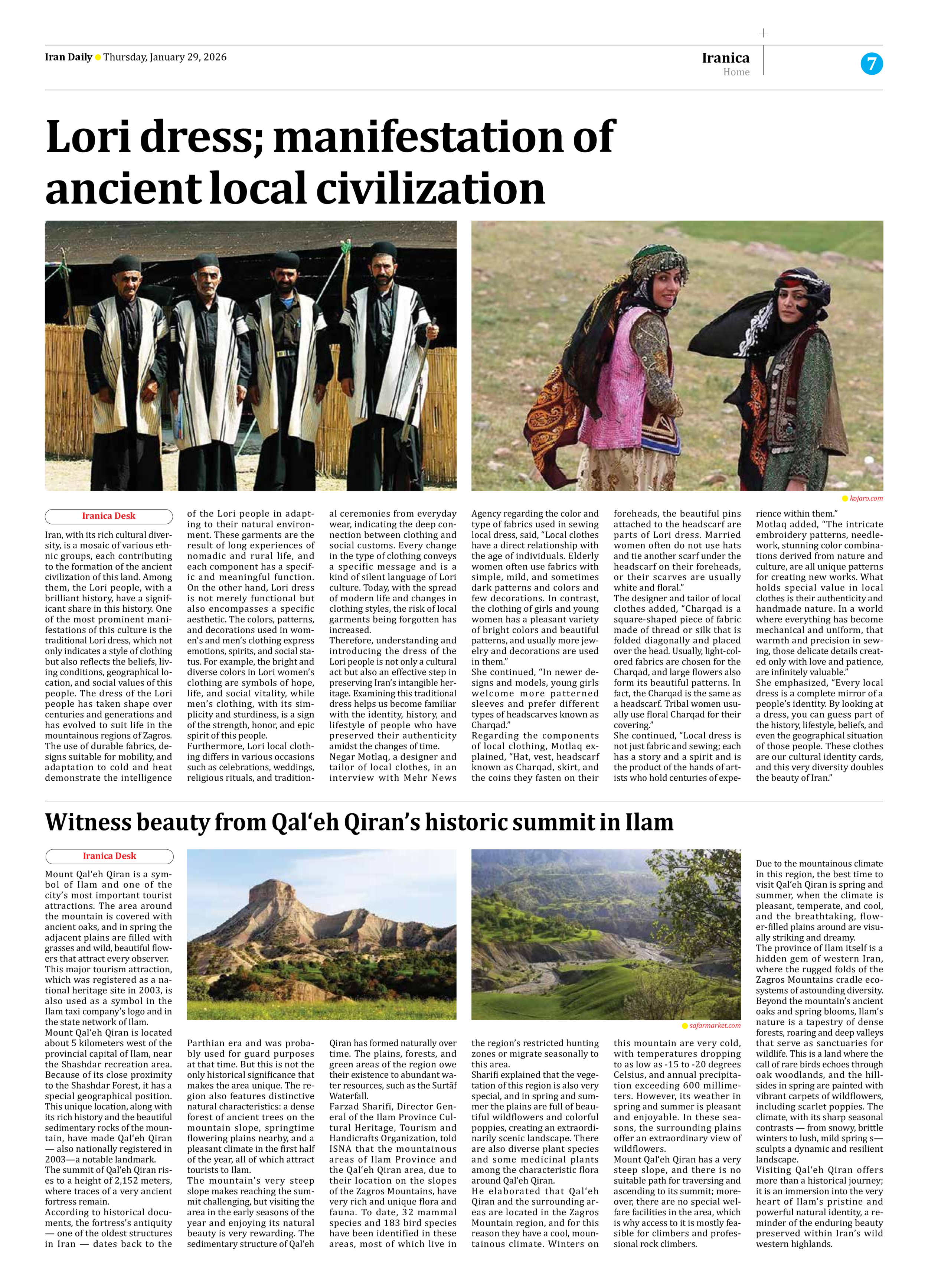


Lori dress; manifestation of ancient local civilization
Iran, with its rich cultural diversity, is a mosaic of various ethnic groups, each contributing to the formation of the ancient civilization of this land. Among them, the Lori people, with a brilliant history, have a significant share in this history. One of the most prominent manifestations of this culture is the traditional Lori dress, which not only indicates a style of clothing but also reflects the beliefs, living conditions, geographical location, and social values of this people. The dress of the Lori people has taken shape over centuries and generations and has evolved to suit life in the mountainous regions of Zagros.
The use of durable fabrics, designs suitable for mobility, and adaptation to cold and heat demonstrate the intelligence of the Lori people in adapting to their natural environment. These garments are the result of long experiences of nomadic and rural life, and each component has a specific and meaningful function. On the other hand, Lori dress is not merely functional but also encompasses a specific aesthetic. The colors, patterns, and decorations used in women’s and men’s clothing express emotions, spirits, and social status. For example, the bright and diverse colors in Lori women’s clothing are symbols of hope, life, and social vitality, while men’s clothing, with its simplicity and sturdiness, is a sign of the strength, honor, and epic spirit of this people.
Furthermore, Lori local clothing differs in various occasions such as celebrations, weddings, religious rituals, and traditional ceremonies from everyday wear, indicating the deep connection between clothing and social customs. Every change in the type of clothing conveys a specific message and is a kind of silent language of Lori culture. Today, with the spread of modern life and changes in clothing styles, the risk of local garments being forgotten has increased.
Therefore, understanding and introducing the dress of the Lori people is not only a cultural act but also an effective step in preserving Iran’s intangible heritage. Examining this traditional dress helps us become familiar with the identity, history, and lifestyle of people who have preserved their authenticity amidst the changes of time.
Negar Motlaq, a designer and tailor of local clothes, in an interview with Mehr News Agency regarding the color and type of fabrics used in sewing local dress, said, “Local clothes have a direct relationship with the age of individuals. Elderly women often use fabrics with simple, mild, and sometimes dark patterns and colors and few decorations. In contrast, the clothing of girls and young women has a pleasant variety of bright colors and beautiful patterns, and usually more jewelry and decorations are used in them.”
She continued, “In newer designs and models, young girls welcome more patterned sleeves and prefer different types of headscarves known as Charqad.”
Regarding the components of local clothing, Motlaq explained, “Hat, vest, headscarf known as Charqad, skirt, and the coins they fasten on their foreheads, the beautiful pins attached to the headscarf are parts of Lori dress. Married women often do not use hats and tie another scarf under the headscarf on their foreheads, or their scarves are usually white and floral.”
The designer and tailor of local clothes added, “Charqad is a square-shaped piece of fabric made of thread or silk that is folded diagonally and placed over the head. Usually, light-colored fabrics are chosen for the Charqad, and large flowers also form its beautiful patterns. In fact, the Charqad is the same as a headscarf. Tribal women usually use floral Charqad for their covering.”
She continued, “Local dress is not just fabric and sewing; each has a story and a spirit and is the product of the hands of artists who hold centuries of experience within them.”
Motlaq added, “The intricate embroidery patterns, needlework, stunning color combinations derived from nature and culture, are all unique patterns for creating new works. What holds special value in local clothes is their authenticity and handmade nature. In a world where everything has become mechanical and uniform, that warmth and precision in sewing, those delicate details created only with love and patience, are infinitely valuable.”
She emphasized, “Every local dress is a complete mirror of a people’s identity. By looking at a dress, you can guess part of the history, lifestyle, beliefs, and even the geographical situation of those people. These clothes are our cultural identity cards, and this very diversity doubles the beauty of Iran.”