







Global opera star takes ‘Shahnameh’ to Iranian stage
From Europe’s grand opera houses to Shiraz, Reza Fekri comes home
By Alireza Sepahvand
Journalist
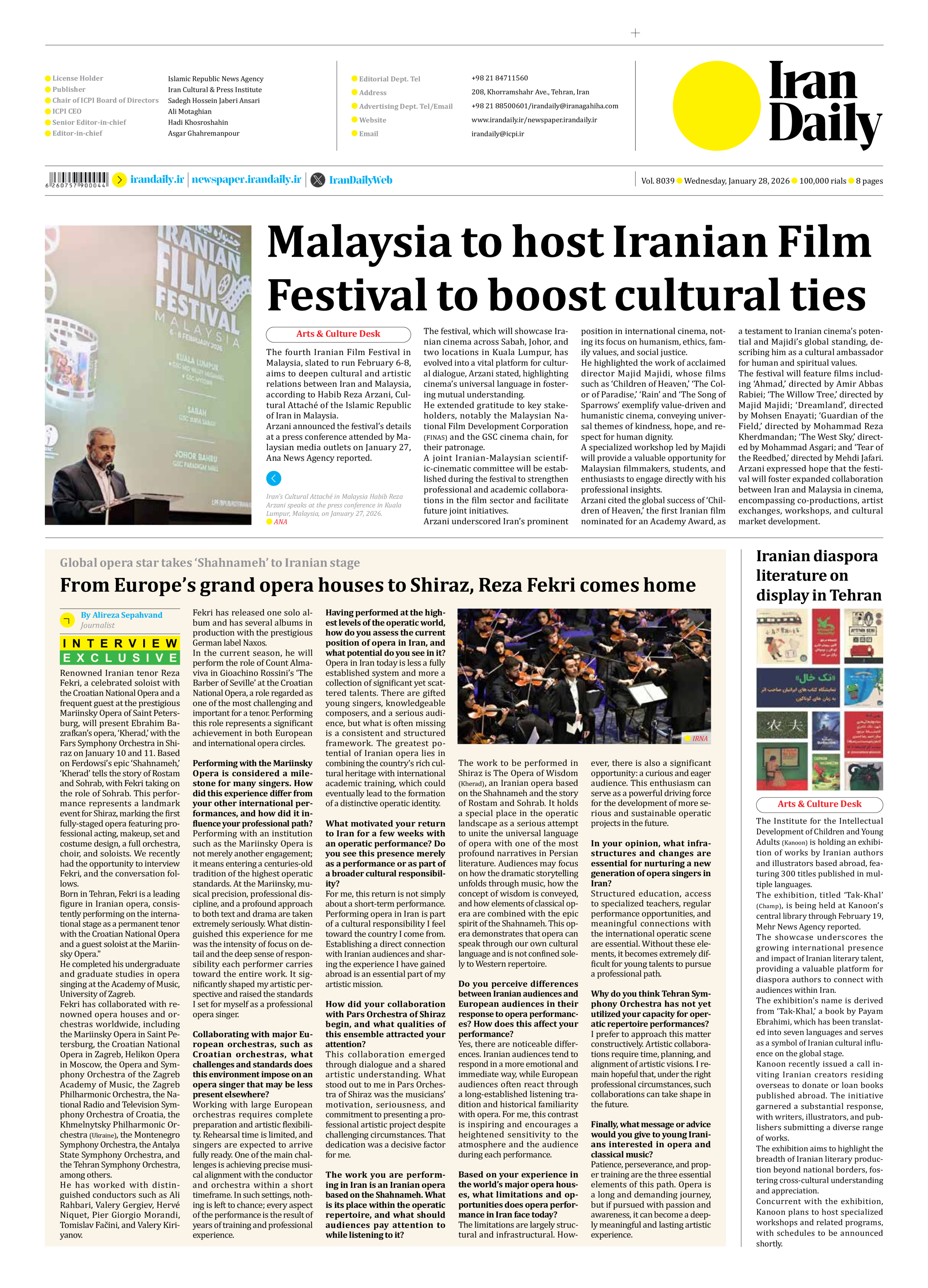
Renowned Iranian tenor Reza Fekri, a celebrated soloist with the Croatian National Opera and a frequent guest at the prestigious Mariinsky Opera of Saint Petersburg, will present Ebrahim Bazrafkan’s opera, ‘Kherad,’ with the Fars Symphony Orchestra in Shiraz on January 10 and 11. Based on Ferdowsi’s epic ‘Shahnameh,’ ‘Kherad’ tells the story of Rostam and Sohrab, with Fekri taking on the role of Sohrab. This performance represents a landmark event for Shiraz, marking the first fully-staged opera featuring professional acting, makeup, set and costume design, a full orchestra, choir, and soloists. We recently had the opportunity to interview Fekri, and the conversation follows.
Born in Tehran, Fekri is a leading figure in Iranian opera, consistently performing on the international stage as a permanent tenor with the Croatian National Opera and a guest soloist at the Mariinsky Opera."
He completed his undergraduate and graduate studies in opera singing at the Academy of Music, University of Zagreb.
Fekri has collaborated with renowned opera houses and orchestras worldwide, including the Mariinsky Opera in Saint Petersburg, the Croatian National Opera in Zagreb, Helikon Opera in Moscow, the Opera and Symphony Orchestra of the Zagreb Academy of Music, the Zagreb Philharmonic Orchestra, the National Radio and Television Symphony Orchestra of Croatia, the Khmelnytsky Philharmonic Orchestra (Ukraine), the Montenegro Symphony Orchestra, the Antalya State Symphony Orchestra, and the Tehran Symphony Orchestra, among others.
He has worked with distinguished conductors such as Ali Rahbari, Valery Gergiev, Hervé Niquet, Pier Giorgio Morandi, Tomislav Fačini, and Valery Kiriyanov.
Fekri has released one solo album and has several albums in production with the prestigious German label Naxos.
In the current season, he will perform the role of Count Almaviva in Gioachino Rossini’s ‘The Barber of Seville’ at the Croatian National Opera, a role regarded as one of the most challenging and important for a tenor. Performing this role represents a significant achievement in both European and international opera circles.
Performing with the Mariinsky Opera is considered a milestone for many singers. How did this experience differ from your other international performances, and how did it influence your professional path?
Performing with an institution such as the Mariinsky Opera is not merely another engagement; it means entering a centuries-old tradition of the highest operatic standards. At the Mariinsky, musical precision, professional discipline, and a profound approach to both text and drama are taken extremely seriously. What distinguished this experience for me was the intensity of focus on detail and the deep sense of responsibility each performer carries toward the entire work. It significantly shaped my artistic perspective and raised the standards I set for myself as a professional opera singer.
Collaborating with major European orchestras, such as Croatian orchestras, what challenges and standards does this environment impose on an opera singer that may be less present elsewhere?
Working with large European orchestras requires complete preparation and artistic flexibility. Rehearsal time is limited, and singers are expected to arrive fully ready. One of the main challenges is achieving precise musical alignment with the conductor and orchestra within a short timeframe. In such settings, nothing is left to chance; every aspect of the performance is the result of years of training and professional experience.
Having performed at the highest levels of the operatic world, how do you assess the current position of opera in Iran, and what potential do you see in it?
Opera in Iran today is less a fully established system and more a collection of significant yet scattered talents. There are gifted young singers, knowledgeable composers, and a serious audience, but what is often missing is a consistent and structured framework. The greatest potential of Iranian opera lies in combining the country’s rich cultural heritage with international academic training, which could eventually lead to the formation of a distinctive operatic identity.
What motivated your return to Iran for a few weeks with an operatic performance? Do you see this presence merely as a performance or as part of a broader cultural responsibility?
For me, this return is not simply about a short-term performance. Performing opera in Iran is part of a cultural responsibility I feel toward the country I come from. Establishing a direct connection with Iranian audiences and sharing the experience I have gained abroad is an essential part of my artistic mission.
How did your collaboration with Pars Orchestra of Shiraz begin, and what qualities of this ensemble attracted your attention?
This collaboration emerged through dialogue and a shared artistic understanding. What stood out to me in Pars Orchestra of Shiraz was the musicians’ motivation, seriousness, and commitment to presenting a professional artistic project despite challenging circumstances. That dedication was a decisive factor for me.
The work you are performing in Iran is an Iranian opera based on the Shahnameh. What is its place within the operatic repertoire, and what should audiences pay attention to while listening to it?
The work to be performed in Shiraz is The Opera of Wisdom (Kherad), an Iranian opera based on the Shahnameh and the story of Rostam and Sohrab. It holds a special place in the operatic landscape as a serious attempt to unite the universal language of opera with one of the most profound narratives in Persian literature. Audiences may focus on how the dramatic storytelling unfolds through music, how the concept of wisdom is conveyed, and how elements of classical opera are combined with the epic spirit of the Shahnameh. This opera demonstrates that opera can speak through our own cultural language and is not confined solely to Western repertoire.
Do you perceive differences between Iranian audiences and European audiences in their response to opera performances? How does this affect your performance?
Yes, there are noticeable differences. Iranian audiences tend to respond in a more emotional and immediate way, while European audiences often react through a long-established listening tradition and historical familiarity with opera. For me, this contrast is inspiring and encourages a heightened sensitivity to the atmosphere and the audience during each performance.
Based on your experience in the world’s major opera houses, what limitations and opportunities does opera performance in Iran face today?
The limitations are largely structural and infrastructural. However, there is also a significant opportunity: a curious and eager audience. This enthusiasm can serve as a powerful driving force for the development of more serious and sustainable operatic projects in the future.
In your opinion, what infrastructures and changes are essential for nurturing a new generation of opera singers in Iran?
Structured education, access to specialized teachers, regular performance opportunities, and meaningful connections with the international operatic scene are essential. Without these elements, it becomes extremely difficult for young talents to pursue a professional path.
Why do you think Tehran Symphony Orchestra has not yet utilized your capacity for operatic repertoire performances?
I prefer to approach this matter constructively. Artistic collaborations require time, planning, and alignment of artistic visions. I remain hopeful that, under the right professional circumstances, such collaborations can take shape in the future.
Finally, what message or advice would you give to young Iranians interested in opera and classical music?
Patience, perseverance, and proper training are the three essential elements of this path. Opera is a long and demanding journey, but if pursued with passion and awareness, it can become a deeply meaningful and lasting artistic experience.