







Global security continued to unravel in 2025
Crucial tests are coming in 2026
By Marion Messmer
Director of International Security Programme
By Katja Bego
Research fellow at International Security Programme
2025 has not been a banner year for the international security order. A ceasefire in Gaza’s brutal war was achieved – though Israel and Hamas each accuse the other of violating the truce. Elsewhere, from Ukraine to Sudan, ongoing conflicts seem only more intractable. And the threat of further violence looms from Venezuela to the India–Pakistan border.
In response to this growing instability, governments are spending on defence at levels not seen since the Cold War. Meanwhile international aid spending has been slashed by many Western countries – worsening conditions in conflict affected countries and degrading early warning systems.
2025 accelerated numerous developments in insecurity but four particular trends stand out.
Nuclear showdowns and nuclear power
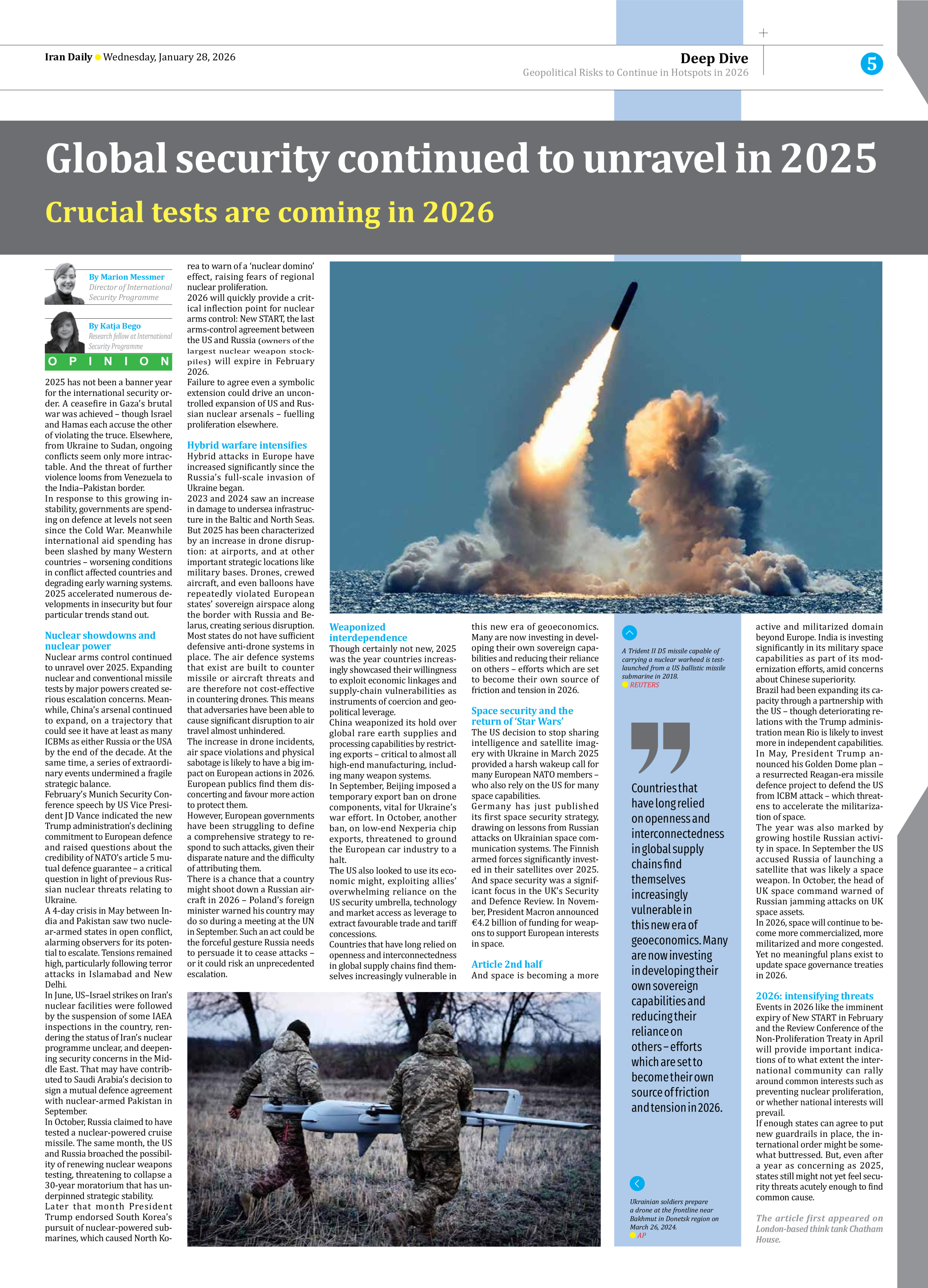
Nuclear arms control continued to unravel over 2025. Expanding nuclear and conventional missile tests by major powers created serious escalation concerns. Meanwhile, China’s arsenal continued to expand, on a trajectory that could see it have at least as many ICBMs as either Russia or the USA by the end of the decade. At the same time, a series of extraordinary events undermined a fragile strategic balance.
February’s Munich Security Conference speech by US Vice President JD Vance indicated the new Trump administration’s declining commitment to European defence and raised questions about the credibility of NATO’s article 5 mutual defence guarantee – a critical question in light of previous Russian nuclear threats relating to Ukraine.
A 4-day crisis in May between India and Pakistan saw two nuclear-armed states in open conflict, alarming observers for its potential to escalate. Tensions remained high, particularly following terror attacks in Islamabad and New Delhi.
In June, US–Israel strikes on Iran’s nuclear facilities were followed by the suspension of some IAEA inspections in the country, rendering the status of Iran’s nuclear programme unclear, and deepening security concerns in the Middle East. That may have contributed to Saudi Arabia’s decision to sign a mutual defence agreement with nuclear-armed Pakistan in September.
In October, Russia claimed to have tested a nuclear-powered cruise missile. The same month, the US and Russia broached the possibility of renewing nuclear weapons testing, threatening to collapse a 30-year moratorium that has underpinned strategic stability.
Later that month President Trump endorsed South Korea’s pursuit of nuclear-powered submarines, which caused North Korea to warn of a ‘nuclear domino’ effect, raising fears of regional nuclear proliferation.
2026 will quickly provide a critical inflection point for nuclear arms control: New START, the last arms-control agreement between the US and Russia (owners of the largest nuclear weapon stockpiles) will expire in February 2026.
Failure to agree even a symbolic extension could drive an uncontrolled expansion of US and Russian nuclear arsenals – fuelling proliferation elsewhere.
Hybrid warfare intensifies
Hybrid attacks in Europe have increased significantly since the Russia’s full-scale invasion of Ukraine began.
2023 and 2024 saw an increase in damage to undersea infrastructure in the Baltic and North Seas. But 2025 has been characterized by an increase in drone disruption: at airports, and at other important strategic locations like military bases. Drones, crewed aircraft, and even balloons have repeatedly violated European states’ sovereign airspace along the border with Russia and Belarus, creating serious disruption.
Most states do not have sufficient defensive anti-drone systems in place. The air defence systems that exist are built to counter missile or aircraft threats and are therefore not cost-effective in countering drones. This means that adversaries have been able to cause significant disruption to air travel almost unhindered.
The increase in drone incidents, air space violations and physical sabotage is likely to have a big impact on European actions in 2026. European publics find them disconcerting and favour more action to protect them.
However, European governments have been struggling to define a comprehensive strategy to respond to such attacks, given their disparate nature and the difficulty of attributing them.
There is a chance that a country might shoot down a Russian aircraft in 2026 – Poland’s foreign minister warned his country may do so during a meeting at the UN in September. Such an act could be the forceful gesture Russia needs to persuade it to cease attacks – or it could risk an unprecedented escalation.
Weaponized interdependence
Though certainly not new, 2025 was the year countries increasingly showcased their willingness to exploit economic linkages and supply-chain vulnerabilities as instruments of coercion and geopolitical leverage.
China weaponized its hold over global rare earth supplies and processing capabilities by restricting exports – critical to almost all high-end manufacturing, including many weapon systems.
In September, Beijing imposed a temporary export ban on drone components, vital for Ukraine’s war effort. In October, another ban, on low-end Nexperia chip exports, threatened to ground the European car industry to a halt.
The US also looked to use its economic might, exploiting allies’ overwhelming reliance on the US security umbrella, technology and market access as leverage to extract favourable trade and tariff concessions.
Countries that have long relied on openness and interconnectedness in global supply chains find themselves increasingly vulnerable in this new era of geoeconomics. Many are now investing in developing their own sovereign capabilities and reducing their reliance on others – efforts which are set to become their own source of friction and tension in 2026.
Space security and the return of ‘Star Wars’
The US decision to stop sharing intelligence and satellite imagery with Ukraine in March 2025 provided a harsh wakeup call for many European NATO members – who also rely on the US for many space capabilities.
Germany has just published its first space security strategy, drawing on lessons from Russian attacks on Ukrainian space communication systems. The Finnish armed forces significantly invested in their satellites over 2025. And space security was a significant focus in the UK’s Security and Defence Review. In November, President Macron announced €4.2 billion of funding for weapons to support European interests in space.
Article 2nd half
And space is becoming a more active and militarized domain beyond Europe. India is investing significantly in its military space capabilities as part of its modernization efforts, amid concerns about Chinese superiority.
Brazil had been expanding its capacity through a partnership with the US – though deteriorating relations with the Trump administration mean Rio is likely to invest more in independent capabilities.
In May, President Trump announced his Golden Dome plan – a resurrected Reagan-era missile defence project to defend the US from ICBM attack – which threatens to accelerate the militarization of space.
The year was also marked by growing hostile Russian activity in space. In September the US accused Russia of launching a satellite that was likely a space weapon. In October, the head of UK space command warned of Russian jamming attacks on UK space assets.
In 2026, space will continue to become more commercialized, more militarized and more congested. Yet no meaningful plans exist to update space governance treaties in 2026.
2026: intensifying threats
Events in 2026 like the imminent expiry of New START in February and the Review Conference of the Non-Proliferation Treaty in April will provide important indications of to what extent the international community can rally around common interests such as preventing nuclear proliferation, or whether national interests will prevail.
If enough states can agree to put new guardrails in place, the international order might be somewhat buttressed. But, even after a year as concerning as 2025, states still might not yet feel security threats acutely enough to find common cause.
The article first appeared on
London-based think tank Chatham House.